
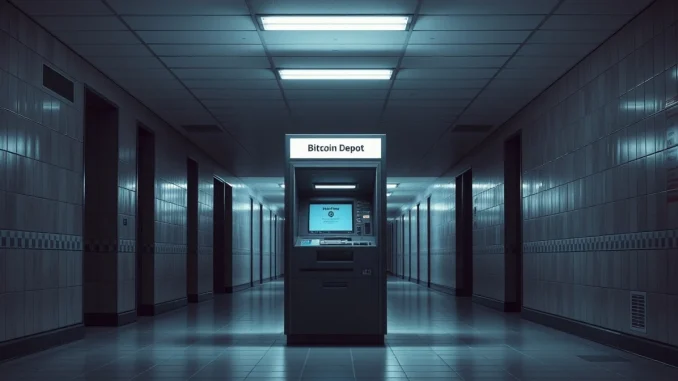
Bitcoin Depot, one of the largest cryptocurrency ATM operators in North America, has disclosed serious doubts about its ability to remain in business, citing a cascade of legal judgments, mounting regulatory restrictions, and a sharp drop in revenue. In a quarterly filing with the U.S. Securities and Exchange Commission on Tuesday, the company reported more than $20 million in legal costs and warned that its financial position may no longer be sustainable.
Regulatory and legal pressures mount
The Atlanta-based firm, which operates thousands of Bitcoin kiosks across the U.S. and Canada, revealed in its Form 10-Q that it had accrued over $20 million in legal judgments during the fourth quarter of 2025. Chief Financial Officer David Gray stated that management had concluded there is substantial doubt about the company’s ability to continue as a going concern. The filing pointed to ongoing litigation with state authorities in Massachusetts, Iowa, and Maine, where Bitcoin Depot paid $1.9 million to settle claims with the state’s Consumer Credit Protection Bureau in January.
Also read: Ripple co-founder Chris Larsen backs Senator Gillibrand's son's crypto venture: Report
Beyond state-level actions, a growing number of U.S. municipalities have passed ordinances restricting or banning crypto ATMs altogether, citing concerns that the machines are being used to defraud vulnerable residents. These local measures, combined with stricter compliance requirements, have directly impacted transaction volumes. According to the SEC filing, revenue for the three months ending March 31 fell by $80.7 million compared to the same period in 2025, a decline the company attributed primarily to regulatory impacts and enhanced compliance controls. Bitcoin Depot also reported a net loss of $9.5 million over that quarter.
Leadership change and market reaction
In an attempt to deal with the turbulent environment, Bitcoin Depot appointed Alex Holmes as CEO in March. Holmes, who previously led MoneyGram from 2016 to 2024, is known for his focus on global regulatory compliance. He replaced Scott Buchanan, who had held the role for only three months. Investors have reacted negatively to the mounting headwinds. Shares of Bitcoin Depot, traded on the Nasdaq under the ticker BTM, fell more than 40% over the five trading days leading up to the filing, dropping from $5.01 to $2.93.
Canadian ban proposal adds cross-border pressure
The regulatory challenges extend beyond U.S. borders. In April, the Canadian government released its Spring Economic Update for 2026, which included a proposal to ban crypto ATMs nationwide. Policymakers argued that the machines are increasingly used for money laundering and scams. If enacted, the ban would still allow Canadians to purchase digital assets through registered money services businesses. Bitcoin Depot reported that it currently operates approximately 220 machines across Canada, placing a significant portion of its infrastructure at risk.
The company’s difficulties reflect a broader trend of tightening oversight on crypto kiosks. According to blockchain security firm CertiK, losses from crypto ATM scams surged 33% in 2025, with scammers increasingly using AI-powered tactics to target victims. This has prompted regulators in multiple jurisdictions to reevaluate the role of unstaffed crypto terminals in the financial ecosystem.
Conclusion
Bitcoin Depot’s latest SEC filing paints a stark picture of a company caught between aggressive litigation, a shifting regulatory market, and declining user trust. While the appointment of a compliance-focused CEO signals an effort to stabilize operations, the combination of a $20 million legal burden, falling revenue, and potential Canadian ban raises serious questions about the company’s long-term viability. For the crypto ATM industry as a whole, the case underscores the growing cost of operating in an increasingly regulated environment.
FAQs
Q1: What does ‘going concern’ mean in Bitcoin Depot’s SEC filing?
A ‘going concern’ warning means that a company’s management has identified conditions that raise substantial doubt about its ability to continue operating for the foreseeable future, typically within the next 12 months. It is a serious financial red flag for investors and creditors.
Q2: Why are U.S. states and cities targeting crypto ATMs?
Regulators and local governments have expressed concerns that crypto ATMs are being used to help scams, particularly targeting elderly individuals, and for money laundering. The machines allow users to convert cash to cryptocurrency with minimal oversight, making them attractive to bad actors.
Q3: How might a Canadian crypto ATM ban affect Bitcoin Depot?
Bitcoin Depot operates about 220 machines in Canada. If the proposed ban is enacted, the company would likely be forced to shut down its Canadian operations, losing a significant portion of its network and revenue stream at a time when it is already struggling financially.






Be the first to comment