
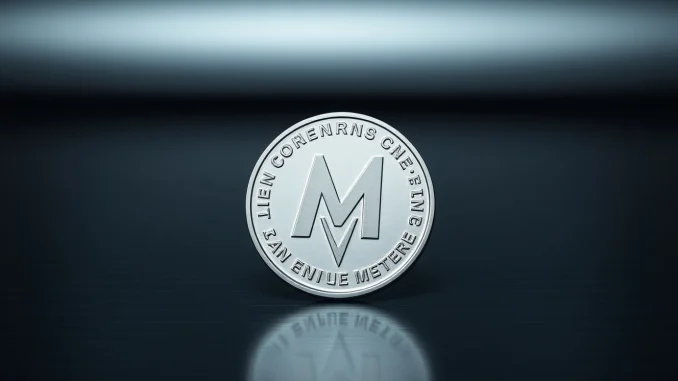
Monero (XMR) has long held a distinct position in the cryptocurrency market as the leading privacy-focused digital asset. While the broader crypto market has experienced cycles of explosive growth and sharp corrections, XMR has often moved to its own rhythm, driven by a dedicated community, strong fundamentals, and persistent regulatory attention. As the market looks toward the next potential bull run, many investors are asking whether privacy coins like Monero can lead the charge or if they will remain a niche asset in an increasingly transparent blockchain ecosystem.
Monero’s Unique Position in the Crypto Environment
Unlike Bitcoin and Ethereum, where all transactions are recorded on a public ledger, Monero uses advanced cryptographic techniques—ring signatures, stealth addresses, and confidential transactions—to obscure sender, receiver, and amount. This privacy-by-default design has made XMR a preferred tool for users seeking financial confidentiality, but it has also drawn scrutiny from regulators worldwide. The ongoing tension between privacy and compliance is the single most important factor shaping Monero’s price trajectory.
Also read: Notcoin (NOT) Price Prediction 2026-2030: Can the Telegram Gaming Token Stage a Recovery?
From a market perspective, Monero has demonstrated resilience. Its price history shows less extreme volatility compared to many altcoins, and it has maintained a relatively stable market capitalization rank within the top 30 to 50 cryptocurrencies over the past several years. This stability reflects a real, if niche, demand for private digital cash that persists regardless of broader market sentiment.
Key Factors Influencing XMR Price Through 2030
Several interconnected variables will determine whether Monero can appreciate significantly in the coming years. The most critical are regulatory developments, technological adoption, and the overall health of the cryptocurrency market.
Also read: Monero (XMR) Price Prediction 2026–2030: Can Privacy Coins Sustain Momentum?
Regulatory Headwinds and Tailwinds
Regulatory clarity remains the biggest uncertainty for Monero. In recent years, several major exchanges have delisted XMR in response to pressure from financial authorities in jurisdictions like the European Union and South Korea. The Financial Action Task Force (FATF) has issued guidance encouraging countries to regulate virtual asset service providers that handle privacy coins. If more nations follow suit with outright bans or strict compliance requirements, liquidity could shrink, potentially suppressing price.
However, the opposite scenario is also possible. Growing public concern over financial surveillance and data privacy could drive demand for tools that protect transactional privacy. If regulatory frameworks evolve to accommodate privacy coins under clear, reasonable guidelines—such as requiring licensed custodians for large transactions—Monero could benefit from a surge in adoption among both retail and institutional users who value confidentiality.
Technological Developments and Network Health
Monero’s development community remains active, with regular protocol upgrades focused on improving privacy, scalability, and user experience. The upcoming transition to a more efficient proof-of-work algorithm and potential integration with layer-2 solutions could reduce transaction costs and broaden use cases. A technically solid network with growing real-world usage would provide a strong foundation for price appreciation.
Broader Market Cycles and the Next Bull Run
Cryptocurrency markets are historically cyclical, with major bull runs occurring roughly every four years, often coinciding with Bitcoin halving events. The next halving is expected in 2028, which could catalyze a broader market rally in the late 2020s. During past bull runs, privacy coins have occasionally outperformed the market as investors rotate into assets with unique value propositions. Whether Monero can lead the next rally depends on whether the market narrative shifts toward privacy as a core requirement for digital finance.
Price Scenarios for 2026–2030
Given the inherent uncertainty in cryptocurrency markets, any price prediction should be treated with caution. However, by analyzing historical patterns, network fundamentals, and potential regulatory outcomes, a range of plausible scenarios emerges.
- Bearish scenario (2026–2030): Widespread regulatory crackdowns reduce exchange availability and liquidity. XMR trades in a range of $80–$150, with limited upside as privacy coins become increasingly marginalized in mainstream finance.
- Base case scenario (2026–2030): Monero maintains its niche but does not experience explosive growth. Steady adoption among privacy-conscious users and gradual regulatory acceptance in some jurisdictions keep XMR between $150 and $350, with moderate gains correlated to overall market cycles.
- Bullish scenario (2026–2030): A significant shift in public attitudes toward financial privacy, combined with clear and favorable regulation in key markets, drives a new wave of adoption. Monero becomes a standard tool for both individuals and businesses. Under this scenario, XMR could reach $500–$1,000 by 2030, potentially outperforming many other altcoins.
Keep in mind that none of these scenarios are guaranteed. The cryptocurrency market remains highly speculative, and external shocks—technological, regulatory, or macroeconomic—could produce outcomes outside these ranges.
Why This Matters for Investors
Monero represents a bet on the enduring value of financial privacy. For investors considering XMR, the key question is not just whether the price will rise, but whether the underlying use case will remain relevant in a world where blockchain transparency is increasingly mandated. If privacy becomes a premium feature that users are willing to pay for, Monero is well-positioned to capture that value. If regulators succeed in pushing privacy coins to the margins, the investment thesis weakens significantly.
As with any cryptocurrency investment, diversification and a long-term perspective are essential. Monero’s future is not predetermined, but its technology, community, and market position give it a credible path to growth—provided the regulatory environment allows it to thrive.
Conclusion
Monero’s price outlook through 2030 is balanced between significant upside potential and substantial regulatory risk. The coin’s strong fundamentals and loyal user base provide a floor, while the evolving global stance on privacy will determine the ceiling. Investors should monitor regulatory developments closely and consider Monero as a specialized allocation within a broader crypto portfolio, rather than a core holding. The next bull run may lift many assets, but whether privacy coins lead it depends on factors far beyond market sentiment alone.
FAQs
Q1: Is Monero legal to buy and hold in 2026?
The legality of Monero varies by jurisdiction. In most countries, owning XMR is legal, but some exchanges have delisted it due to regulatory pressure. Always check local laws and exchange policies before purchasing.
Q2: Can Monero’s privacy features be broken?
Monero’s cryptographic privacy has been extensively reviewed and is considered resilient. No practical attacks have been demonstrated that could break its core privacy guarantees, though all systems have theoretical vulnerabilities.
Q3: What is the maximum supply of Monero?
Monero has a tail emission model: after the initial supply of approximately 18.4 million coins is mined, a constant small block reward continues indefinitely, ensuring ongoing network security without a hard supply cap.





Be the first to comment