
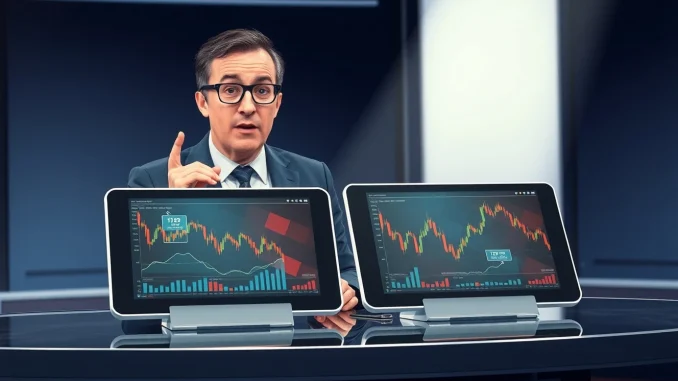
HBO’s John Oliver launched a direct attack on the burgeoning prediction market industry during the April 20, 2026, episode of Last Week Tonight. The host’s detailed critique focused on platforms like Kalshi and Polymarket, questioning their regulatory oversight and highlighting potential for manipulation. His segment has amplified existing legal and ethical debates surrounding these financial instruments.
John Oliver Targets Prediction Market Platforms
During the show, Oliver dissected what he called “trivial” event contracts. He cited specific examples, including bets on whether members of a previous presidential administration would use certain words in speeches. The host connected these to broader concerns about the platforms’ partnerships with major news organizations. This suggests a blurring line between financial speculation and news reporting.
Oliver spent significant time on the role of Donald Trump Jr. He is an adviser to both Kalshi and Polymarket. The host questioned how this relationship interacts with market integrity. His critique extended to regulators. Oliver argued the U.S. Commodity Futures Trading Commission (CFTC), under Chair Michael Selig, appears ineffective. He claimed the agency isn’t trying hard enough to block contracts on extreme events like terrorism or assassination.
The Manipulation Question and a Viral Pledge
A central theme was market manipulation. Oliver played a clip from a 2025 Coinbase earnings call. In it, CEO Brian Armstrong listed crypto terms like “Bitcoin” and “Ethereum.” This caused payouts for users who had bet those words would be said. The host used this as a prime example of how outcomes can be swayed.
Also read: Spain’s CNMV Chair Rules Out MiCA Deadline Extension for Crypto Firms, Impacting Binance
“I’m going to make you a promise tonight,” Oliver stated, mirroring Armstrong’s tone. “I will never do anything because someone online placed a bet on it.” He added a characteristically sharp caveat. “So you can be confident that if I ever say Bitcoin, Ethereum, blockchain, staking and Web3, it won’t be because I’m trying to move markets — it will be because I’m having a stroke.” This pledge instantly circulated on social media, framing the host as opposed to market influence.
Regulatory Scrutiny and Legal Challenges
Oliver’s commentary arrives amid intense legal pressure. Gaming authorities in multiple states have filed lawsuits against Kalshi. They allege the platform facilitates illegal sports betting. This legal fight is expected to escalate. Coinbase’s chief legal officer, Paul Grewal, has said he believes these cases will ultimately reach the U.S. Supreme Court.
Data shows user activity on prediction markets has grown rapidly. Some analysts project the total market could reach $1 trillion by 2030. This growth has forced regulators to play catch-up. The existing framework, designed for traditional futures, struggles with novel event contracts. What this means for investors is heightened regulatory risk. The legal status of these platforms could change abruptly based on court rulings or new legislation.
Traditional Finance Eyes the Market
Despite the controversy, mainstream financial firms are showing interest. This creates a complex dynamic. Companies like Charles Schwab and Citadel Securities have recently signaled they are evaluating prediction markets. Charles Schwab CEO Rick Wurster told investors the company would “take a hard look at” the sector. On the same day, Citadel Securities President Jim Esposito said his firm was “absolutely keeping an eye on developments.”
These statements indicate serious consideration. They also follow high-profile media partnerships. Platforms have already teamed with CNN, CNBC, Fox News, and Dow Jones. The implication is that prediction markets are moving from niche to mainstream. Industry watchers note that involvement from established firms could bring more legitimacy. But it could also attract stricter regulatory scrutiny.
Analysis: The Core Conflict
The debate Oliver highlighted centers on a fundamental question: What is the primary purpose of a prediction market? Proponents argue they are efficient information aggregation tools. Prices reflect the collective wisdom of participants on event probabilities. Critics, including Oliver, see them as gambling venues dressed in financial technology clothing. The triviality of some contracts fuels this perception.
The regulatory space is fragmented. The CFTC oversees some event contracts as “binary options.” But its authority is limited and tested. State gambling laws add another layer of complexity. A platform legal in one state may be illegal in another. This patchwork system creates uncertainty for operators and users alike. The current situation is unsustainable. It demands clearer federal guidelines.
What This Means for the Future
Oliver’s segment acts as a catalyst. It brings niche financial debates to a mass audience. Public awareness can influence political and regulatory priorities. Lawmakers may feel increased pressure to act. Several bills targeting prediction markets have already been introduced in Congress, though none have passed.
The show’s impact is twofold. First, it educates millions about a complex topic. Second, it frames the issue around ethics and manipulation. This could shape public opinion against the industry. Platforms may need to adjust their public relations strategies. They might also reconsider the types of contracts they offer to avoid appearing frivolous.
Conclusion
John Oliver’s critique of prediction markets on Last Week Tonight has thrust a complex financial niche into the spotlight. His focus on manipulation, regulatory gaps, and questionable contracts underscores the industry’s growing pains. While traditional finance explores entry, legal challenges mount at the state level. The path forward hinges on regulatory clarity. The CFTC and Congress must define the rules for this new asset class. Until they do, prediction markets will operate in a contentious and uncertain space, balancing innovation with increasing scrutiny.
FAQs
Q1: What are prediction markets?
Prediction markets are platforms where users trade contracts based on the outcome of future events. The price of a contract reflects the market’s collective probability assessment of that event occurring.
Q2: What platforms did John Oliver specifically mention?
Oliver’s segment focused on Kalshi and Polymarket. He discussed their event contracts, partnerships with news organizations, and the advisory role of Donald Trump Jr.
Q3: What is the main regulatory body for prediction markets in the U.S.?
The Commodity Futures Trading Commission (CFTC) has jurisdiction over certain prediction market contracts, treating them similarly to binary options. State gaming commissions also claim authority, leading to legal conflicts.
Q4: What was John Oliver’s promise regarding prediction markets?
Oliver pledged never to alter his behavior or statements because users placed bets on them. He humorously stated that if he ever uttered a string of crypto terms, it would be due to a medical emergency, not market manipulation.
Q5: Are major financial companies getting involved in prediction markets?
Yes. Firms including Charles Schwab and Citadel Securities have publicly stated they are evaluating the prediction market sector, signaling potential future expansion.





Be the first to comment