
In this article5 sections
Heatbit has introduced Bitwater, a replacement water heater element that carries 20 Bitcoin mining chips instead of a resistive coil, so the heat generated by hashing warms the tank. Decrypt reported that the element is rated at up to 34 terahashes per second on up to 600 watts, and that the first batch costs $899 to preorder.
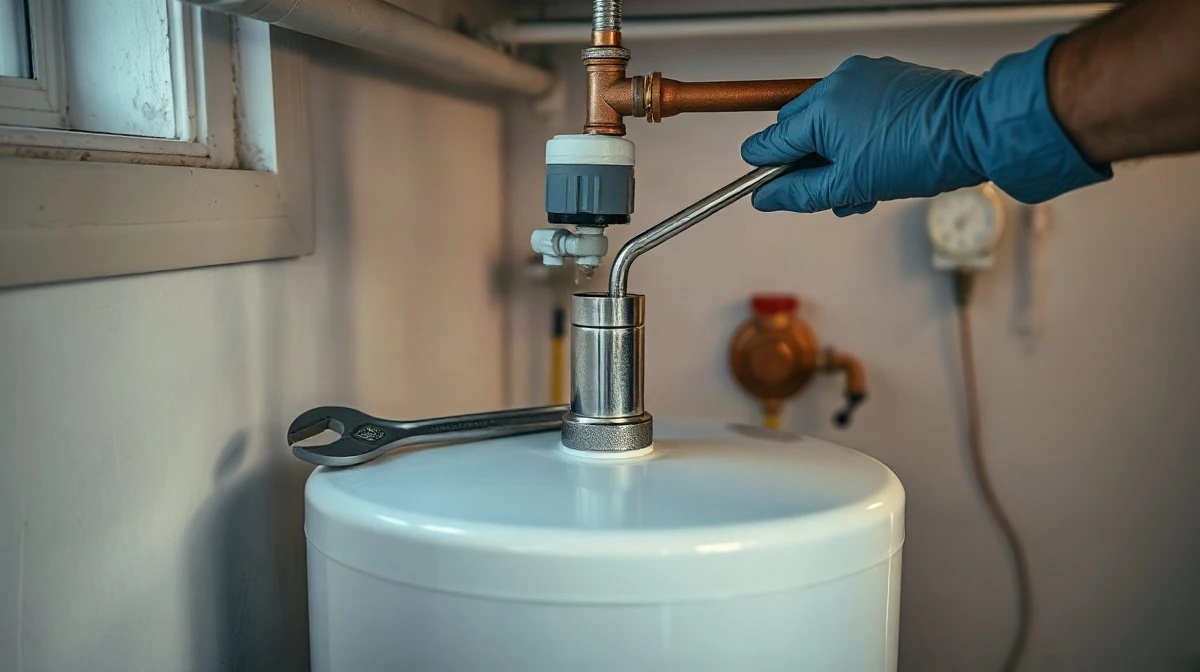
The company announced the product in a tweet on October 22, 2026, arguing that the electricity would have been spent on hot water regardless, and that the hardware adds Bitcoin without a separate power budget. Bitwater is designed to screw into the standard one-inch port of existing electric tanks in the U.S. and Canada, a do-it-yourself job that Heatbit describes as breaker off, tank drained, old element unscrewed and the new one threaded in with an included wrench.
Also read: Tokenized stocks trade mostly after Wall Street's 4 pm close
Key facts
- Bitwater uses 20 of Bitmain’s BM1370 chips, runs at up to 34 TH/s and draws up to 600 watts at 12 joules per terahash, with the water cooling the chips so it needs no fans.
- Preorders for the “Genesis batch” are $899, later batches are priced at up to $1,299, and the refundable orders are due to ship in the first quarter of 2027, per Decrypt.
- Heatbit says it fits 30- to 80-gallon electric tanks already in U.S. and Canadian homes, including units made by A. O. Smith, Rheem, Bradford White, Whirlpool and GE, with no plumbing or circuit changes.
- Cryptobriefing reported that the Delaware-based company was founded in 2020 by Alex Busarov and has raised $250,000 from investors including Stillmark and Axiom BTC.
- Heatbit shared an xAI Grok reply putting earnings at about $1 to $1.25 a day and noted that estimates are not guarantees; it has not published its own projection.
Why it matters
Heatbit’s case rests on reuse: the company says homes worldwide spend about 300 terawatt-hours a year heating water, against about 170 terawatt-hours for the entire Bitcoin network. If that comparison holds, domestic heat offers a bigger surface for mining than the network itself. The pitch also lands as large public miners shift toward AI. Bernstein counted 17 deals worth more than $110 billion over two years in which miners contracted out roughly 6 gigawatts of power to companies including Google, Amazon, Microsoft, Nvidia and CoreWeave, and expects AI revenue at the miners it covers to grow from $1.2 billion in 2026 to $10.7 billion by 2030.
That shift is where Heatbit aims its marketing, writing that public miners are answering to Wall Street while home miners answer to no one. The two businesses are not equivalent, though: miners can switch off to relieve grid pressure, while AI data centers need continuous power, as Compass Mining’s Shanon Squires told Decrypt in March 2025. Cryptobriefing framed the consumer angle differently, describing mining rewards as a partial rebate on the cost of heating water if Heatbit’s claim that energy use stays the same holds.
Also read: Bitcoin Difficulty Dips 0.03% as September Mining Revenue Hits $1.12B
Power draw and earnings
At up to 600 watts, Bitwater draws well under the 4,500-watt elements common in U.S. tanks. Those heat quickly and shut off, while Heatbit says Bitwater runs longer and more slowly, with the tank’s upper element still providing backup when demand spikes. The company says the element is built to run more than 80% of the time, and earnings would move with Bitcoin’s price and network difficulty.
Using a hashprice of about $36.73 per petahash per second per day from Hashrate Index, Decrypt calculated that a full 34 TH/s element would mine about $1.25 of Bitcoin daily, roughly $455 a year. The reports differ on power: Decrypt gives a 600-watt rating, while Cryptobriefing multiplied 34 TH/s by 12 J/TH to reach a peak draw of about 408 watts. Users can track water temperature, hashrate and earnings in an app, choose between solo mining and a pool, and direct mined Bitcoin to an address they control; Cryptobriefing adds that pool payouts arrive in satoshis, while solo mode would pay a full block reward on a win.
Why it matters
What to watch
Heatbit says it tested the element through the winter with households of four and five in New York and Florida, and has teased a version for homes with gas water heaters. The first shipment window in the first quarter of 2027 is the milestone that will show whether units in basements deliver the advertised 34 TH/s and 12 J/TH. Cryptobriefing also noted competition from Superheat, which has introduced similar home mining products.
This article is not financial advice. Bitcoin and mining economics are volatile and uncertain, and any earnings figure is an estimate rather than a promise.
Reported by decrypt.co.
Sources: Decrypt, Cryptobriefing