
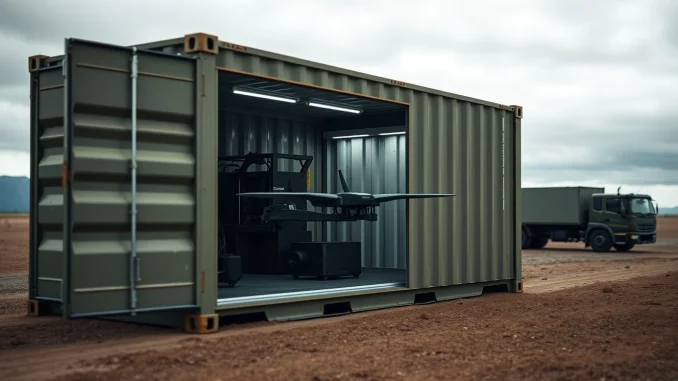
Defense startup Firestorm Labs has secured $82 million in Series B funding to scale its mobile, containerized drone manufacturing platform, a system designed to move production closer to conflict zones and reduce reliance on vulnerable supply chains. The round was led by Washington Harbour Partners, with participation from NEA, Ondas, In-Q-Tel, Lockheed Martin, Booz Allen Ventures, Geodesic, and Motley Fool Ventures, bringing total funding to $153 million.
Why mobile manufacturing matters for modern conflict
In a Pacific theater scenario, the nearest U.S. drone factory could be thousands of miles from the front lines. Ships and aircraft transporting parts would face significant threat from enemy fire. Firestorm Labs believes the solution lies in a factory that fits inside a standard shipping container. The company’s xCell platform uses an industrial-grade HP 3D printer to produce drone airframes and components in under 24 hours, on-site and on-demand.
Also read: OpenAI Limits GPT-5.6 Rollout After U.S. Government Request, Calls Restrictions a 'Short-Term Step'
The Pentagon has designated contested logistics as one of only six national critical technology areas, underscoring the strategic importance of keeping weapons and supplies moving under fire. Firestorm’s technology directly addresses this priority by enabling production close to operational units.
From drone maker to factory builder
Firestorm Labs did not begin as a manufacturing company. It started as a drone designer, but customer demand for forward-deployed production drove a strategic pivot. CEO Dan Magy, a serial defense tech entrepreneur, leads the company alongside co-founders Chad McCoy, a career special operations veteran, and CTO Ian Muceus, who holds over a dozen patents in 3D printing.
Also read: OpenAI, Google, and SpaceX are all building their own AI chips — here's why that matters
The xCell platform can be configured for surveillance, electronic warfare, or lethal operations, depending on mission requirements. All platforms are delivered to uniformed Department of Defense operational commands, who deploy them in accordance with military doctrine. Magy confirmed to TechCrunch that the drones are capable of lethal operations.
Real-world deployment and operational use
Two xCell units are currently deployed domestically: one with the Air Force Research Laboratory in Rome, New York, and one with Air Force Special Operations Command in Florida. The company also confirmed the platform is operational in the Indo-Pacific region, though specific units were not disclosed. The Air Force contract carries a $100 million ceiling, with $27 million obligated to date.
Beyond drones, the Army has used xCell to print replacement parts for a Bradley Fighting Vehicle on-site, reducing procurement timelines from months to days.
Why the Indo-Pacific is the main focus
Firestorm Labs views the Indo-Pacific as the primary operational challenge. The vast distances, dispersed island geography, and threat to fixed manufacturing sites make mobile production critical. Lessons from Ukraine, where drone designs evolve within days, reinforce the need for flexible, forward-deployed manufacturing. The company aims to achieve full operational deployment of xCell in the region within two years.
Fixed manufacturing sites are themselves vulnerable targets, a vulnerability Ukraine learned through direct experience. Firestorm’s containerized approach mitigates this risk by distributing production across multiple mobile units.
Conclusion
Firestorm Labs’ $82 million raise signals strong investor confidence in a new pattern for defense logistics: bringing the factory to the fight. With backing from major defense primes and intelligence community investors, the company is positioned to play a key role in how the U.S. military sustains operations in contested environments. The shift from centralized supply chains to distributed, on-demand manufacturing represents a fundamental change in military readiness.
FAQs
Q1: What is the xCell platform?
A: xCell is a containerized manufacturing system that uses industrial 3D printing to produce drone airframes and military replacement parts on-site, in under 24 hours.
Q2: Who invested in Firestorm Labs’ Series B round?
A: Washington Harbour Partners led the round, with participation from NEA, Ondas, In-Q-Tel, Lockheed Martin, Booz Allen Ventures, Geodesic, and Motley Fool Ventures.
Q3: Where are xCell units currently deployed?
A: Two units are deployed domestically with the Air Force Research Laboratory and Air Force Special Operations Command. The platform is also operational in the Indo-Pacific region.






Be the first to comment