
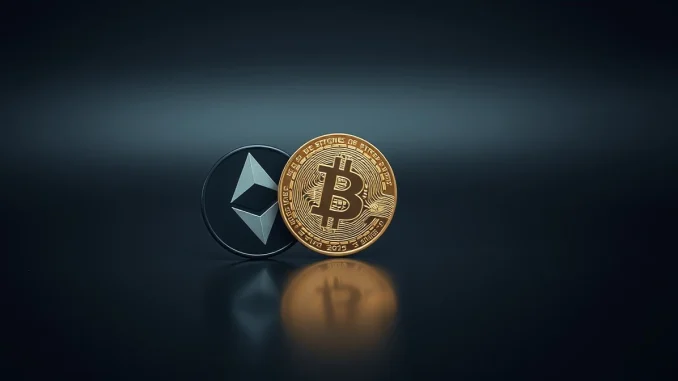
Ether (ETH) continues to underperform against Bitcoin (BTC) in recent trading sessions, a trend that has drawn fresh scrutiny from analysts at JPMorgan. The investment bank’s latest research note questions whether Ethereum’s much-anticipated network upgrades are delivering the promised boost to the asset’s value and network utility.
JPMorgan’s Skeptical View on Ethereum Upgrades
In a note to clients dated March 2025, JPMorgan analysts led by Nikolaos Panigirtzoglou expressed that Ethereum’s recent technological improvements, including the Dencun upgrade aimed at reducing transaction fees for layer-2 networks, have not yet translated into a sustainable price advantage over Bitcoin. The report suggests that while these upgrades improve the network’s efficiency, the expected surge in user activity and ETH demand has been muted. The analysts point to a lack of significant new applications or user growth that would materially boost the token’s value proposition.
Also read: SharpLink Gaming Resumes Crypto Buying With $62.4 Million Ethereum Purchase
This skepticism comes as the ETH/BTC ratio continues to trend downward, hovering near multi-year lows. The ratio, which measures the value of Ether relative to Bitcoin, has fallen sharply since the beginning of the year, indicating a clear preference among investors for Bitcoin’s perceived stability and store-of-value narrative.
Market Dynamics and Investor Sentiment
The divergence in performance between the two largest cryptocurrencies is not solely a matter of network upgrades. Broader market dynamics are also at play. Bitcoin has benefited from the approval of spot Bitcoin exchange-traded funds (ETFs) in the United States, which have channeled significant institutional capital into the asset. Ethereum, despite the launch of its own spot ETFs in mid-2024, has not seen the same level of sustained inflows.
Also read: Ethereum Foundation Cuts 20% of Staff in Major Reorganization
Furthermore, the competitive environment for smart contract platforms is intensifying. Networks like Solana and Avalanche continue to attract developers and users with lower fees and faster transaction speeds, potentially siphoning activity away from Ethereum. JPMorgan’s report highlights that the market is reassessing Ethereum’s long-term dominance in the decentralized finance (DeFi) and non-fungible token (NFT) sectors.
What This Means for Investors
For cryptocurrency investors, the current trend suggests a need to recalibrate expectations. While Ethereum remains a foundational technology in the crypto ecosystem, its price action is increasingly disconnected from its technological progress. The market is signaling that network upgrades alone are insufficient to drive price appreciation without corresponding growth in user adoption and on-chain activity. Investors should monitor the ETH/BTC ratio as a key indicator of relative strength and consider the broader competitive and regulatory environment when assessing Ethereum’s prospects.
Conclusion
Ether’s struggle against Bitcoin is a multifaceted issue, underscored by JPMorgan’s critical assessment of Ethereum’s upgrade impact. While the network continues to evolve, the market’s response has been tepid, favoring Bitcoin’s established narrative and ETF-driven demand. The coming months will be critical for Ethereum to demonstrate tangible user growth and network utility to regain investor confidence.
FAQs
Q1: Why is Ether underperforming compared to Bitcoin?
Ether is underperforming due to a combination of factors: stronger institutional inflows into Bitcoin ETFs, a lack of sustained demand for Ethereum ETFs, and increasing competition from other smart contract platforms. JPMorgan also suggests that recent Ethereum upgrades have not yet translated into significant user growth or token demand.
Q2: What is the ETH/BTC ratio and why does it matter?
The ETH/BTC ratio measures how many Bitcoins one Ether can buy. A declining ratio indicates that Ether is losing value relative to Bitcoin. It is a key metric for traders and investors to gauge relative strength between the two largest cryptocurrencies.
Q3: Are Ethereum upgrades still important for the network’s future?
Yes, upgrades like Dencun are critical for improving Ethereum’s scalability and reducing transaction costs. However, the market’s reaction suggests that technological improvements must be paired with real-world adoption and user growth to drive price appreciation. The upgrades are necessary but not sufficient for immediate market gains.


Be the first to comment