
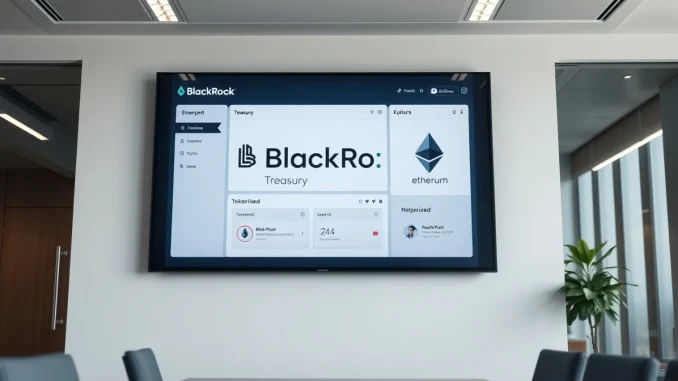
BlackRock, the world’s largest asset manager, has taken a significant step in the integration of traditional finance with blockchain technology by recording its institutional Treasury fund on the Ethereum network. This move represents a major milestone in the ongoing tokenization of real-world assets (RWAs), a trend that is reshaping how institutional investors interact with digital ledgers.
Tokenization of the BlackRock USD Institutional Digital Liquidity Fund
The fund in question, the BlackRock USD Institutional Digital Liquidity Fund (ticker: BUIDL), is now having its share records maintained on the Ethereum blockchain. This effectively tokenizes the fund, allowing for near-instantaneous settlement, 24/7 transferability, and greater transparency for qualified investors. The move is not about issuing a new cryptocurrency but about using blockchain technology to modernize the back-end infrastructure of a traditional financial product. This marks one of the most high-profile validations of Ethereum’s capabilities for enterprise-grade finance.
Also read: Ethereum Foundation Cuts 20% of Staff in Major Reorganization
Implications for Traditional Finance and DeFi
This development bridges the gap between the $1.5 trillion digital asset market and the $100 trillion traditional asset management industry. For BlackRock, tokenizing a Treasury fund on Ethereum provides operational efficiencies and positions the firm as a leader in the digital asset space. For the decentralized finance (DeFi) ecosystem, it offers a new source of high-quality, low-risk collateral. Protocols can now potentially use BUIDL shares as collateral in on-chain lending markets, creating a direct link between a stable, yield-bearing Treasury product and the DeFi economy. This could significantly reduce reliance on volatile crypto assets for collateral and attract more conservative institutional capital to DeFi.
Why Ethereum Was Chosen
Ethereum’s selection as the record-keeping layer is strategic. Its established smart contract functionality, extensive developer ecosystem, and track record for security make it the preferred network for institutional-grade tokenization projects. While other blockchains offer similar capabilities, Ethereum’s liquidity and existing infrastructure for stablecoins and DeFi protocols provide the deepest integration potential. BlackRock’s choice signals a long-term commitment to public, permissionless networks for institutional finance, challenging the notion that only private, permissioned blockchains are suitable for regulated entities.
Also read: Ethereum Co-Founder Points to AI and Finance as Key Drivers for Blockchain Adoption
Conclusion
BlackRock’s decision to put Treasury fund records on Ethereum is more than a technical update; it is a strategic endorsement of blockchain technology as the future of financial infrastructure. It provides a clear, real-world use case for Ethereum beyond cryptocurrency speculation, offering a blueprint for how other asset managers might follow. The move enhances liquidity, transparency, and efficiency in the fund’s operations, while simultaneously injecting a wave of credibility and stability into the broader tokenization market.
FAQs
Q1: What does it mean to ‘tokenize’ a Treasury fund?
Tokenization means creating a digital representation of a fund’s shares on a blockchain. In this case, BlackRock’s BUIDL fund shares are recorded on Ethereum, allowing for faster, more transparent, and programmable transfers compared to traditional systems.
Q2: Is BlackRock issuing a cryptocurrency?
No. BlackRock is using blockchain technology to manage the records of an existing institutional fund. It is not creating a new cryptocurrency for retail investors. The fund remains a traditional money market fund, but its ownership records are now on a digital ledger.
Q3: How does this affect regular investors?
Directly, the impact is limited to qualified institutional investors who can access the BUIDL fund. However, indirectly, it could lead to more efficient financial markets and potentially lower costs for all investors as traditional finance adopts blockchain technology. It also paves the way for more regulated financial products to become available in the future.




Be the first to comment