
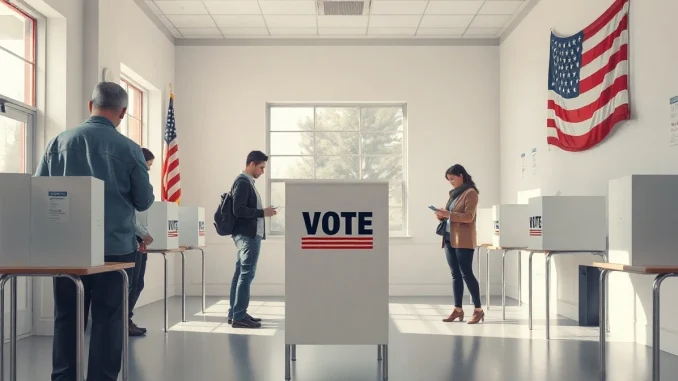
A cryptocurrency-backed political action committee has spent roughly $12 million to influence the outcome of Alabama’s Senate primary runoff, as voters in the state head to the polls Tuesday. The spending underscores the growing financial footprint of the crypto industry in U.S. elections and its strategic focus on shaping federal policy through candidate support.
Defend American Jobs spending details
Defend American Jobs, a super PAC affiliated with the crypto advocacy group Fairshake, reported spending more than $4.7 million on media and advertisements backing Republican candidate Barry Moore in the runoff. That figure adds to the $7.4 million the PAC had already disclosed ahead of the May 20 primary, bringing total known expenditures in the race to over $12 million.
Also read: UK FCA Gets 123 Tokenization Responses, Plans Joint Roadmap With Bank of England
Moore, who has also received an endorsement from President Donald Trump, is running against Jared Hudson to replace retiring Senator Tommy Tuberville. Tuberville has opted not to seek reelection, instead pursuing a gubernatorial bid. The winner of Tuesday’s runoff will advance to the general election for Alabama’s Senate seat.
Crypto industry’s electoral strategy
The Alabama runoff represents a key test for the crypto industry’s ability to sway primary contests. Fairshake and its affiliates have already invested heavily in races across Texas and California, and similar spending is expected in upcoming primaries in Maryland and New York. In those contests, the PACs are backing Democratic candidates Adrian Boafo and Ritchie Torres with approximately $5 million and $500,000 in media buys, respectively.
Also read: Revolut Attackers Threaten Daily Data Leaks After Customer IDs Exposed
Stand With Crypto, a Coinbase-affiliated advocacy group, rated Moore as “strongly supports crypto” based on his voting record and public statements. Hudson was rated “neutral” on crypto policy. Hudson has publicly acknowledged that “Big Crypto” did not back his campaign, though he has expressed support for the crypto market structure bill currently under Senate consideration.
Additional PAC support and war chest
The Blockchain Leadership Fund, a hybrid PAC backed by Anchorage Digital and Chainlink, announced its endorsement of Moore in May, though FEC filings as of Tuesday showed no related expenditures. The Fellowship PAC, which received $11 million from Cantor Fitzgerald and Anchorage, disclosed $350,000 in spending to support Moore’s candidacy.
Fairshake reported holding a $193 million war chest as of January, positioning the organization to play a significant role in the 2026 midterm elections. The PAC has publicly stated its intention to “oppose anti-crypto politicians and support pro-crypto leaders” through targeted media campaigns.
Why this matters for crypto policy
Control of the Senate will determine the fate of several crypto-related bills currently stalled in Congress. The Digital Asset Market Clarity (CLARITY) Act, which passed the House in July 2025, has faced delays in the Senate amid debates over stablecoin rewards, ethics rules, and tokenized equities. Republicans currently hold a slim majority in both chambers, but Democrats are seeking to regain control starting in 2027.
The outcome of races like Alabama’s Senate runoff could shift the balance of power and influence the legislative agenda for digital assets. The crypto industry’s heavy investment in primary elections signals a long-term strategy to build a coalition of supportive lawmakers regardless of party affiliation.
Conclusion
As Alabama voters cast their ballots Tuesday, the scale of crypto PAC spending in the race highlights the industry’s determination to shape federal policy through electoral influence. With additional primaries on the horizon and a massive war chest still available, the crypto sector is positioning itself as a major political force in the 2026 election cycle.
FAQs
Q1: How much has the crypto PAC spent in the Alabama Senate runoff?
Defend American Jobs has spent over $12 million combined on the primary and runoff, including $4.7 million in the runoff alone.
Q2: Which candidates are running in the Alabama Senate runoff?
Republican candidates Barry Moore and Jared Hudson are competing to replace retiring Senator Tommy Tuberville.
Q3: Why is the crypto industry spending heavily on this race?
The industry aims to elect candidates supportive of crypto-friendly legislation, such as the CLARITY Act, and to influence the balance of power in the U.S. Senate.




Be the first to comment