
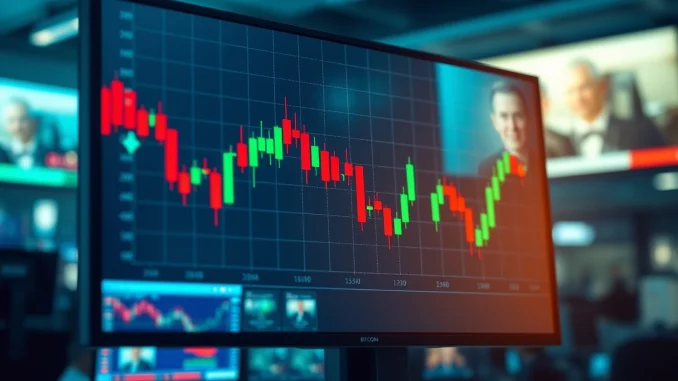
Bitcoin experienced renewed volatility on Monday, oscillating around the $80,000 mark as geopolitical tensions escalated following an Iranian strike on a petroleum facility in the United Arab Emirates. The event injected fresh uncertainty into cryptocurrency and broader risk-asset markets, reversing a period of relative calm.
Geopolitical shockwaves hit crypto and oil markets
Data from TradingView showed whipsaw price action for Bitcoin (BTC) as the $80,000 level became a central battleground for bulls and bears. The development came as oil prices surged, with West Texas Intermediate crude rising over 5% to surpass $105 per barrel, while Brent crude hit $119 per barrel, nearing its highest levels in nearly three years. US stock markets also came under pressure as investors assessed the implications of the widening conflict.
Also read: Botanix shutdown: Does Bitcoin DeFi have a demand problem?
QCP Capital, a trading firm, described the situation as fluid, noting in its latest market analysis that while markets had been pricing in de-escalation, that calculus could change quickly. The firm highlighted that the key resistance for Bitcoin lay in the semi-filled gap in the CME Group’s Bitcoin futures market.
CME futures gap becomes key resistance target
Trader Daan Crypto Trades pointed out that a new small CME gap had opened, and Bitcoin was well on its way to closing the previous large gap from $84,000. These gaps, which occur when futures markets open at a different price than the previous close, often act as price magnets and potential reversal zones. For traders, closing the gap would signal genuine price strength rather than a temporary bounce.
Also read: Bitcoin Options Traders Hedge Downside as Uncertainty Lingers, Anchorage Digital Reports
The aggregate cost basis of Bitcoin’s short-term holders—speculative investors holding for up to six months—also emerged as a critical level. According to onchain analytics platform CryptoQuant, a confirmed daily close above $81,500 would flip that level from resistance to support, potentially opening the path toward $87,000 to $92,000. Conversely, a failure to hold could send the price back to test the new money realized price near $76,500.
Long-term holders remain unfazed
Despite the volatility, CryptoQuant contributor Crazzyblockk noted that Bitcoin’s long-term holders appeared unbothered by their average 27% unrealized losses. This suggests that more experienced investors are not panicking and may view the current price levels as a buying opportunity rather than a reason to sell.
The broader market context remains complex. While geopolitical events have historically had a mixed impact on Bitcoin, the current situation underscores the asset’s sensitivity to macroeconomic shocks and its growing correlation with traditional risk assets like equities and commodities.
Conclusion
Bitcoin’s struggle around $80,000 reflects the delicate balance between geopolitical risk and technical market dynamics. The CME futures gap and short-term holder cost basis are key levels to watch in the coming days. As events in the Middle East continue to unfold, traders should prepare for further volatility and remain cautious, as the situation remains highly fluid.
FAQs
Q1: What caused Bitcoin’s recent volatility near $80,000?
A1: The volatility was triggered by an Iranian strike on a petroleum facility in the UAE, which unsettled global risk assets, including cryptocurrencies, and caused a surge in oil prices.
Q2: What is a CME futures gap and why does it matter for Bitcoin?
A2: A CME futures gap occurs when Bitcoin futures open at a different price than the previous close. These gaps often act as price magnets, and traders watch for them to be filled as a sign of market strength or weakness.
Q3: How are short-term and long-term Bitcoin holders reacting to the price drop?
A3: Short-term holders are near breakeven on unrealized losses, making their cost basis a key support level. Long-term holders, however, appear unbothered by their 27% unrealized losses, indicating they are not panicking.





Be the first to comment