
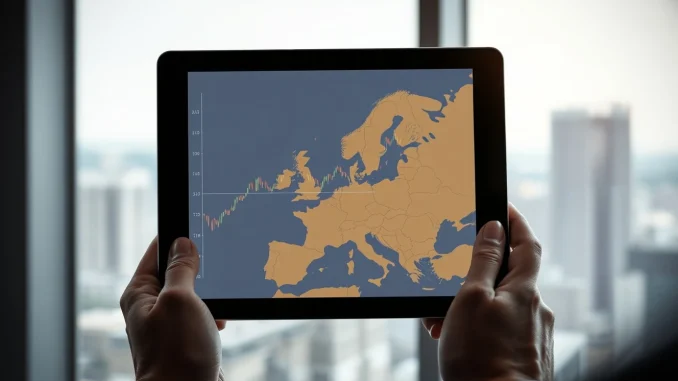
Bitcoin’s attempt to regain lost ground is meeting stiff resistance from global tensions and shifting monetary policy. Meanwhile, a quiet revolution is underway in European finance as major institutions move to adopt stablecoins. This dual narrative of market fragility and institutional progress defines the current crypto climate, where privacy concerns also resurfaced with a stark warning from a messaging app pioneer.
Bitcoin’s Recovery Tested by Geopolitical and Economic Winds
After a week of gains, Bitcoin’s price action remains on shaky ground. According to Nic Puckrin, a crypto market analyst and founder of the Coin Bureau media outlet, the recovery is “fragile.” He points to the ongoing conflict in the Middle East as a primary source of market pressure. “Even if the war ends now, its repercussions will likely be the story of 2026, and certainly the dominant narrative for Q2,” Puckrin told Cointelegraph. This suggests that geopolitical risk has become a persistent factor for digital asset valuations.
The conflict’s economic impact is already visible. Data from the US Bureau of Labor Statistics shows an inflationary spike, which has cooled investor expectations for interest rate cuts. Rate cuts typically stimulate asset prices by making borrowing cheaper. Puckrin noted he does not expect a rate cut until late in the third quarter or the fourth quarter of 2026, if at all. This macroeconomic backdrop creates a headwind for risk assets like Bitcoin.
From a technical perspective, Bitcoin faces a critical test. Puckrin indicated that if Bitcoin closes the week above $71,000, it could signal continued upward momentum. However, significant resistance is forming around the $74,000 level. At the time of reporting, BTC continues to trade below its 200-day exponential moving average, a key long-term trend indicator watched by many traders.
Also read: Spain’s CNMV Chair Rules Out MiCA Deadline Extension for Crypto Firms, Impacting Binance
Europe’s Stablecoin Shift: From Theory to Execution
While Bitcoin wrestles with macro forces, a structural change is accelerating in Europe. Banks and corporations are moving beyond mere exploration of stablecoins. They are now actively selecting technology partners to launch real-world applications. Lamine Brahimi, co-founder of custody technology firm Taurus, confirmed this shift. He told Cointelegraph that conversations have evolved from educational to operational.
“Eighteen months ago, most conversations were still educational, focused on understanding stablecoins and their risks,” Brahimi said. “Today, firms with board-level approval are preparing to go live.” This marks a decisive phase in the integration of digital assets into mainstream finance.
The catalyst for this acceleration is clear. The European Union’s Markets in Crypto-Assets Regulation (MiCA) has provided a unified legal framework. It replaces a patchwork of national rules that created uncertainty for cross-border operations. “In the past twelve months alone some of Europe’s most stringent financial institutions are all arriving at the same conclusion,” Brahimi explained. “Digital assets, including stablecoins, belong inside the existing banking stack, not beside it.”
The Corporate Treasury Driver
Corporate treasury teams are leading this charge. Their initial use cases focus on practical financial operations:
- Faster Payments: Moving funds across borders in minutes instead of days.
- Cost Reduction: Avoiding hefty fees associated with traditional wire transfers.
- Extended Hours: Operating outside the constraints of standard banking settlement times.
This demand is not speculative. It is driven by a clear desire for efficiency and cost savings in business operations. The stablecoin market, with a total value locked in the hundreds of billions, is poised for further growth as these institutional pipelines activate.
Telegram Founder’s Stark Privacy Warning
Beyond markets and regulation, a fundamental issue resurfaced: digital privacy. Pavel Durov, the co-founder of Telegram, issued a public warning about a potential vulnerability. He highlighted how data stored in push notification logs on mobile devices could be exploited to breach user privacy.
Durov cited specific reports involving the messaging app Signal. According to those reports, forensic analysts at the US Federal Bureau of Investigation retrieved messages by accessing push notification system logs on an Apple iPhone. This method potentially circumvents the end-to-end encryption that protects the messages within the app itself.
“Turning off notification previews won’t make you safe if you use those applications,” Durov stated, “because you never know whether the people you message have done the same.” His warning underscores a broader challenge. Even the most secure applications can generate metadata—information about the communication—that exists outside the encrypted channel.
This incident reveals a complex layer in the privacy debate. It shows that security is only as strong as the weakest link in the data chain. For users, the implication is that absolute privacy requires scrutiny of all data trails, not just the primary content of messages.
Connecting the Threads: A Market at an Inflection Point
The day’s developments paint a picture of a maturing industry facing multifaceted pressures. Bitcoin, often seen as a macroeconomic barometer, is reacting to traditional forces of war and inflation. Its fragile recovery indicates that crypto markets are not decoupled from global events. They are deeply integrated.
Conversely, the European stablecoin push demonstrates institutional confidence. The move from strategy to execution signals that major financial players see a viable, regulated future for certain digital assets. This institutional adoption could provide a stabilizing counterweight to Bitcoin’s volatility over the long term.
The privacy warning from Durov serves as a vital reminder. As financial and social activity increasingly moves on-chain or into encrypted apps, the security of the surrounding infrastructure is paramount. For regulators and users alike, understanding these ancillary data risks will be essential.
Conclusion
Bitcoin’s price remains sensitive to geopolitical strife and delayed rate cuts, testing the durability of its recent recovery. In Europe, the implementation of MiCA is catalyzing a tangible shift, with banks and corporations moving to integrate stablecoins into core financial operations. Simultaneously, a warning about push notification vulnerabilities highlights the ongoing battle for user privacy in an encrypted world. Together, these stories underscore a crypto industry addressing complex challenges while building foundational infrastructure for wider adoption.
FAQs
Q1: Why is Bitcoin’s recovery considered fragile?
Analyst Nic Puckrin cites ongoing geopolitical conflict in the Middle East and its inflationary impact, which has reduced expectations for near-term interest rate cuts from central banks. These macroeconomic headwinds create selling pressure.
Q2: What is MiCA and how is it affecting stablecoins?
The Markets in Crypto-Assets Regulation is a comprehensive EU law providing a single rulebook for crypto assets. It has given banks and corporations the regulatory clarity needed to move from exploring stablecoins to actively building and launching products.
Q3: How could push notifications compromise privacy in encrypted apps?
According to Pavel Durov, data from notifications can be stored in device logs outside the app’s encrypted environment. Forensic experts could potentially access this metadata to glean information about communications, even if the messages themselves are encrypted.
Q4: Who is driving stablecoin adoption in Europe?
Lamine Brahimi of Taurus identifies corporate treasury teams as key drivers. They are focused on practical benefits like faster cross-border payments, lower transaction costs, and the ability to settle outside traditional banking hours.
Q5: What key price level is Bitcoin watching?
Analysts are watching the $71,000 level for a weekly close as a potential signal of continued strength, with major resistance expected around $74,000 based on recent trading patterns.





Be the first to comment