
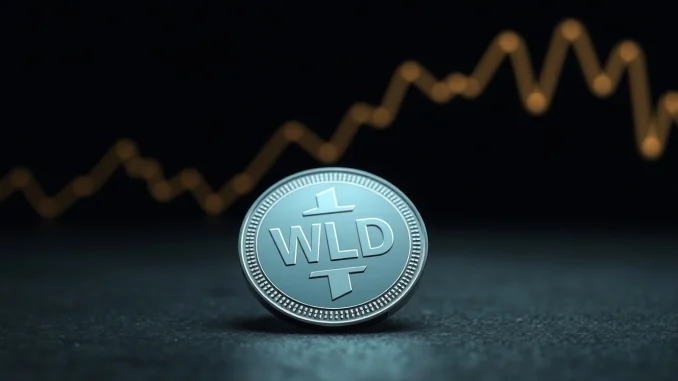
The Worldcoin (WLD) cryptocurrency fell to a new record low this week after its founding organization sold a massive stake. On March 29, 2026, the World Foundation, linked to OpenAI CEO Sam Altman, announced it had raised $65 million by selling WLD tokens at a steep discount. This move sent shockwaves through the crypto market and raised serious questions about the project’s financial stability.
World Foundation’s $65 Million Token Sale Details
According to a post on the social media platform X, the foundation’s token issuance arm, World Assets, completed the sale over-the-counter (OTC) to four counterparties. The first transaction settled on March 20. Data from the announcement indicates the tokens were priced at an average of roughly $0.27 each. This suggests approximately 239 million WLD tokens changed hands.
Also read: DCG-backed Yuma launches institutional fund targeting Bittensor ecosystem
“This sale funds the project’s core operations and activities, R&D, orb manufacturing, ecosystem development, and more,” the World Foundation stated. However, the pricing reveals a troubling discount. Of the total $65 million, $25 million worth of tokens are locked up for six months. The remaining $40 million was immediately liquid, adding sudden sell pressure to the market.
This sale price stands in stark contrast to previous funding rounds. In May 2024, Worldcoin raised $135 million at about $1.13 per token. Backers included prominent venture firms Andreessen Horowitz and Bain Capital Crypto. The latest sale represents a 76% discount from that price. Industry watchers note that such a deep discount for a core operational fundraise is unusual and often signals urgent cash needs or a lack of traditional financing options.
Also read: Securitize expects $400M war chest as tokenization platform prepares for NYSE debut
WLD Price Crashes to Record Lows
Following the sale announcement, the WLD token’s price briefly tumbled to an all-time low near $0.24. It has since recovered marginally to around $0.27. This price represents a catastrophic decline of about 97% from its peak near $11.82 in March 2024. According to data from CoinMarketCap, the token is now trading at levels not seen since its initial distribution phase.
The price action suggests investors are reacting negatively to the dilution and the signal sent by the foundation’s sale. What this means for investors is a rapid erosion of value. A token down 97% requires a 3,233% gain just to break even. This creates a massive psychological and financial barrier for recovery.
Analyzing the Downward Spiral
The steep decline isn’t happening in a vacuum. Several factors are converging. First, the OTC sale directly injects a large volume of tokens into the market at a low price, setting a new benchmark. Second, the broader cryptocurrency market has experienced volatility. But WLD’s drop far exceeds the average. This suggests project-specific issues are at play.
Third, and perhaps most significantly, more supply pressure is imminent. Data from analytics platform DefiLlama shows a major community token unlock is scheduled for July 23, 2026. This event will release roughly 52.5% of the token’s total 10 billion supply. Such a massive unlock typically forecasts further price declines unless met with equally massive demand, which currently appears absent.
Mounting Global Regulatory Scrutiny
Worldcoin’s challenges extend far beyond its token price. The project, which collects iris scans via physical “Orb” devices to verify human identity, has faced escalating regulatory pushback worldwide. These actions directly impact user growth, operational costs, and public trust—key drivers for any cryptocurrency’s utility and value.
In October 2025, authorities in Thailand raided an iris-scanning site linked to Worldcoin. The country’s Securities and Exchange Commission, alongside the Cyber Crime Investigation Bureau, stated the service may have violated digital asset laws by operating without a license. This led to arrests and an ongoing investigation.
Thailand is not an isolated case. Since its launch in 2023, Worldcoin has faced probes and operational restrictions in multiple jurisdictions:
- Kenya: The government suspended Worldcoin’s activities in August 2023, citing concerns over data privacy and security.
- Germany: Bavarian data protection authorities have been investigating the project’s data processing practices.
- Brazil: Officials launched an inquiry into Worldcoin’s collection and use of biometric data.
- Indonesia: The government took steps to halt Worldcoin’s operations over similar licensing and data concerns.
The common thread is anxiety over the handling of sensitive biometric data. Regulators are questioning whether Worldcoin has adequate safeguards, proper legal authorization, and transparent data usage policies. Each regulatory action forces the project to expend resources on legal defense and compliance, diverting focus from development. This creates a hostile environment for adoption.
Broader Implications for Crypto Projects
The Worldcoin situation offers a case study in the risks facing ambitious crypto ventures. The project combined a high-profile founder, a novel technological premise (biometric proof-of-personhood), and significant venture funding. Yet, it is now struggling with core issues of tokenomics, regulatory compliance, and market confidence.
This suggests that even well-capitalized projects with famous backers are not immune to fundamental market forces and legal realities. The reliance on token sales to fund operations, especially at steep discounts, can become a vicious cycle. Selling tokens to pay bills suppresses the price, which then necessitates selling even more tokens to raise the same amount of capital, further depressing the price.
Furthermore, the regulatory clashes highlight a growing trend. Governments worldwide are moving from observation to enforcement in the crypto space. Projects that handle sensitive personal data, like biometrics, are attracting particular scrutiny. The implication is that future crypto ventures must prioritize regulatory strategy from day one, not treat it as an afterthought.
What’s Next for Worldcoin and WLD?
The immediate future for WLD hinges on two events: the market’s absorption of the recently sold tokens and the looming July unlock. If the foundation’s counterparties decide to sell their immediately liquid tokens, downward pressure will continue. The locked $25 million portion creates a potential overhang, as markets will anticipate its release in six months.
The July unlock of approximately 5.25 billion tokens presents a much larger challenge. This release will dramatically increase the circulating supply. Without a corresponding surge in demand—driven by new utility, partnerships, or user adoption—basic economics suggests the price will face extreme pressure.
Worldcoin’s team may attempt to counter this through development updates. The project recently launched AgentKit, a software development kit for creating AI agents verified by its World ID system. It is also expanding its World app toward a “super-app” model. However, technical milestones have so far failed to offset negative market sentiment fueled by sales and regulatory news.
The project’s long-term thesis—that proof-of-personhood will be vital in an AI-driven world—remains untested at scale. The current financial and regulatory headwinds, however, are very real and present. They threaten the project’s ability to survive long enough to prove its concept.
Conclusion
The $65 million Worldcoin WLD token sale by Sam Altman’s World Foundation is more than a simple fundraising event. It is a distress signal that triggered a new record low for the cryptocurrency. Coupled with a massive token unlock scheduled for July 2026 and persistent global regulatory actions, the project faces a critical period. The coming months will test whether Worldcoin’s technological vision can overcome severe financial and legal challenges. For the crypto market at large, this episode serves as a stark reminder of the complex interplay between tokenomics, regulation, and market confidence.
FAQs
Q1: Why did the World Foundation sell $65 million in WLD tokens?
The foundation stated the sale funds core operations, research and development, manufacturing of its iris-scanning “Orb” devices, and ecosystem development. However, selling at a 76% discount to a previous funding round suggests an urgent need for capital.
Q2: What was the price of the WLD token sale?
The transactions were completed at an average price of roughly $0.27 per token. This is a significant discount compared to the $1.13 per token price in a May 2024 funding round.
Q3: What is the major risk for WLD’s price in July 2026?
Data from DefiLlama shows a scheduled token unlock on July 23, 2026, that will release about 52.5% of WLD’s total 10 billion supply. This massive increase in circulating supply could place tremendous downward pressure on the price if demand does not increase proportionally.
Q4: What are the main regulatory challenges facing Worldcoin?
Worldcoin has faced investigations, suspensions, or raids in multiple countries including Thailand, Kenya, Germany, Brazil, and Indonesia. Concerns primarily focus on the collection and use of biometric data without proper licenses or in violation of data protection laws.
Q5: How much has the WLD token fallen from its peak?
The WLD token is down approximately 97% from its all-time high near $11.82, which it reached in March 2024. Its recent crash to around $0.24 marks a new record low for the cryptocurrency.



Be the first to comment