
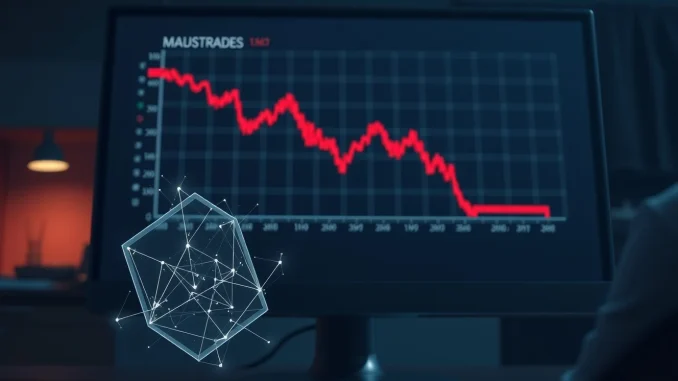
The WLFI token is under intense pressure, with analysts warning of a potential 20% decline in April 2026. This comes as its parent project, World Liberty Financial, faces serious allegations comparing its financial practices to the catastrophic collapse of Terra’s LUNA. Market confidence is rattled.
Technical Chart Points to Sharp WLFI Decline
As of mid-April 2026, the WLFI/USDT trading pair shows a concerning pattern. Data from TradingView indicates the token is consolidating inside what technical analysts identify as a bear flag. This pattern often signals a continuation of a prior downtrend.
The structure’s measured move suggests a downside target near $0.066. That represents a drop of roughly 20% from recent price levels around $0.0825. A break below the pattern’s lower trendline on significant volume would confirm this bearish forecast.
However, not all signals are negative. A decisive break above the pattern’s upper boundary could invalidate the setup. In that scenario, the token might rally toward its 20-day and 50-day exponential moving averages, situated near $0.081 and $0.085 respectively. Market participants are watching these levels closely.
Also read: Spain’s CNMV Chair Rules Out MiCA Deadline Extension for Crypto Firms, Impacting Binance
‘LUNA 2.0’ Allegations and a $75 Million Borrowing Scheme
The technical worries are compounded by fundamental concerns. On-chain investigators and critics have leveled what they term ‘LUNA 2.0’ allegations at World Liberty Financial. The comparison references the 2022 collapse of the Terra ecosystem, which erased tens of billions in market value.
Central to the controversy is a complex borrowing arrangement. According to blockchain data from Arkham Intelligence, wallets associated with the project deposited between 3 and 5 billion WLFI tokens as collateral on the Dolomite lending platform. These tokens are described as largely illiquid.
Using this collateral, the entities borrowed approximately $75 million in stablecoins, including USDC and USD1. A significant portion of these funds—over $40 million—was subsequently transferred to Coinbase Prime. This activity pushed the lending pool’s utilization rate to about 93%, severely restricting withdrawal capacity for other users.
Industry watchers note the risky structure. “Using thinly traded, internal tokens to borrow substantial real liquidity creates a fragile house of cards,” one market analyst explained, requesting anonymity due to the sensitivity of the topic. “A sharp decline in WLFI’s price could make the collateral worthless, triggering bad debt and forcing liquidations that deepen the sell-off.” This mechanism bears superficial resemblance to the death spiral that doomed LUNA and its UST stablecoin.
Justin Sun’s Accusations Add Fuel to the Fire
Adding to the project’s troubles are public accusations from Tron founder Justin Sun. Sun, who reportedly invested around $75 million in World Liberty Financial and served as an advisor, has made serious claims. He alleges the project’s smart contract contains a hidden backdoor function allowing the team to unilaterally freeze wallets.
In social media posts, Sun stated this function was used to freeze his assets without notice. He called the setup a “trap” and denounced what he labeled “token scandals.” Furthermore, he claimed governance votes were rigged and lacked transparency. His demands focus on immediate token unlocks and full financial transparency from the World Liberty Financial team. These allegations strike directly at the core promise of decentralization in blockchain projects.
Insider Activity and Looming Token Unlocks
Scrutiny extends beyond borrowing. Observers are pointing to potential insider trading activity preceding major announcements. While difficult to prove definitively, unusual wallet movements have drawn attention from crypto analytics firms.
Simultaneously, the market is bracing for a proposed unlock of more than 16 billion WLFI tokens. These tokens are tied to still-locked public allocations. Such a large influx of new supply poses a clear dilution risk. If released into the market without sufficient demand, the increased sell pressure could overwhelm current price support levels.
The combination of technical weakness, controversial tap into, insider allegations, and supply inflation creates a perfect storm. This suggests the project faces a significant credibility crisis that could take months to resolve.
Historical Context and Market Implications
The reference to ‘LUNA 2.0’ is not made lightly. The original Terra collapse in May 2022 remains one of the most traumatic events in cryptocurrency history. It triggered a sector-wide contagion that bankrupted major firms like Three Arrows Capital and Celsius Network.
The common thread is the use of a project’s own native token as collateral for borrowing or stabilizing value. When confidence falters, the feedback loop can be violently self-reinforcing. The implication for WLFI is that traders, burned by history, are quick to exit at the first sign of similar mechanics.
What this means for investors is heightened caution. The situation underscores the importance of deep due diligence on blockchain projects, particularly their treasury management, tokenomics, and governance controls. Regulatory bodies worldwide are likely watching this case as they continue crafting frameworks for digital asset oversight.
Conclusion
The WLFI token stands at a critical juncture. A bearish technical pattern points to a 20% price drop, while fundamental allegations of risky tap into and centralized control erode trust. The coming weeks will be decisive. Market participants will watch for clarity on the borrowing positions, the resolution of Justin Sun’s claims, and the management of the impending token unlock. The shadow of LUNA’s failure looms large, reminding everyone of the devastating speed at which crypto confidence can evaporate.
FAQs
Q1: What is the ‘LUNA 2.0’ allegation against World Liberty Financial?
The allegation suggests World Liberty Financial used a risky mechanism similar to Terra’s LUNA: borrowing substantial real value (stablecoins) against a large, illiquid position of its own native WLFI token. Critics fear a price drop could cause a collateral death spiral.
Q2: How much was borrowed using WLFI as collateral?
On-chain data indicates roughly $75 million in stablecoins was borrowed on the Dolomite platform using between 3 and 5 billion WLFI tokens as collateral.
Q3: What are the specific technical reasons for the predicted WLFI price drop?
Technical analysis points to a bear flag pattern on the WLFI/USDT chart. The measured move target of this pattern points to a decline toward $0.066, approximately 20% below recent prices.
Q4: What did Justin Sun accuse World Liberty Financial of doing?
Justin Sun accused the project of embedding a hidden “backdoor” in its smart contract that allowed the team to freeze his wallet assets unilaterally. He also claimed governance was non-transparent.
Q5: What is the dilution risk facing WLFI?
The project has proposed unlocking over 16 billion WLFI tokens from locked public allocations. This massive increase in circulating supply could dilute the token’s value if new demand does not match the selling pressure.





Be the first to comment