
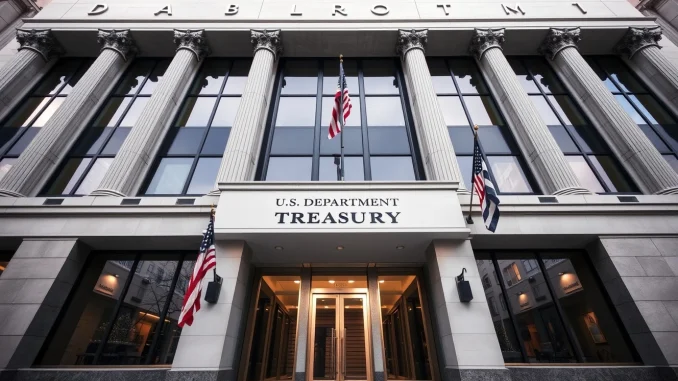
The United States Department of the Treasury has privately demanded that cryptocurrency exchange Binance adhere to a monitoring program established under a 2023 settlement, following reports that the platform facilitated approximately $1 billion in transactions linked to Iran. The demand, reported by The Information on Thursday, signals escalating scrutiny of the exchange’s compliance with anti-money laundering obligations.
Background of the 2023 settlement
The Treasury’s reported letter comes after Binance agreed in November 2023 to a $4.3 billion settlement with the Treasury and the US Department of Justice. The deal required the exchange to implement a three-year monitoring program overseen by government officials, stemming from charges that Binance failed to maintain an adequate anti-money laundering regime. Former CEO Changpeng Zhao pleaded guilty to one felony count related to these failures and resigned as CEO.
Recent developments and scrutiny
Reports emerged that Binance had fired employees who alerted executives about $1 billion in funds flowing through the platform to entities with ties to Iran. In response, a group of US senators urged Treasury Secretary Scott Bessent to report on Binance’s compliance with the 2023 settlement terms. The Treasury’s reported letter appears to be a direct follow-up to these concerns.
Binance responded to the report, stating: “Binance is committed to cooperating with the independent monitor and our ongoing collaboration with relevant agencies. We welcome constructive feedback from the Treasury and view this oversight as an important part of continuously strengthening our compliance and anti-money laundering controls. We are providing the monitor with full cooperation and transparency.”
Also read: Spain’s CNMV Chair Rules Out MiCA Deadline Extension for Crypto Firms, Impacting Binance
Political and regulatory context
The exchange’s relationship with the Trump administration has drawn attention after a United Arab Emirates-based entity invested $2 billion in Binance using USD1 stablecoins issued by World Liberty Financial, a company co-founded by President Donald Trump and his sons. Trump also pardoned Zhao in October 2025. These connections have fueled questions about the administration’s approach to crypto enforcement and the independence of regulatory oversight.
Separately, US authorities recently froze $344 million in cryptocurrency linked to Iran, highlighting ongoing efforts to disrupt illicit financial flows through digital assets.
Zhao’s current stance
Speaking at the Consensus conference in Miami on Thursday, Zhao said he had been “trying to avoid the US” but floated the idea of revitalizing Binance.US to provide users with global liquidity. He dismissed the possibility of returning to a leadership role at any crypto company, stating: “I don’t think I’ve got the stamina to run another startup, to lead another company. I’m a one-trick pony. I’m okay with that level. I’m done.”
Why this matters
The Treasury’s reported demand underscores the ongoing regulatory risks for major cryptocurrency exchanges operating under US oversight. For Binance, compliance with the monitoring program is critical to avoiding further penalties and maintaining its ability to serve US customers. For the broader crypto industry, the case illustrates the increasing emphasis on anti-money laundering controls and the potential consequences of non-compliance.
Conclusion
The Treasury’s reported private demand signals that US authorities are actively monitoring Binance’s compliance with its 2023 settlement. The exchange’s response emphasizes cooperation, but the broader context of political connections and past violations continues to generate scrutiny. The outcome of this compliance review could have significant implications for Binance’s operations and for regulatory enforcement in the cryptocurrency sector.
FAQs
Q1: What did the US Treasury reportedly demand from Binance?
The Treasury reportedly sent a letter demanding that Binance comply with a monitoring program established under a 2023 settlement, following reports that the exchange facilitated $1 billion in transactions linked to Iran.
Q2: What was the 2023 settlement between Binance and US authorities?
Binance agreed to pay $4.3 billion to the Treasury and DOJ and to implement a three-year monitoring program overseen by government officials. Former CEO Changpeng Zhao pleaded guilty to a felony charge related to anti-money laundering failures.
Q3: How did Binance respond to the Treasury’s reported demand?
A Binance spokesperson said the exchange is committed to cooperating with the independent monitor and relevant agencies, welcomes constructive feedback, and is providing full cooperation and transparency.






Be the first to comment