
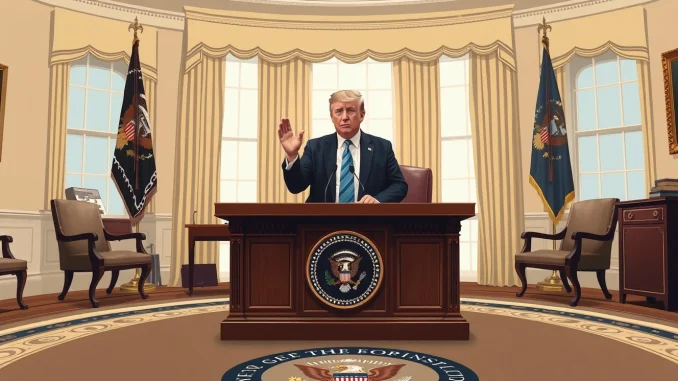
WASHINGTON, D.C. — In a move that could reshape Middle Eastern geopolitics, President Donald Trump stated on Tuesday that the United States will conclude its military campaign in Iran and withdraw forces within the next two to three weeks. The announcement, made from the Oval Office on March 31, 2026, signals a potential end to a conflict that escalated sharply in February.
Trump’s Timeline for US Exit from Iran
“We’re finishing the job, and I think within maybe two weeks, maybe a couple of days longer to do the job,” Trump told reporters. He provided a slightly varied timeframe in his remarks, also stating, “I would say that within two weeks, maybe two weeks, maybe three.” The president framed the decision as mission-accomplished. “We’ll leave because there’s no reason for us to do this.”
According to the Wall Street Journal, Trump had earlier signaled to aides a willingness to end operations even if the strategic Strait of Hormuz remains largely closed. This waterway has been a focal point of the conflict since Iran initiated a blockade in response to U.S. and Israeli strikes. The president’s declaration suggests a strategic pivot, prioritizing declared objectives over complete resolution of all secondary economic and maritime disruptions.
Declared Objectives and the Nuclear Threat
Central to Trump’s justification for the withdrawal is the claim that core U.S. security goals have been met. “We have had regime change … I had one goal: they will have no nuclear weapons and that goal has been attained,” he asserted. The president further elaborated on the scope of the military action, stating, “We want to knock out every single thing they have,” referring to Iran’s military capabilities.
Also read: Spain’s CNMV Chair Rules Out MiCA Deadline Extension for Crypto Firms, Impacting Binance
This claim of eliminating Iran’s nuclear threat represents a significant, if contested, endpoint. International inspectors from the IAEA have not had access to Iranian sites since before the conflict began. Independent verification of the state of Iran’s nuclear program remains impossible. Analysts note that destroying hardened, dispersed nuclear facilities is an immense challenge. The declaration may be as much a political marker as a military assessment.
Strategic and Regional Implications
A U.S. exit under these conditions carries profound risks and potential consequences. The Strait of Hormuz handles about 20% of global oil trade. A prolonged Iranian blockade, even after a U.S. withdrawal, could keep energy markets volatile. Regional allies, particularly Israel and Gulf states like Saudi Arabia and the UAE, may view a rapid American departure with deep anxiety. It could signal a reduced U.S. commitment to regional security architecture.
Conversely, a withdrawal could de-escalate a conflict that risked broader regional war. It might open diplomatic channels that have been completely closed. The key question is what political reality exists in Tehran post-“regime change.” U.S. officials have not detailed the nature of this change or identified a clear successor authority capable of governing and reopening the Strait.
Timeline of Escalation: From Strikes to Blockade
The current phase of open conflict began in February 2026. The U.S. and Israel conducted coordinated strikes against Iranian targets, which U.S. officials at the time linked to Iran’s nuclear program and support for regional proxy groups. Iran’s response was swift and economically potent: a military blockade of the Strait of Hormuz.
This action effectively weaponized global energy routes. Oil prices surged in subsequent weeks. The U.S. Navy’s Fifth Fleet, based in Bahrain, has been engaged in operations to challenge the blockade and ensure freedom of navigation, leading to periodic skirmishes. The president’s latest comments indicate a decision to conclude these missions irrespective of the blockade’s final status.
Market and Global Response
Financial markets have reacted to every development in this conflict. The initial blockade sent Brent crude prices soaring by over 15% in a single week. News of a potential U.S. withdrawal introduces new uncertainty. Analysts are divided on the impact.
Some argue that an end to active combat could ease risk premiums, even if the Strait remains problematic. Others warn that a power vacuum in Iran and a persistent blockade could be worse. “The market hates uncertainty more than anything,” said a senior commodities analyst at a major European bank, speaking on background. “A clear, stable outcome in the Strait is what’s needed for prices to normalize. It’s unclear if this announcement provides that.”
What Comes After the US Military Exit?
The operational challenge of withdrawing forces from a active theater in two to three weeks is significant. It involves securing equipment, coordinating departures, and ensuring the safety of personnel. More complex is the political aftermath. The U.S. will likely seek to maintain intelligence and potential strike capabilities in the region, possibly from bases in neighboring countries or via naval assets.
The future of Iran itself is the largest unknown. Reports of internal strife and factional fighting have been widespread since the February strikes. No cohesive opposition group has emerged as a clear U.S.-backed alternative. The result could be a fractured state, unable to fully control its territory or its military, including those units enforcing the Hormuz blockade.
Conclusion
President Trump’s announcement of a U.S. withdrawal from Iran within weeks aims to close a chapter of direct military engagement. By declaring the neutralization of Iran’s nuclear and military threat as a achieved goal, the administration is setting the conditions for an exit. However, the lasting effects on global energy security, regional stability, and the internal future of Iran remain deeply uncertain. The coming weeks will test whether a military withdrawal leads to peace or simply a new, unstable phase in a volatile region.
FAQs
Q1: What exactly did President Trump announce?
President Trump stated that the United States will finish its military operations in Iran and withdraw all forces within two to three weeks, claiming the core objective of eliminating Iran’s nuclear threat has been achieved.
Q2: What is the Strait of Hormuz and why is it important?
The Strait of Hormuz is a narrow sea passage between Oman and Iran. It is a critical chokepoint for global oil shipments, with about 20% of the world’s oil supply passing through it. Iran blockaded it in February 2026 in response to U.S. and Israeli strikes.
Q3: Has the U.S. confirmed that Iran’s nuclear program is completely destroyed?
No independent verification exists. President Trump stated the goal was attained, but the International Atomic Energy Agency (IAEA) has had no access to Iranian sites. Military experts caution that fully eliminating a dispersed, hardened nuclear program is extremely difficult to confirm.
Q4: How have oil markets reacted to this news?
Markets initially spiked on the conflict and blockade. The withdrawal announcement creates new uncertainty. Analysts say stability depends less on U.S. troops leaving and more on whether the Strait of Hormuz reopens for safe shipping.
Q5: What does “regime change” mean in this context?
President Trump used the term but provided no details. It implies the removal of Iran’s existing leadership, but no clear new government has been identified. The situation inside Iran appears to be fragmented, with no single authority in control.






Be the first to comment