
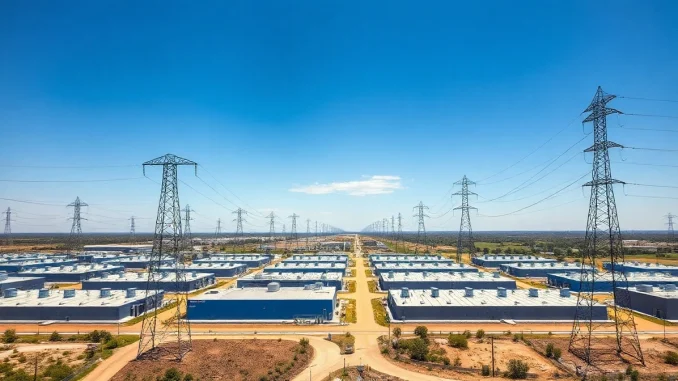
Texas Governor Greg Abbott on Monday ordered a halt to new data center grid connections, requiring all proposed projects to undergo audits by the Public Utility Commission of Texas (PUCT) and the state’s grid operator, ERCOT. The decision comes as ERCOT’s interconnection queue has ballooned to 474 gigawatts — more than double the figure from January and representing more than five times the grid’s total peak demand.
Texas has long been a magnet for data center developers, ranking second only to Virginia in hosting capacity. The state’s deregulated energy market, abundant natural gas, and growing renewable generation have kept electricity relatively affordable. But the rapid influx of power-hungry facilities, including crypto mining operations, has begun to strain the system.
Also read: Bitmine expands ETH treasury to $10.9B, repurchases 4.5M shares
ERCOT’s Queue Explodes as Speculative Projects Pile Up
ERCOT’s interconnection queue has become a focal point of concern. In January, the queue stood at 233 gigawatts. By late July, it had more than doubled to 474 gigawatts, according to Abbott’s office. The grid operator attributes roughly 90% of those requests to data centers.
Industry analysts note that many of these projects are speculative. With connection wait times stretching for years, developers often submit requests early to secure a place in line, and a significant portion never materialize. Even so, if only a fraction of the proposed capacity comes online, it could overwhelm the grid.
Also read: Coldcard exploit sparks $90M Bitcoin flight, Clarity Act stalls: Hodler’s Digest, August 2
“The queue is a leading indicator of stress,” said energy analyst Michael Webber, a professor at the University of Texas at Austin. “Even if 80% of these projects fall through, the remaining 20% would still represent a massive addition to peak demand.”
Abbott’s Shift from Voluntary to Mandatory Oversight
The governor’s order marks a notable departure from Texas’s traditionally hands-off regulatory approach. Earlier this year, Abbott’s office launched a voluntary survey asking data center operators to disclose their power and water usage, noise levels, and tax incentives. The response rate was poor, prompting the state to adopt a mandatory audit process.
The new audits will require developers to provide detailed information on:
- On- and off-site electricity and water demand
- Noise mitigation and light control measures
- Use of tax incentives and abatements
- Ownership structure and financial backing
The data will be reviewed by both PUCT and ERCOT before any new connection is approved. Abbott’s office has not specified a timeline for the audits, but the move effectively freezes new data center grid hookups until the process is complete.
Grid Growth and Renewable Expansion
Texas’s electricity generation has expanded significantly in recent years, driven largely by renewables. According to the U.S. Energy Information Administration (EIA), utility-scale solar capacity grew fourfold between 2021 and 2025. Wind power has also played a key role in meeting growing demand.
Despite this growth, electricity prices in Texas have been rising. A report from energy analytics firm Amperon noted that while Texas power remains relatively affordable compared with other states, the upward trend is partly attributed to the influx of data centers and crypto mining facilities.
The state’s grid has faced stress tests before, most notably during Winter Storm Uri in 2021, which caused widespread outages. More recently, ERCOT has issued conservation appeals during extreme heat waves, though it has avoided rolling blackouts.
What This Means for the Data Center Industry
The audit requirement could slow Texas’s data center boom, which has been a major economic driver. The state offers business-friendly regulations, no corporate income tax, and a skilled workforce. Tech giants like Google and Microsoft have invested heavily in Texas facilities, drawn by the availability of natural gas and renewable energy.
However, the new oversight may prompt some developers to look elsewhere. Other states, including Arizona, Nevada, and Ohio, have been courting data center projects with their own incentives. The long-term impact on Texas’s position as a data center hub will depend on how quickly the audits are completed and what they reveal.
For now, the message from Austin is clear: the era of unchecked data center growth in Texas is over. The state is no longer willing to accept projects without a full accounting of their impact on the grid and the environment.
This article is for informational purposes only and does not constitute financial advice. The data center and energy markets are subject to rapid change and uncertainty. Readers should conduct their own research before making any investment or business decisions.






Be the first to comment