
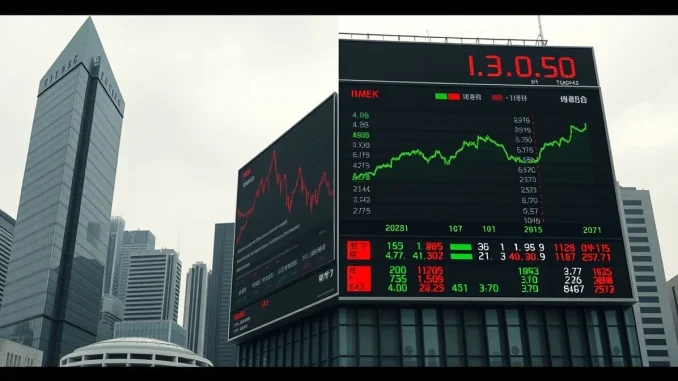
South Korean investors have dramatically reduced their cryptocurrency exposure over the past year, with total holdings falling from $83.3 billion to $41.4 billion as capital rotated into the stock market. The 50% decline reflects both falling crypto prices and a broader shift in investor sentiment toward traditional equities.
Market data reveals steep decline
According to data submitted by the Bank of Korea to lawmaker Cha Gyu-geun of the Rebuilding Korea Party, crypto holdings held by South Korean investors fell from 121.8 trillion won at the end of January 2025 to 60.6 trillion won by February 2026. The figures were first reported by local outlet The Chosun Daily.
Daily trading volumes across the country’s five major exchanges — Upbit, Bithumb, Korbit, Coinone, and Gopax — collapsed from $11.6 billion in December 2024 to just $3 billion by February 2026. Won deposits held at exchanges, a key indicator of investor dry powder, also dropped from 10.7 trillion won at end-2024 to 7.8 trillion won.
Stablecoins buck the broader trend
While most crypto assets saw outflows, stablecoin holdings followed a different trajectory. Stablecoin balances climbed from $60 million in July 2024 to a peak of $597 million in December 2025, before easing to $41 million in February 2026. The relatively mild decline suggests some investors maintained a cautious presence in the market rather than exiting entirely.
Also read: Spain’s CNMV Chair Rules Out MiCA Deadline Extension for Crypto Firms, Impacting Binance
Regulatory headwinds intensify
The market contraction comes as South Korean regulators prepare to tighten oversight. Financial authorities plan to implement revised Anti-Money Laundering (AML) rules in August 2026 that would automatically flag any crypto transaction above 10 million won involving overseas exchanges or private wallets as suspicious.
Industry body DAXA has pushed back against the proposal, arguing it is disproportionate and could drive users to offshore platforms like Binance. DAXA warned the rule could increase suspicious transaction reports from South Korea’s five largest exchanges by 85 times — from about 63,000 cases last year to over 5.4 million — making compliance impractical.
Taxation debate heats up
Debate over the government’s planned 22% crypto tax, set to take effect in 2027, is also intensifying. On Thursday, South Korea’s Finance Ministry confirmed for the first time that the tax on crypto gains will proceed as scheduled on January 1, 2027. The confirmation has added to uncertainty among retail investors already dealing with a challenging market.
Institutional developments continue
Despite the retail market downturn, institutional interest in blockchain infrastructure remains strong. Samsung SDS has won a contract to build and operate a blockchain-based securities platform for the Korea Securities Depository (KSD), with completion expected by February 2027. The project is part of South Korea’s broader push to develop market infrastructure for tokenized assets ahead of a new legal framework taking effect in early 2027.
Why this matters
The halving of South Korean crypto holdings signals a significant shift in one of the world’s most active retail crypto markets. The combination of falling prices, tighter regulation, and a competitive stock market has reshaped investor behavior. For global observers, South Korea often serves as a bellwether for retail crypto sentiment, and the current trend suggests a cooling period that could extend into 2027 as tax and AML rules take effect.
Conclusion
South Korea’s crypto market is undergoing a structural recalibration. While retail holdings and trading volumes have fallen sharply, the government’s push for clearer regulation and institutional blockchain infrastructure suggests the market is maturing rather than retreating entirely. Investors and industry participants will be watching closely as the August AML rules and 2027 tax deadline approach.
FAQs
Q1: Why did South Korean crypto holdings halve in a year?
The decline is attributed to falling crypto prices and a shift in investor capital toward the stock market, combined with regulatory uncertainty and upcoming tax changes.
Q2: What new crypto regulations is South Korea planning?
Revised AML rules in August 2026 will flag transactions above 10 million won involving overseas exchanges or private wallets. A 22% tax on crypto gains is scheduled for January 1, 2027.
Q3: How did stablecoins perform compared to other cryptocurrencies?
Stablecoin holdings grew from $60 million in July 2024 to a peak of $597 million in December 2025, before declining modestly to $41 million in February 2026 — a far smaller drop than the broader crypto market.




Be the first to comment