
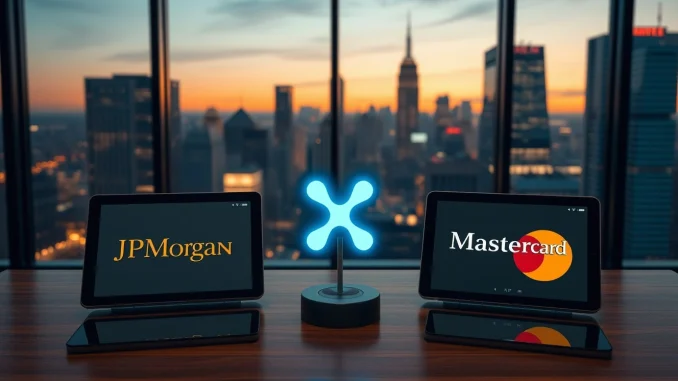
Wall Street bank JPMorgan and payments giant Mastercard have successfully completed the first cross-border, cross-bank redemption of a tokenized US Treasury fund, utilizing Ripple’s XRP Ledger alongside traditional interbank settlement rails. The transaction, announced on May 7, 2026, marks a significant step toward integrating public blockchain infrastructure with established global banking systems.
How the transaction worked
The pilot involved blockchain tokenization platform Ondo Finance redeeming its US Ondo Short-Term US Government Treasuries (OUSG) fund for Ripple on the XRP Ledger. Settlement instructions were routed through Mastercard’s Multi-Token Network, which connected to JPMorgan’s blockchain platform, Kinexys, to deliver US dollars to Ripple’s bank account in Singapore.
Ondo Finance described the event as the first time a public blockchain and global banking infrastructure settled a cross-border transaction of a tokenized fund together in real time. The pilot builds on an earlier collaboration between JPMorgan and Ondo Finance in May 2025, when a tokenized US Treasury fund was moved between a public and permissioned blockchain network.
Why this matters for TradFi and crypto
The transaction reflects growing collaboration between cryptocurrency firms and traditional financial institutions seeking faster, lower-cost payment and settlement systems that operate outside conventional banking hours. Real-world asset tokenization has attracted increasing interest from Wall Street leaders, who envision tokenizing everything from stocks and bonds to money market funds and real estate.
Also read: Spain’s CNMV Chair Rules Out MiCA Deadline Extension for Crypto Firms, Impacting Binance
According to RWA.xyz data, more than $31.1 billion worth of real-world assets, excluding stablecoins, are currently tokenized onchain. Boston Consulting Group estimated in 2022 that the tokenization market could reach $16 trillion by 2030, while McKinsey & Co. projected a more conservative $2 trillion over the same timeframe.
Regulatory hurdles remain
Despite the progress, the International Monetary Fund flagged several concerns in an April report, warning that tokenization shifts risk from the banking system to shared ledgers and smart contract code, making intervention during stress events more difficult. The IMF also noted that without legal clarity over ownership records and settlement finality, tokenized markets risk remaining fragmented and peripheral.
Shark Tank investor Kevin O’Leary echoed these concerns at Consensus Miami 2026, stating that significant capital will not flow into tokenized assets until US crypto market structure legislation passes and becomes compliant with Securities and Exchange Commission rules. When that occurs, O’Leary said, it will change everything.
Broader tokenization momentum
The New York Stock Exchange’s parent company, Intercontinental Exchange, announced in January that it would launch a tokenization platform for 24/7 trading and instant settlement of stocks and exchange-traded funds using a blockchain post-trade system. That development is considered one of the biggest in the tokenization space to date.
Conclusion
The JPMorgan-Mastercard-Ripple pilot demonstrates that public blockchain networks and traditional banking infrastructure can interoperate for real-time, cross-border settlement of tokenized assets. While regulatory clarity remains a barrier to mass adoption, the transaction signals growing institutional confidence in blockchain-based financial infrastructure.
FAQs
Q1: What exactly was transferred in this pilot?
A1: Ondo Finance redeemed its tokenized US Treasury fund, OUSG, for Ripple on the XRP Ledger, with settlement occurring via Mastercard’s Multi-Token Network and JPMorgan’s Kinexys platform, delivering US dollars to Ripple’s Singapore bank account.
Q2: Why is this transaction considered significant?
A2: It is the first time a public blockchain (XRP Ledger) and traditional banking infrastructure (JPMorgan and Mastercard) have settled a cross-border, cross-bank tokenized fund transaction in real time, demonstrating interoperability between crypto and TradFi systems.
Q3: What are the main barriers to wider tokenization adoption?
A3: Key barriers include the need for clear regulatory frameworks for ownership records and settlement finality, as well as concerns from institutions like the IMF about risk shifting to smart contracts during market stress events.



Be the first to comment