
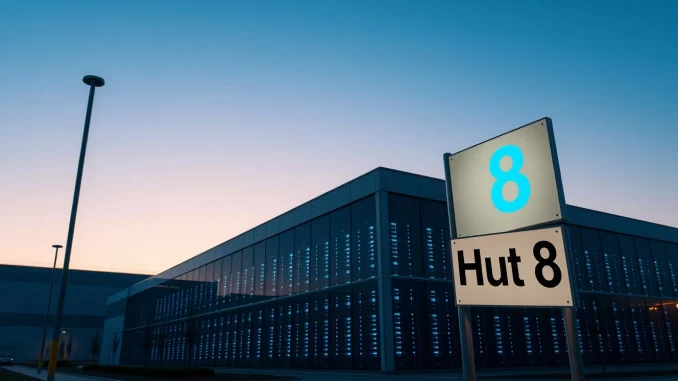
Hut 8 Corp. shares surged more than 33% on Wednesday as investors looked past a first-quarter net loss of $253 million, focusing instead on the Bitcoin miner’s $9.8 billion deal to lease 352 megawatts of energy capacity to an undisclosed artificial intelligence company over 15 years. The stock move signaled that the market is betting heavily on the company’s strategic pivot from pure crypto mining to high-performance computing and AI infrastructure.
Financial results and market reaction
Hut 8 reported quarterly revenue of $71 million, down roughly 22% from the prior period’s $88.4 million and below analyst expectations of $78.5 million, according to FactSet. The net loss was largely attributed to a mark-to-market adjustment on the company’s Bitcoin holdings, which declined in value as BTC fell from a high of over $126,000 in October 2025 to a low of $60,000 in February 2026. Despite the miss, investors viewed the AI energy leasing deal as a transformative catalyst that could stabilize revenue streams and reduce dependence on volatile cryptocurrency markets.
The $9.8 billion AI energy deal
Under the terms of the agreement, Hut 8 will provide 352 megawatts of power capacity to a third-party AI company over a 15-year period. The deal is expected to generate recurring, predictable revenue, a sharp contrast to the fluctuating income from Bitcoin mining. The company’s first-quarter results showed it generated $66 million from ASIC compute, AI cloud, and traditional cloud solutions, underscoring its growing focus on non-mining revenue sources. The announcement came as Hut 8 continues to build out its energy infrastructure portfolio, positioning itself as a key player in the race to power AI workloads.
Industry-wide pivot from Bitcoin mining
Hut 8’s strategy reflects a broader trend among publicly traded crypto mining companies, many of which are diversifying into AI and high-performance computing to offset declining mining revenues and rising energy costs. Core Scientific, for example, recently announced a 1.5-gigawatt data center push focused on AI workloads. The shift is driven by economics: AI companies can pay between $200 and $500 per megawatt for power, compared to $57 to $129 per megawatt for Bitcoin mining, according to crypto trader and analyst Ran Neuner. This disparity is pushing miners to reallocate energy resources to more profitable AI applications.
Also read: Spain’s CNMV Chair Rules Out MiCA Deadline Extension for Crypto Firms, Impacting Binance
Implications for Bitcoin network security
Neuner warned that the migration of energy capacity away from Bitcoin mining could weaken the network’s security. As miners redirect computing power to AI ventures, the total hash rate securing the Bitcoin blockchain may decline, potentially making the network more vulnerable to attack. This dynamic pits two high-growth industries against each other for the same finite resource: electricity. The competition has also driven demand for nuclear energy, with hyperscale companies like Google, Microsoft, Amazon, and Meta announcing nuclear energy deals since 2024 to power their AI infrastructure.
Conclusion
Hut 8’s stock surge despite a quarterly loss highlights investor optimism about the company’s AI-driven transformation. While the financial results were weak, the $9.8 billion energy leasing deal provides a clear path to more stable, long-term revenue. The broader industry pivot from Bitcoin mining to AI infrastructure carries implications for energy markets and blockchain security, making Hut 8 a bellwether for this evolving sector. Investors and industry watchers will be closely monitoring how the company executes its diversification strategy in the coming quarters.
FAQs
Q1: Why did Hut 8’s stock surge despite a net loss?
Investors focused on the company’s $9.8 billion AI energy leasing deal, which promises stable, long-term revenue and reduces reliance on volatile Bitcoin mining income.
Q2: What caused Hut 8’s first-quarter loss?
The loss was primarily due to a reduction in the market value of its Bitcoin holdings, which fell from over $126,000 to $60,000 during the quarter.
Q3: How does the AI energy deal affect Bitcoin network security?
As miners redirect power to AI, the total computing power securing the Bitcoin blockchain may decline, potentially making the network more vulnerable to attack, according to analyst Ran Neuner.





Be the first to comment