
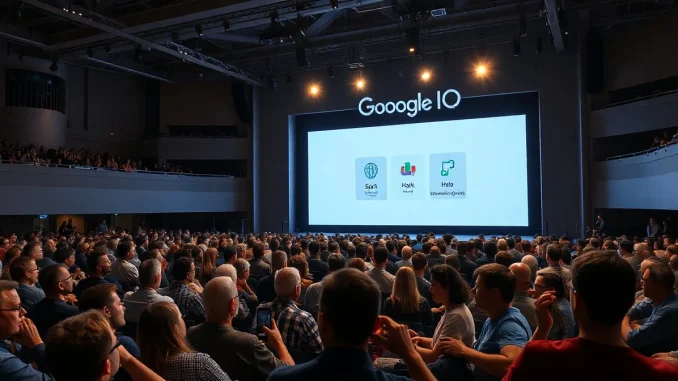
At Google I/O 2026, the company unveiled a sweeping vision for AI agents—automated digital assistants designed to work in the background, tracking news, managing inboxes, and even planning neighborhood block parties. But for most consumers, the message was lost in a fog of brand names, tiered pricing, and abstract demos that felt disconnected from everyday life.
What Google Announced: A Fragmented Agent Ecosystem
Google introduced several distinct AI agent products during its developer conference, each with its own name and access requirements:
Also read: The $3 trillion AI question: Can revenue ever catch up to infrastructure spending?
- Information Agents: An AI-powered evolution of Google Alerts, designed to monitor topics like market trends, price changes, or weather warnings. Available this summer to Gemini Ultra subscribers ($100/month).
- Gemini Spark: A personal AI agent that integrates with Gmail, Docs, and Workspace to surface email themes, track home inventory, or plan group trips. Coming soon to Ultra users.
- Android Halo: A notification system for Spark alerts on Android devices. Shipping later this year.
- Daily Brief: A personalized digest from Gmail, calendar, and tasks, rolling out to Ultra, Pro, and Plus subscribers in the U.S.
Google also demonstrated an increasingly agentic Chrome browser, where users could configure car purchases by speaking naturally to the browser. The company stated it intends to bring some agentic features to free users ‘when the time is right,’ but for now, the focus is on iterating with paying subscribers.
The Consumer Disconnect
The problem isn’t the technology—it’s the packaging. Google presented four distinct agent-related brands (Information Agents, Spark, Halo, Daily Brief) alongside existing Gemini branding, creating a confusing entry point for average users. During a press briefing ahead of I/O, Google acknowledged the fragmentation but defended the strategy as necessary for targeted iteration with power users.
Also read: Elon Musk calls Anthropic the ‘leader in AI’ after signing $40 billion SpaceX deal
This approach widens the gap between early adopters and the broader public. Many consumers still associate AI primarily with chatbots replacing search, or with ‘AI slop’ flooding social media. Google’s own demos didn’t help: goofy AI-generated animations, a corny talking Tensor chip sequence, and an Android glasses demo that turned a photo of the audience into a scene with a blimp—a feature one executive called ‘neat’ but critics dismissed as a party trick.
Why This Matters
The average consumer is struggling with real-world pressures—rising costs, job markets reshaped by AI recruiting systems, and screen time addiction. Google’s pitch for AI agents could have been powerful: tools that reduce time spent on repetitive tasks, freeing users to live offline. Instead, the company focused on engineering-minded examples (organizing a block party) and kept the most useful features behind a $100/month paywall.
Startups like Poke, Poppy, RPLY, and Wingman are already offering simpler, messaging-based AI agents that work through text—a feature Google says will come to Spark ‘at some point in the future.’ This contrasts sharply with Google’s early strategy, when products like Gmail and Search were free, simple, and immediately accessible.
Conclusion
Google I/O 2026 showcased impressive AI agent technology, but the company failed to sell its value to the people who need it most. By fragmenting its offerings behind multiple brands and a premium paywall, Google risks repeating the pattern of creating powerful tools that only a few can use—while the rest of the world watches, confused and disconnected.
FAQs
Q1: What are Google’s new AI agents?
Google announced several AI agents at I/O 2026, including Information Agents (AI-powered monitoring), Gemini Spark (personal assistant), Android Halo (notification system), and Daily Brief (inbox digest). Most are initially available only to Gemini Ultra subscribers.
Q2: When will these AI agents be available to free users?
Google has said it will bring some agentic features to free users ‘when the time is right,’ but no specific timeline has been provided. Currently, the company is focused on iterating with paying subscribers.
Q3: How do Google’s AI agents compare to existing AI assistants?
Google’s agents are designed to operate autonomously in the background, performing tasks like monitoring news, tracking prices, and managing digital life. However, competitors like Poke and Wingman offer simpler, messaging-based interfaces that may be more accessible to average users.





Be the first to comment