
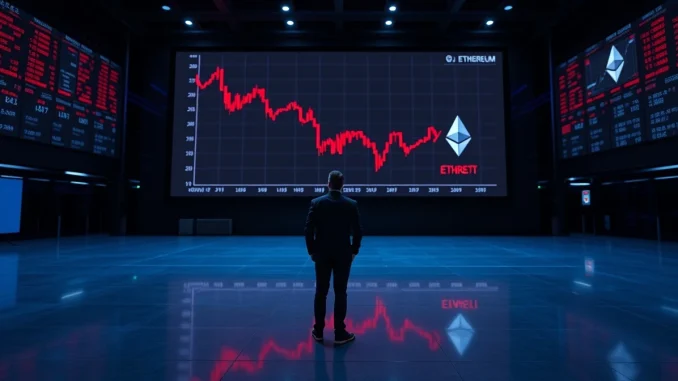
Ethereum (ETH) is facing its most negative market sentiment in over three years, according to on-chain and derivatives data, even as institutional interest remains visible through Bitmine’s ongoing ETH accumulation. The divergence between price action and whale activity has created an unusual tension in the market, leaving traders and analysts debating the next direction for the second-largest cryptocurrency by market capitalization.
Sentiment Indicators Flash Deep Red
Multiple sentiment metrics tracked by analytics platforms have turned decisively bearish on Ethereum. The funding rate for ETH perpetual futures has flipped negative, indicating that short sellers are currently paying a premium to maintain their positions. Meanwhile, the put/call ratio on major derivatives exchanges has risen sharply, reflecting a growing preference for downside protection over bullish bets. This combination of signals has not been seen since the market downturn of late 2023.
Also read: Wintermute Warns Ethereum Is the Wrong Trade as ETH Slides 10% This Week
The shift in sentiment appears driven by a combination of factors: slowing network activity, declining total value locked (TVL) in DeFi protocols built on Ethereum, and increasing competition from alternative layer-1 blockchains that have captured developer attention and capital flows. Additionally, uncertainty around the timing and scale of future Ethereum protocol upgrades has contributed to a cautious outlook among retail and institutional participants alike.
Bitmine’s Counter-Current Accumulation
In stark contrast to the broader bearish mood, Bitmine, a publicly traded cryptocurrency mining and investment firm, has been steadily increasing its Ethereum holdings. The company disclosed in its latest quarterly filing that it had acquired an additional 45,000 ETH over the past two months, bringing its total treasury position to over 180,000 ETH, valued at approximately $540 million at current prices.
Also read: Bitmine Acquires 71,672 ETH Amid Ethereum Price Dip, Signaling Long-Term Confidence
Bitmine’s buying spree has been executed through open market purchases and over-the-counter (OTC) deals, often at prices that analysts consider near the lower end of the current trading range. The firm has not publicly detailed its investment thesis, but industry observers note that such accumulation by a well-capitalized entity often signals a long-term conviction in Ethereum’s value proposition, particularly as the network continues to generate significant fee revenue and maintain its dominance in the smart contract ecosystem.
Why the Divergence Matters
The disconnect between bearish market sentiment and Bitmine’s aggressive buying creates a complex sector for investors. On one hand, sentiment-driven price action could continue to pressure ETH lower in the short term, especially if broader macroeconomic conditions remain uncertain. On the other hand, large-scale accumulation by a publicly traded company with a fiduciary duty to its shareholders suggests that at least one sophisticated market participant sees current prices as a compelling entry point.
Historical patterns in cryptocurrency markets have shown that periods of extreme bearish sentiment often coincide with market bottoms, particularly when accompanied by sustained accumulation from deep-pocketed buyers. However, past performance does not guarantee future results, and the current environment includes unique variables such as evolving regulatory frameworks and shifting competitive dynamics within the blockchain industry.
Market Implications and Outlook
For traders, the current setup presents a classic tension between momentum and value. The bearish sentiment could be self-reinforcing in the near term, as short sellers gain confidence and retail participants reduce exposure. However, if Bitmine’s buying is joined by other institutional players, the accumulated supply could eventually create a floor under prices.
For longer-term holders, the key question is whether the factors driving negative sentiment—such as declining network usage and competitive pressure—are temporary headwinds or structural challenges. Ethereum’s roadmap includes several planned upgrades aimed at improving scalability and user experience, but their impact on adoption and network economics remains uncertain.
Conclusion
Ethereum is managing a period of unusually bearish sentiment, with derivatives and on-chain data reflecting the most cautious outlook since 2023. Yet the simultaneous accumulation by Bitmine highlights that not all market participants share the same view. The coming weeks will be critical in determining whether the bearish sentiment is a precursor to further downside or a contrarian signal that a bottom is forming. Investors should weigh both the risks and the potential opportunities as the market digests these conflicting signals.
FAQs
Q1: Why is Ethereum sentiment so bearish right now?
Bearish sentiment is driven by declining network activity, reduced total value locked in DeFi, competition from other blockchains, and uncertainty around future protocol upgrades. Derivatives data shows a rise in short positions and put options, reflecting a cautious market outlook.
Q2: What is Bitmine doing with its Ethereum purchases?
Bitmine has been accumulating Ethereum as part of its treasury strategy, adding 45,000 ETH over the past two months. The firm has not disclosed its exact investment thesis, but the buying suggests a long-term bullish view on Ethereum’s value.
Q3: Does Bitmine’s buying mean Ethereum will go up?
Not necessarily. While large-scale accumulation by a public company can signal confidence, market sentiment and price action are influenced by many factors. Bitmine’s buying alone does not guarantee a price increase, but it does indicate that at least one significant institutional player sees current prices as attractive.




Be the first to comment