
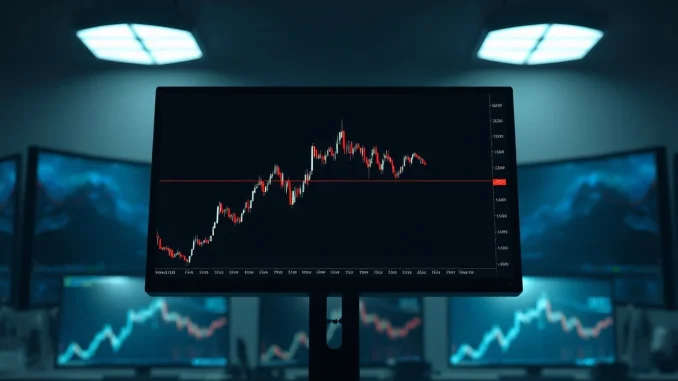
Ether (ETH) dropped 3.4% to $2,287 on April 27, 2026, after failing to break the $2,400 level for the fourth time since April 14. This repeated rejection has formed a triple top pattern on the daily chart. Many ETH analysts now doubt a bullish trend change is near.
The price remains below the 100-day moving average. Over $2.5 billion in leveraged long positions sit near the $2,150 support zone. A break below that level could trigger forced selling.
Ether triple top signals resistance at $2,400
Each retest of $2,400 saw selling pressure increase. The 100-day exponential moving average (EMA) near $2,350 acts as dynamic resistance. The price has not held above it on the one-day chart since early April.
According to Cointelegraph, the triple top pattern suggests sellers are absorbing supply at this level. The pattern is bearish when confirmed by a break below the neckline near $2,150.
Also read: Spain’s CNMV Chair Rules Out MiCA Deadline Extension for Crypto Firms, Impacting Binance
Key technical levels to watch:
- $2,400 — resistance zone with four rejections
- $2,350 — 100-day EMA, dynamic resistance
- $2,150 — critical support and neckline of triple top
- $2,050 to $1,900 — next downside target if $2,150 breaks
Data from CoinGlass shows $2.5 billion in liquidation risk below $2,150. A move below this level could trigger a cascade of forced selling.
ETH/BTC ratio weakness adds to bearish signals
Michaël van de Poppe, founder of MN Capital, noted weakness in the ETH/BTC pair. The ratio dropped below 0.032 BTC on April 27. This removed a key support level tied to prior continuation attempts.
The ETH/BTC ratio also slipped under the 21-period moving average. This signals fading relative strength against Bitcoin. The next higher-time frame level sits near 0.026 BTC, where buyers previously stepped in.
Industry watchers note that Ether’s underperformance against Bitcoin often precedes broader altcoin weakness. If the ratio continues to decline, it could confirm a bearish trend for ETH.
What the ETH/BTC ratio means for traders
A declining ETH/BTC ratio suggests investors prefer Bitcoin over Ether. This shift in sentiment can lead to capital outflows from Ethereum-based assets. The ratio’s break below 0.032 BTC is a technical warning sign.
Traders should monitor the 0.026 BTC level. A break below that could signal deeper downside for Ether relative to Bitcoin.
ETH futures positioning hints at a market reset
On Binance, Ether’s open interest (OI) dropped to $2.58 billion. This matches levels seen when ETH traded near $2,200 earlier in April. The decline points to a reset in employ after recent positioning buildup.
Data from CryptoQuant shows the funding rate near -0.013%. That is the lowest reading since February. Short positions now dominate new activity, while earlier long exposure has been reduced.
Crypto analyst Amr Taha noted that this combination places ETH in a shorts-heavy setup with lower apply. If price holds near current levels, the imbalance between positioning and price could tighten. This could lead to a breakout sooner than later.
The key zone centers on $2,150, where liquidation risks and the technical level converge on the daily chart.
Liquidation risks amplify downside pressure
The liquidation map from CoinGlass shows heavy concentration below $2,150. Over $2.5 billion in leveraged longs sit in this zone. A break below this level could trigger forced selling into the $2,050 to $1,900 range.
This creates a feedback loop. Falling prices trigger liquidations, which push prices lower. Traders should watch for volume spikes near $2,150 as a sign of potential breakdown.
Historical context of triple top patterns
Triple top patterns are rare but reliable bearish signals. They form when price tests a resistance level three times without breaking through. The pattern is confirmed when price falls below the support level between the peaks.
In Ether’s case, the support level is near $2,150. A confirmed break below that could target $1,900 or lower. The pattern’s validity increases with each failed retest.
What this means for Ether investors
The triple top pattern and weak ETH/BTC ratio suggest a bearish outlook for Ether in the short term. The $2,150 support level is critical. A break below it could trigger a sharp decline.
However, the reset in futures positioning could set the stage for a reversal. If price holds above $2,150 and buying volume increases, the bearish pattern may fail. Traders should watch for confirmation before taking positions.
Related factors to monitor:
- Bitcoin price action — a Bitcoin rally could lift Ether
- Macroeconomic data — interest rate decisions affect risk assets
- Ethereum network activity — rising gas fees or DeFi usage could boost demand
Conclusion
The Ether triple top at $2,400 and weak ETH/BTC ratio raise doubts about a bullish trend change. The $2,150 support level is now the key line in the sand. A break below it could trigger forced selling and a move toward $1,900. Traders should monitor liquidation data and funding rates for signs of a market reset. The coming days will determine whether bears maintain control or a reversal takes hold.
FAQs
Q1: What is a triple top pattern in cryptocurrency trading?
A triple top is a bearish chart pattern that forms when an asset’s price tests a resistance level three times without breaking through. It signals that sellers are absorbing supply and a downward move may follow.
Q2: Why is the $2,150 level important for Ether?
The $2,150 level acts as both technical support and the neckline of the triple top pattern. Over $2.5 billion in leveraged longs sit below this level, making it a potential trigger for forced selling.
Q3: How does the ETH/BTC ratio affect Ether’s price?
The ETH/BTC ratio measures Ether’s strength relative to Bitcoin. A declining ratio suggests investors prefer Bitcoin, which can lead to capital outflows from Ether and broader altcoin weakness.
Q4: What does a negative funding rate mean for ETH futures?
A negative funding rate indicates that short positions are paying longs. This suggests bearish sentiment and that traders expect prices to fall. It can also signal a potential squeeze if price reverses.
Q5: Can the triple top pattern fail?
Yes, triple top patterns can fail if price breaks above the resistance level instead of below. In that case, the pattern becomes a reversal signal to the upside. Traders should wait for confirmation before acting.






Be the first to comment