
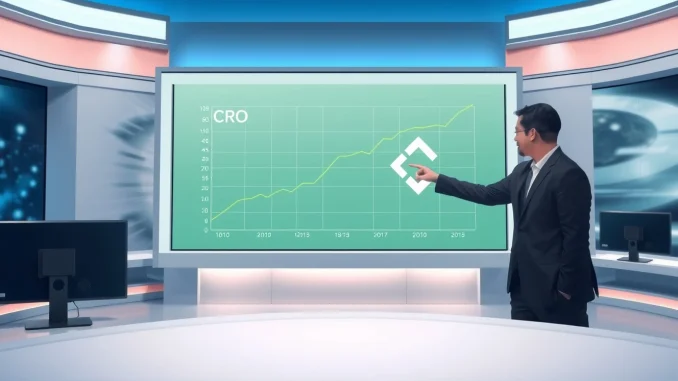
The Cronos blockchain, built to power decentralized applications and payments within the Crypto.com ecosystem, has drawn steady attention from both retail and institutional participants. Its native token, CRO, has experienced significant volatility since its launch, but the network’s expanding use cases and strategic partnerships have kept it in the conversation among long-term crypto investors. This article examines the factors that could influence CRO’s price trajectory from 2026 through 2030, grounded in verifiable developments and market fundamentals rather than speculative hype.
Understanding Cronos and Its Ecosystem
Cronos is an Ethereum-compatible blockchain network developed by Crypto.com, designed to enable high-throughput, low-cost decentralized finance (DeFi) and non-fungible token (NFT) applications. The CRO token serves multiple functions: it is used for transaction fees, staking, and as a bridge asset within the Crypto.com ecosystem, including the exchange, the DeFi wallet, and the Cronos chain itself. The network’s interoperability with Ethereum and Cosmos ecosystems has been a key driver of its adoption, allowing developers to deploy existing smart contracts with minimal modification.
Also read: Notcoin (NOT) Price Prediction 2026-2030: Can the Telegram Gaming Token Stage a Recovery?
As of early 2026, Cronos hosts over 400 decentralized applications and has processed more than 100 million transactions. Its total value locked (TVL) in DeFi protocols, while fluctuating with market conditions, has shown resilience compared to smaller layer-1 chains. The network’s governance model, which involves CRO stakers in key decisions, adds a layer of community-driven development that can influence long-term token demand.
Key Factors Shaping CRO’s Price Outlook (2026–2030)
Network Adoption and Developer Activity
The number of active developers and daily active users on Cronos directly correlates with demand for CRO. If the network continues to attract projects from DeFi, gaming, and real-world asset tokenization, the utility of CRO could expand beyond its current scope. The Crypto.com exchange’s user base, which exceeds 80 million globally, provides a built-in distribution channel that many competing chains lack. However, developer activity is also influenced by broader market sentiment and the availability of grants and incentives, which have been reduced since the peak of the 2021 bull market.
Also read: Monero (XMR) Price Prediction 2026–2030: Can Privacy Coins Sustain Momentum?
Tokenomics and Supply Dynamics
CRO has a maximum supply of 30 billion tokens, with a significant portion already in circulation. The token’s inflation rate has been decreasing as the network matures, with staking rewards tapering according to the original schedule. In 2026, the annual inflation rate is approximately 2.5%, down from over 10% in earlier years. This reduction in new supply entering the market could support price stability, provided demand does not decline. Token burns, which have been implemented periodically by Crypto.com, also play a role in reducing circulating supply, though the frequency and scale of burns are discretionary.
Regulatory Environment and Institutional Interest
Regulatory clarity around cryptocurrencies in major jurisdictions—particularly the United States, the European Union, and parts of Asia—will significantly impact CRO’s price. Cronos, as a network tied to a centralized exchange, faces unique regulatory scrutiny. Crypto.com has obtained licenses and registrations in multiple countries, including a Virtual Asset Service Provider (VASP) registration in Ireland and a Digital Payment Token license in Singapore. These credentials could position CRO as a relatively compliant asset for institutional investors, but any adverse regulatory action against the exchange or the network could trigger sharp price corrections.
Price Scenarios for 2026–2030
Notably that cryptocurrency price predictions are inherently uncertain. The following scenarios are based on publicly available data, historical patterns, and reasonable assumptions about adoption and market cycles. They are not financial advice.
Base Case: Steady Growth with Market Cycles
In a scenario where the broader crypto market follows historical four-year cycles, CRO could experience moderate growth. If the network maintains its current adoption rate and the Crypto.com ecosystem expands, CRO might trade in a range of $0.15 to $0.35 by 2027, with potential peaks above $0.50 during the next bull market, possibly in 2028 or 2029. This scenario assumes no major regulatory shocks and continued developer activity.
Bull Case: Mass Adoption and Ecosystem Dominance
If Cronos becomes a leading platform for tokenized real-world assets and gains significant market share in the DeFi and NFT sectors, CRO could see substantial appreciation. In this optimistic scenario, the token might reach between $1.00 and $2.00 by 2030, driven by increased utility, staking demand, and a shrinking supply. This would require a sustained bull market and the successful onboarding of major traditional finance partners.
Bear Case: Stagnation or Decline
If the crypto market enters a prolonged bear phase or if Cronos fails to differentiate itself from competing layer-1 and layer-2 solutions, CRO could underperform. In this scenario, prices might range between $0.05 and $0.10 through 2030, with the token serving primarily as a utility asset within a shrinking ecosystem. Regulatory crackdowns or a loss of developer interest could accelerate this decline.
Why This Matters to Crypto Investors
For investors considering CRO, the key takeaway is that the token’s value is closely tied to the health and growth of the Cronos network and the broader Crypto.com ecosystem. Unlike many cryptocurrencies that rely purely on speculative narratives, CRO has a concrete use case within a platform with millions of users. However, it also carries the risks associated with centralized exchange-linked tokens, including potential regulatory actions and corporate governance decisions. Understanding these dynamics is essential for making informed decisions.
Conclusion
Cronos (CRO) has established itself as a functional layer-1 blockchain with a real user base and a clear value proposition within the Crypto.com ecosystem. While its price outlook from 2026 to 2030 depends on multiple variables—including network adoption, tokenomics, and regulatory developments—the token’s fundamentals provide a basis for reasoned analysis rather than mere speculation. Investors should focus on verifiable metrics such as TVL, developer activity, and regulatory compliance when evaluating CRO’s potential. As with all cryptocurrency investments, diversification and caution are advised.
FAQs
Q1: What is the maximum supply of CRO tokens?
The maximum supply of CRO is 30 billion tokens. As of 2026, the majority of these tokens are already in circulation, with the remaining supply being released gradually through staking rewards and ecosystem incentives.
Q2: How does Cronos differ from other Ethereum-compatible blockchains?
Cronos is tightly integrated with the Crypto.com exchange and ecosystem, providing a large built-in user base and cross-platform utility. It also supports interoperability with both Ethereum and Cosmos, offering developers flexibility in deploying applications.
Q3: Is CRO a good long-term investment?
Long-term investment in CRO carries both opportunities and risks. The token benefits from a strong ecosystem and regulatory compliance efforts, but its price is highly correlated with the overall crypto market and the success of Crypto.com. Investors should conduct their own research and consider their risk tolerance.





Be the first to comment