
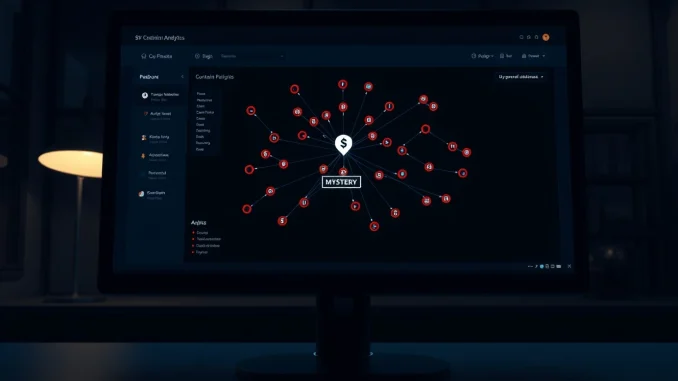
Blockchain analytics firm Bubblemaps has identified a coordinated cluster of 90 newly funded wallets that purchased 90% of the Mystery (MYSTERY) memecoin supply immediately at launch, raising serious concerns about market manipulation and investor risk. The wallets were all pre-funded from a single source, wallet address 0x544E, which withdrew 20 Ether from Binance and distributed the funds before the token went live.
How the sniping cluster operated
According to Bubblemaps, the 90 wallets acted in unison to buy up nearly the entire token supply within moments of trading opening. After accumulating the supply, the cluster sold approximately $100,000 worth of tokens and still holds roughly 40% of the total supply. Bubblemaps described the pattern as a ‘textbook scam’ in a Tuesday post on X, highlighting how automated sniping tools and coordinated wallet networks can dominate thinly traded memecoin launches.
Sniping refers to the use of bots or automated trading scripts to purchase newly launched tokens before ordinary traders can react. When combined with pre-funded wallet clusters, this tactic allows a small group to control supply and exit positions at the expense of later buyers.
Impact on Mystery token price and market cap
The Mystery token reached a peak market capitalization of $7.5 million on April 28, but has since declined approximately 75% to around $1.9 million at the time of reporting, according to Dexscreener data. The rapid drop reflects the sell pressure from the initial sniping cluster and the resulting loss of confidence among retail traders.
Also read: Spain’s CNMV Chair Rules Out MiCA Deadline Extension for Crypto Firms, Impacting Binance
The memecoin project brands itself as a free-spirited frog character from Matt Furie’s ‘The Night Riders’ and claims to have acquired the official HEDZ NFT and related intellectual property rights from Furie, as stated in a Monday X post. Cointelegraph was unable to reach the Mystery team for comment.
Broader implications for memecoin launches
Sniping and coordinated wallet clusters have been a persistent issue in the memecoin space, undermining the concept of a ‘fair launch’ where all participants have an equal opportunity to buy tokens. In February 2025, a cryptocurrency sniper generated nearly $28 million in profit on the Broccoli (BROCCOLI) memecoin after Binance co-founder Changpeng Zhao revealed his dog’s name, triggering a wave of community-driven token listings on Pump.fun.
In November 2025, Bubblemaps reported a similar pattern involving approximately 160 wallets that accumulated 30% of Edel Finance’s (EDEL) token supply at launch, worth over $11 million. Edel Finance co-founder James Sherborne denied the allegations, stating the team planned to acquire 60% of the supply.
Why this matters for investors
The Mystery token case illustrates the risks associated with memecoin investing, particularly when launch mechanics are opaque and supply distribution is heavily concentrated. For everyday traders, the presence of coordinated sniping clusters means that buying into a newly launched token carries a high probability of facing immediate sell pressure from insiders who control the majority of supply.
Blockchain analytics tools like Bubblemaps provide transparency by tracing wallet connections and funding sources, but the speed of sniping often leaves retail participants at a disadvantage. Investors are advised to verify token distribution data and be cautious of projects with unusually concentrated supply at launch.
Conclusion
The Bubblemaps findings on the Mystery token underscore ongoing challenges in the memecoin market, where automated sniping and coordinated wallet clusters can extract value from ordinary participants. While the project claims legitimate IP ownership, the distribution pattern raises questions about fairness and long-term viability. As regulatory scrutiny of cryptocurrency markets evolves, such detection methods may become increasingly important for investor protection.
FAQs
Q1: What is token sniping in cryptocurrency?
Token sniping is the practice of using automated bots or scripts to purchase newly launched tokens immediately when trading opens, often before human traders can react. This allows snipers to acquire tokens at the lowest possible price and potentially sell them at a profit as demand increases.
Q2: How did Bubblemaps detect the Mystery token cluster?
Bubblemaps analyzed on-chain data and identified 90 wallets that were all funded from a single source wallet (0x544E), which withdrew 20 Ether from Binance. The wallets acted in coordination to purchase 90% of the Mystery token supply at launch, a pattern the firm described as a textbook scam.
Q3: What can investors do to protect themselves from sniping schemes?
Investors can use blockchain analytics tools like Bubblemaps to check token distribution before buying. Red flags include highly concentrated supply among a small number of wallets, wallets funded from a single source, and rapid price spikes followed by sharp declines. Always verify project fundamentals and be cautious of memecoin launches with opaque mechanics.





Be the first to comment