
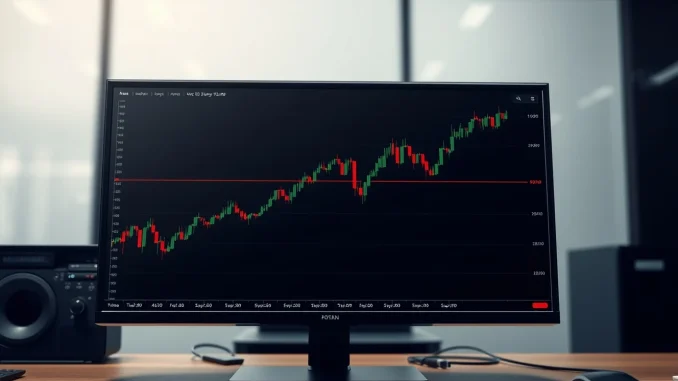
Bitcoin’s price has been locked in a tight band for weeks. Data shows this $10,000 range between $60,000 and $70,000 is likely to persist. The reason? A market dominated by futures traders, with a notable absence of fresh capital from spot buyers. This creates a fragile setup where short-term use, not long-term investment, dictates daily moves.
Futures Markets Dictate Bitcoin’s Direction
According to data from market maker Wintermute, perpetual futures trading volume massively outpaces spot trading on major exchanges. The ratio has climbed to 15 times spot volume. This means price action is primarily driven by leveraged bets, not by investors buying the actual asset.
Funding rates, which indicate whether traders are paying to hold long or short positions, show no sustained trend. They oscillate between positive and negative. Wintermute’s data indicates funding rate volatility has compressed to 2.9%, down from around 5% earlier in 2025. This suggests traders are using use for small, quick trades without strong conviction about Bitcoin’s next major move. The market is coiling within a narrow band, waiting for a catalyst.
The Critical Lack of Spot Market Demand
For a sustained breakout, Bitcoin needs new money. That demand is currently missing. Data from analytics firm CryptoQuant shows a 30-day “apparent demand” metric at -60,000 BTC. More coins are leaving exchanges than are being accumulated. This is a clear signal of net selling pressure, not accumulation.
Also read: Spain’s CNMV Chair Rules Out MiCA Deadline Extension for Crypto Firms, Impacting Binance
Stablecoin inflows to spot exchanges, often a precursor to buying, tell a similar story. The metric sits near $452 million, close to a two-year low. Industry watchers note that without this reservoir of ready capital, rallies struggle to find fuel. The implication is simple: the market lacks the fresh cash needed to push Bitcoin decisively above its current ceiling.
Pressure from Underwater Short-Term Holders
Another layer of selling pressure comes from recent buyers. Data shared by researcher Axel Adler Jr. shows short-term holders—those who bought within the last 155 days—are in a tough spot. Their average cost basis is around $85,800. With Bitcoin trading well below that, many are sitting on losses.
Two metrics highlight their distress. The Short-Term Holder Spent Output Profit Ratio (STH SOPR) has stayed below 1.0 for over 110 days. A value below 1 means coins are being sold at a loss. This suggests consistent loss-taking by this group. Furthermore, the short-term holder realized price year-on-year change has turned negative, hitting -5.35%. This is the first negative reading since the 2022 bear market. It confirms losses are persistent, not a brief dip.
What this means for the market is clear. Traders holding unrealized losses are prone to sell into any price bounce to exit positions. This behavior creates a ceiling on rallies and reinforces the current trading range.
How This Market Structure Limits Breakouts
The combination of these factors creates a self-reinforcing cycle. Futures traders with no directional bias chop the price within a range. A lack of spot demand prevents sustained upward momentum. Meanwhile, short-term holders sell rallies to cut losses, adding immediate supply. This keeps Bitcoin volatile but directionless.
Analysts point out that until one of these dynamics shifts, the $10,000 range is likely to hold. A breakout would require a surge in spot buying power, a sustained shift in futures market sentiment, or both. Until then, the market remains in a state of fragile equilibrium, controlled more by use and sentiment than by fundamental inflows.
Historical Context and Market Psychology
This pattern is not entirely new. Similar phases have occurred in past Bitcoin cycles, often during consolidation periods after major rallies. The market digests gains and shakes out weak hands before a new trend emerges. The current data suggests this digestion phase is being prolonged by the specific dominance of futures and the absence of spot buyers.
Market veterans often look for a shift in the derivatives-to-spot volume ratio as an early signal. A decline would indicate spot market participation is returning. Similarly, a sustained move in funding rates, coupled with rising stablecoin reserves, could signal building momentum for a directional move.
Conclusion
Bitcoin’s price remains trapped in a $10,000 range, pinned between $60,000 and $70,000. Current market data points to a clear cause: futures trading dominates price action while spot market demand lags. This creates a fragile structure where rallies are shortened by selling from underwater short-term holders. The range is expected to hold until a significant influx of spot buyer capital changes the equation. For now, the market waits for a catalyst to break the stalemate.
FAQs
Q1: What is the main reason Bitcoin is stuck in a $10,000 range?
The primary reason is the dominance of futures and derivatives trading over spot market buying. Data shows perpetual futures volume is 15 times spot volume, meaning price is driven by leveraged bets, not new investment. A lack of fresh capital from spot buyers prevents sustained breakouts.
Q2: What does a negative “apparent demand” metric mean?
According to CryptoQuant, a negative 30-day apparent demand of -60,000 BTC means more Bitcoin is being moved out of known exchange wallets than is being deposited. This indicates net selling or movement to cold storage, not accumulation by buyers on exchanges.
Q3: Why are short-term holders creating selling pressure?
Data shows the average purchase price for short-term holders is around $85,800. With Bitcoin trading below $70,000, these holders are at a loss. Metrics like the STH SOPR staying below 1.0 for over 110 days show they are consistently selling at a loss, which caps price rallies.
Q4: What would signal a potential breakout from this range?
A sustained increase in stablecoin inflows to exchanges would signal ready buying power. A decrease in the futures-to-spot volume ratio would show spot market participation is growing. Together, these could provide the fuel for a sustained price move.
Q5: How does futures funding rate volatility affect the price?
Low and directionless funding rate volatility, like the current 2.9%, indicates futures traders lack conviction. They are not aggressively betting on sustained upward or downward moves. This contributes to choppy, range-bound price action without a clear trend.





Be the first to comment