
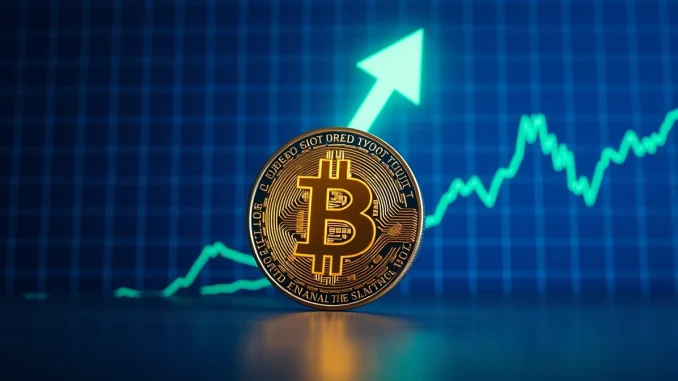
Bitcoin has shown clear signs of recovering its full bullish momentum, according to multiple on-chain and market indicators. Despite a 2.5% pullback from its May 6 high of $82,800, analysts point to expanding price momentum, recovering liquidity, surging network activity, and a return of real spot demand as evidence that the uptrend remains intact.
Bitcoin price momentum re-enters expansion territory
Private wealth manager Swissblock noted that Bitcoin is “still at full momentum” despite the recent correction. The latest rally pushed BTC price momentum back into expansion territory, with the Bull Market Support Band now acting as support. Analyst The Great Mattsby observed that the 21-week exponential moving average has crossed back above the 20-week simple moving average, confirming the trend has flipped bullish. Bitcoin is currently consolidating between the true market mean and short-term holder cost basis around $80,000 as support, with the active realized price at $85,000 acting as resistance.
Liquidity recovery signals strong buying potential
The Stablecoin Supply Ratio (SSR) has recovered from historic lows below 10, a level that previously marked market bottoms in mid-2021, 2022, and mid-2023. Each time the SSR rebounded from these lows, Bitcoin broke out of its range and staged a significant rally. The Binance Stablecoin Supply Ratio Oscillator has also moved back into positive territory, reaching 12-month highs at 2.8. CryptoQuant analyst Zizcrypto explained that this reflects a strong recovery in stablecoin purchasing demand, with similar readings in May 2025 and November 2024 preceding stronger market phases.
Network activity hits 20-month highs
Bitcoin’s daily transaction count surged 116% in May to 831,450 on May 9, a level last seen in September 2024 before the post-election rally above $100,000. Daily active addresses rose 7.1% to 707,719, while total fee volume jumped 37% to $279,300 over the same period. Analyst CW8900 noted that the network is already showing signals of a bull market, with activity levels exceeding those seen when Bitcoin traded at $100,000. Glassnode’s Market Pulse report confirmed that such significant increases in on-chain activity typically signal bullish market conditions.
Also read: Spain’s CNMV Chair Rules Out MiCA Deadline Extension for Crypto Firms, Impacting Binance
Real spot demand returns
Bitcoin’s 90-day spot taker cumulative volume delta (CVD) flipped positive in early May as the price broke above $78,000 resistance. CryptoQuant analyst Rei Researcher highlighted that this metric indicates buying pressure from whales and institutions looking to hold BTC rather than speculate via derivatives. “Real demand has prevailed,” the analyst said, adding that when bulls are willing to pay higher prices to own Bitcoin, a sustainable uptrend usually follows. Spot CVD has risen 47% to $62 million from $42 million a week ago, indicating a significant uptick in buying aggression among market participants.
Conclusion
The combination of expanding price momentum, recovering stablecoin liquidity, surging network activity, and a return of real spot demand suggests Bitcoin has regained full bullish momentum. While the market remains cautious amid macroeconomic uncertainties, on-chain data points to strengthening fundamentals that could support further upside. As always, readers should conduct their own research and consider the risks inherent in cryptocurrency markets.
FAQs
Q1: What does the Bull Market Support Band indicate for Bitcoin?
The Bull Market Support Band turning into support suggests the trend has flipped bullish, with the 21-week EMA crossing above the 20-week SMA, confirming upward momentum.
Q2: Why is the Stablecoin Supply Ratio (SSR) important?
The SSR measures the ratio of Bitcoin’s market cap to stablecoin market cap. A recovery from low levels indicates fresh liquidity entering exchanges, often preceding Bitcoin price rallies.
Q3: What does a positive spot taker CVD mean?
A positive cumulative volume delta in the spot market indicates that buyers are aggressively purchasing Bitcoin at higher prices, reflecting real demand from institutional players rather than speculative activity.




Be the first to comment