
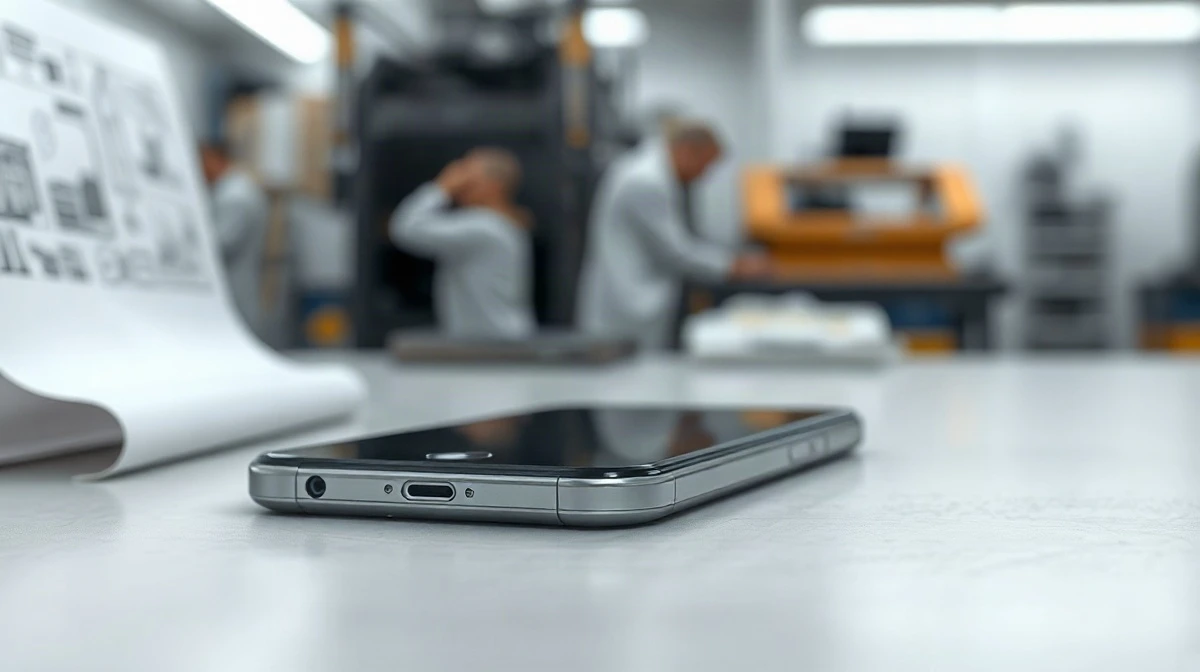
Apple officially entered the foldable phone market on Wednesday, September 9, 2026, unveiling the Duo at its ‘Surprise and Shine’ event. While the device’s form factor is a first for the company, the most significant engineering leap may be hidden inside its hinge, which Chief Hardware Officer Johny Srouji says was designed and manufactured with the help of AI and 3D printing.
Srouji detailed the process during the keynote, explaining that the hinge is a critical component for a device that undergoes significantly more stress than a traditional smartphone. To address the durability concerns that have plagued other foldables, Apple has implemented a manufacturing process that uses artificial intelligence to ensure near-perfect alignment and surface smoothness.
Also read: Apple's New 'Reference Image' Feature Aims to Prove iPhone Photos Aren't AI Slop
An AI-driven manufacturing process for a critical component
Foldable phones have struggled with durability since their inception, with hinges and screens often succumbing to wear and tear from repeated folding. Apple’s approach to solving this on the Duo involves a highly precise, automated quality-control loop during production. According to Srouji, the process uses “AI algorithms to precisely match each individual hinge with its best-fit housing to ensure perfect alignment.”
He elaborated that a “confocal laser progressively scans the topology of every single unit, and 3D prints up to 25 micro layers of a custom photopolymer to eliminate residual waviness.” This level of individual calibration suggests Apple is treating each hinge as a unique component rather than relying on standard mass-production tolerances, which could be key to mitigating the friction and misalignment that cause foldables to degrade over time.
Also read: Apple in talks to pay publishers for news content to power Siri AI: report
This focus on the physical build is notable for a company that typically emphasizes its silicon and software. The Duo also features a “custom nano-texture finish” designed to cut glare and a “multi-layer lamination strategy” aimed at boosting the screen’s resilience against the repeated stress of folding.
What this means for the foldable market
Apple’s entry into the foldable category validates a form factor that rivals like Samsung and Google have championed for years, but it also raises the bar for manufacturing precision. The company is entering a market where consumer enthusiasm has often been tempered by concerns over long-term reliability. By applying AI and 3D printing to the assembly line, Apple appears to be targeting the specific engineering pain points that have prevented foldables from becoming true everyday devices.
The success of the Duo’s hinge will be a key test for Apple’s manufacturing strategy. If the AI-calibrated components hold up in real-world usage, it could set a new standard for how premium devices are assembled. However, the long-term physical resilience of the device remains a critical question that only sustained usage will answer.
As with any new product category, the true test will come from consumers who use the Duo daily. Apple is betting that its investment in AI-driven precision manufacturing will translate into a foldable that finally matches the durability of its traditional iPhones. The company has not yet announced specific drop or cycle-test ratings for the device, leaving some technical questions open for independent reviewers.
This article discusses a new consumer hardware product and its manufacturing process. It does not constitute financial advice or a recommendation to purchase the device or related securities. The consumer electronics market is highly competitive and subject to rapid change.