
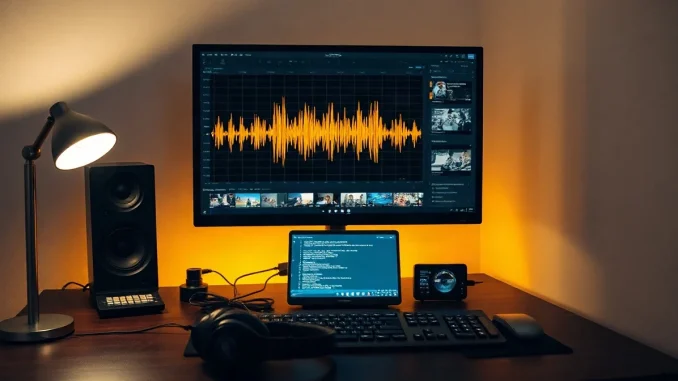
Video and audio have long been awkward material for business systems that were built around spreadsheets, databases, forms and text documents, according to Artificialintelligence-news. A two-hour webinar may hold plenty of useful detail, but locating one specific remark inside it was previously impractical.
The outlet reports that AI systems are now converting recordings into searchable outputs: speech to transcribe, faces and objects to recognise, scenes to classify, timestamps to organise and text to summarise. In practice, it says, a video library starts to behave more like a database that can be questioned, rather than a set of files sitting in storage.
Also read: Sam Altman Says OpenAI IPO Will Not Happen in 2026: 'Ill-Advised'
Key facts
- Artificialintelligence-news describes a pipeline rather than a single tool: a recording passes through several stages that identify key material and return it in a structured form.
- The report states that OpenAI’s current audio transcription API accepts MP3, MP4, M4A, WAV, FLAC and WebM files.
- It adds that Google Cloud recommends lossless audio such as FLAC or LINEAR16 for speech recognition, and notes that audio quality can affect results.
- The outlet’s example workflow converts an MP4 file into a WAV file, removing the video portion to leave a high-quality audio track for speech processing.
- It cites Tencent’s Hunyuan Video-Foley system, which it previously examined, as an example of generating synchronised audio from video content.
Preparing the right input
The report frames file conversion as an ordinary step in production, not a technicality. A marketing team holding an MP4 interview that only needs the spoken conversation, for instance, does not have to push the whole video through every AI tool. Converting the file into the format the next step requires — which the outlet says tools such as Convertio handle — produces what it describes as a cleaner and faster workflow.
That matters because different services support different input formats and configurations. The outlet advises teams to ask not only what a model can do with their content, but whether they are supplying the right input in the first place.
Also read: Jensen Huang Says Nvidia Could Grow Revenue 70% Next Year, Backed by Orders Growing 27% a Month
Where it is already running
The report lists several live applications: meetings turned into searchable notes and action items; education transcripts, summaries and study materials generated from lectures; customer service interactions analysed at scale; large media archives tagged automatically; long videos broken into transcripts, clips, captions and articles; and captions or alternative formats produced for accessibility.
It also gives a worked example of scale. A company sitting on 500 recorded customer interviews could, through a well-designed pipeline, produce transcripts, identify common complaints, group similar themes and surface the moments where customers discuss a particular feature, instead of asking staff to watch the recordings again.
Why it matters
The shift changes what an archive is for. Organisations that already hold years of meetings, support calls and footage can extract value from material they had written off as unsearchable, and staff who previously spent hours reviewing recordings can be directed at the findings instead. It also puts pressure on how recordings are made: a team that captures clean audio and well-lit video gets more reliable output from the same models than one that does not.
What to watch
The report’s own caveat is that heavier investment in smarter models will not fix a poor source file. Overlapping speakers, background noise, blurry footage and weak lighting all degrade results, so the practical benchmark to watch is whether pipelines built around these models keep improving as recording quality, rather than model capability, becomes the limiting factor.

Reported by artificialintelligence-news.com.



Be the first to comment