
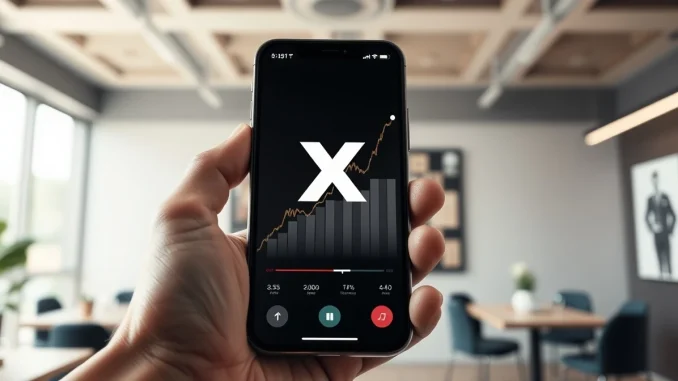
Social media platform X has processed an estimated $1 billion in trading volume through its new Cashtags feature within just two days of launch. The data, announced on April 17, 2026, signals a powerful initial response to Elon Musk’s push to transform X into a comprehensive financial hub.
X Cashtags Drive Immediate User Engagement
According to a post by X’s head of product, Nikita Bier, the platform drove the volume “globally since launching on Tuesday night.” The feature, which went live on April 15, 2026, allows users to view real-time stock and cryptocurrency data directly within the X app. Tapping on a ticker symbol, like $TSLA or $BTC, displays live price charts and aggregates related posts. This immediate access appears to have translated directly into trading action. The $1 billion figure is based on aggregated data from what X calls its “trading pilot.” Industry watchers note that this early metric, while impressive, represents only the volume facilitated through X’s interface. It does not necessarily equate to net new investments across the market.
Also read: Bitcoin at Risk of Sub-$65K Drop as Geopolitical Tensions and Liquidations Pressure Market
The Mechanics and Current Limitations
The rollout has specific geographic and technical boundaries. As of April 18, 2026, Cashtags are only available to users in the United States and Canada who access X via iPhone. The feature’s integration with actual brokerage services is also limited. Canadian online brokerage Wealthsimple has partnered with X, enabling its users to click a Cashtag and be taken directly to its platform to execute a trade. However, a similar integration with a major U.S. brokerage has not yet been announced. This gap means many U.S. users can view data but cannot act on it seamlessly within the X ecosystem. Analysts suggest this is the next critical hurdle for X to overcome to sustain the initial momentum.
Wealthsimple’s Strategic Move
Wealthsimple’s early partnership is a strategic play for market visibility. By being the first brokerage directly linked to Cashtags, it gains exclusive access to a stream of engaged, financially-interested users from one of the world’s largest social platforms. Data from SimilarWeb estimates X sees over 550 million monthly active users globally. For a brokerage, even capturing a tiny fraction of that attention can be significant. This move positions Wealthsimple against larger U.S. rivals in a novel way, tapping into social media integration as a user acquisition channel.
Also read: SEC makes digital assets a strategic priority through 2030, promising clearer rules
Context: Musk’s “Everything App” Vision
Cashtags are not an isolated product. They are a foundational component of Elon Musk’s stated ambition to evolve X into an “everything app.” The long-term vision includes peer-to-peer payments, e-commerce, and comprehensive financial services. Another project, dubbed X Money, is already in external beta testing. Musk’s company has secured money transmitter licenses in more than 40 U.S. states and registered with the Financial Crimes Enforcement Network (FinCEN). These are essential regulatory steps for handling payments. A public beta test in early March 2026 demonstrated a payment between Musk and actor William Shatner. The planned features for X Money reportedly include yield-bearing accounts and a cashback debit card. The role of cryptocurrencies within X Money, however, remains publicly undefined. This ambiguity leaves a key question unanswered for the crypto community.
Market Implications and Competitive Pressure
The rapid adoption of Cashtags applies pressure on established financial data providers. Companies like Bloomberg and Refinitiv dominate professional terminals, while Yahoo Finance and Google Finance serve retail investors. X’s entry is different. It embeds financial data directly into the social conversation. The implication is a blending of news, opinion, and market action into a single, continuous feed. For investors, this could mean faster reaction times but also greater exposure to sentiment-driven volatility. What this means for investors is a new, highly social layer atop market data. The integration could make markets feel more reactive to trends unfolding on the platform itself.
Analyzing the $1 Billion Volume Figure
While $1 billion in two days is a strong start, context is vital. Global daily equity trading volume routinely exceeds $400 billion. Major cryptocurrency exchanges can see tens of billions in daily volume. Therefore, X’s initial foray, while notable, is a small fraction of total market activity. The true test will be whether it can grow consistently and move beyond early adopters. The feature’s success likely hinges on three factors: expanding broker partnerships, launching on Android devices, and rolling out to more countries. If X can check these boxes, the volume could scale substantially. This suggests the initial data is a proof of concept rather than a market-disrupting event—at least for now.
Regulatory and Security Considerations
Merging social media with trading invites scrutiny. Regulatory bodies like the U.S. Securities and Exchange Commission (SEC) and the Financial Industry Regulatory Authority (FINRA) monitor how financial information is disseminated and how trades are executed. X’s model—aggregating data and routing users to partner brokerages—likely places compliance burdens on those brokerage partners. Furthermore, the social nature of the platform raises concerns about market manipulation. Pump-and-dump schemes and coordinated misinformation could theoretically spread more easily if trading is just a tap away. X has reportedly considered new rules for first-time crypto posters to combat scams. How it manages this ecosystem will be closely watched by regulators and users alike.
Conclusion
X’s Cashtags feature has demonstrated clear user demand, generating an estimated $1 billion in trading volume in its first 48 hours. This early result validates part of Elon Musk’s strategy to add financial utility to the social media platform. However, its long-term impact depends on broader broker integration, global expansion, and managing a complex regulatory environment. The move blurs the line between social networking and financial activity, setting the stage for increased competition in how market data and trading access are delivered to the public.
FAQs
Q1: What are X Cashtags?
X Cashtags are a feature that lets users view real-time stock and cryptocurrency price charts directly within the X app. Users can tap on a ticker symbol (like $AAPL) in a post to see a live chart and related discussions.
Q2: Can I trade directly through X using Cashtags?
Not directly through X itself. As of April 18, 2026, the feature can link you to a partnered brokerage. In Canada, it links to Wealthsimple. In the U.S., a brokerage partnership has not yet been announced, so the feature is primarily for viewing data.
Q3: Who currently has access to the Cashtags feature?
Access is currently limited to users with X accounts in the United States and Canada who are using the X app on an iPhone. Android users and users in other countries cannot yet use the feature.
Q4: How does this relate to Elon Musk’s plans for X?
Cashtags are a key step in Musk’s vision to turn X into an “everything app” that includes social media, payments, and commerce. It is a precursor to more advanced financial services like the planned X Money payment system.
Q5: What does the $1 billion trading volume figure represent?
The $1 billion is an estimate from X of the total trading volume that was initiated through its Cashtags interface over two days. It represents trades executed on connected brokerage platforms after users clicked through from X, not money held or processed by X itself.





Be the first to comment