
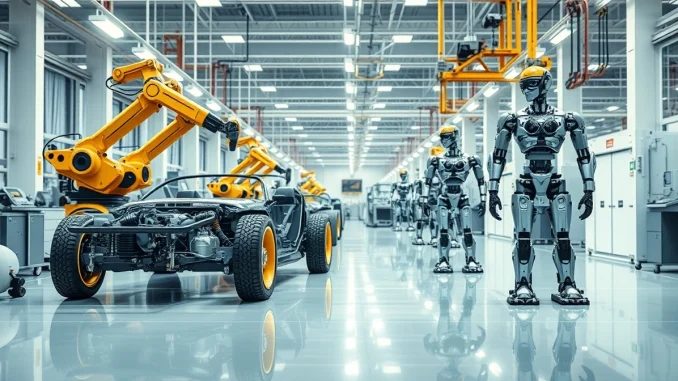
Tesla has set a new financial course, one that demands massive upfront investment. The company announced on April 22, 2026, that its capital expenditures will reach $25 billion next year. This figure triples its typical annual spend and signals a profound strategic shift. According to its first-quarter earnings report, the money will fund a transition from a pure-play electric vehicle maker to what CEO Elon Musk calls an “AI and robotics company.” The plan drew immediate market scrutiny, with shares erasing gains after the announcement.
Tesla’s Capex Plan: A $25 Billion Bet
The $25 billion target for 2026 represents a steep climb. For comparison, Tesla’s annual capital expenditures were $8.5 billion in 2025, $11.3 billion in 2024, and $8.9 billion in 2023. The company had already signaled a major increase in January, projecting expenditures “in excess of $20 billion.” The latest $5 billion uptick suggests its ambitions are growing faster than expected. “With 2026 we’re going to be substantially increasing our investments in the future,” Musk said on the earnings call. He argued the spending is “well justified for a substantially increased future revenue stream.”
Also read: Notion restores Anthropic AI access after brief service disruption
But the scale is staggering. Tesla’s quarterly capital expenditure was $2.5 billion, in line with recent quarters. To hit the $25 billion annual target, spending must accelerate sharply. Chief Financial Officer Vaibhav Taneja confirmed the company will enter “negative free cash flow territory” later this year as this investment cycle begins. This comes despite a strong cash position of $44.7 billion at the end of the first quarter.
Where the Money is Going
Musk and Taneja outlined several key areas for the capital infusion. The spending is not for incremental upgrades but for foundational projects meant to redefine Tesla.
Also read: White House AI Advisor Sriram Krishnan to Depart at End of June
- AI and Compute Infrastructure: A significant portion is earmarked for artificial intelligence. This includes investments in data centers, AI training clusters, and proprietary chip design. Musk has repeatedly stated that Tesla’s value is increasingly tied to its AI software, particularly for full self-driving and robotics.
- Optimus Robot Manufacturing: The company is building a dedicated manufacturing facility for its Optimus humanoid robot outside its Austin, Texas gigafactory. Furthermore, the Fremont, California factory will be retooled. Production of the Model S and Model X will end there to make room for scaling Optimus production. Musk said Tesla plans to increase internal production for testing and make Optimus “useful outside of Tesla sometime next year.”
- Semiconductor Research Fab: Tesla is investing in a new semiconductor research and production facility in Austin. This move aims to secure its supply of specialized AI chips and reduce reliance on external suppliers like Nvidia.
- Supply Chain Strengthening: Musk noted investments will go toward strengthening the supply chain “across the board,” specifically mentioning batteries, energy products, and AI silicon.
The Competitive Context
Tesla is not alone in this spending race. Musk was quick to contextualize Tesla’s plans against other tech giants. Amazon has projected $200 billion in capital expenditures for 2026, targeting AI, chips, robotics, and satellite networks. Google parent Alphabet plans to spend between $175 billion and $185 billion, up from $91.4 billion the previous year. This suggests a sector-wide arms race for AI and infrastructure supremacy. For Tesla, the spending is a defensive and offensive maneuver. Chinese EV makers like BYD are applying intense price pressure in the core auto business. Simultaneously, companies like Google’s Waymo and General Motors’ Cruise are advancing in autonomous technology. Tesla’s massive capex is a bid to outpace all of them in the next technological wave.
Financial Implications and Market Reaction
The announcement created volatility. Tesla’s stock initially rose 4% after the company reported an unexpected $1.4 billion in free cash flow for the quarter. Those gains vanished in after-hours trading as executives detailed the coming spending surge. The reaction highlights a classic investor tension: the promise of future growth versus the pain of present costs. “While this may seem like a lot, and we will have the impact of negative free cash flow for the rest of the year, we believe this is the right strategy to position the company for the next era,” CFO Vaibhav Taneja told investors.
Industry watchers note that Tesla’s profit margins from vehicle sales have been compressing. The company has engaged in repeated price cuts to maintain volume. This makes finding new, high-margin revenue streams from software and robotics an economic imperative. The $25 billion gamble is that these bets will pay off before automotive pressures intensify further.
A Strategic Pivot in Progress
This capex plan is the financial engine for a transformation Musk has teased for years. The vision is a company where revenue comes not just from cars, but from software subscriptions, autonomous ride-hailing networks, and humanoid robots sold to other industries. The capital expenditure is the down payment on that vision. However, the timeline is aggressive. Scaling the Optimus robot and achieving full autonomy are problems that have eluded the entire tech industry. The implication is clear: Tesla is burning cash to buy time and capability. If successful, it could create immense new markets. If not, the company risks a significant financial overhang without the promised returns.
What this means for investors is a period of uncertainty. The next 18 to 24 months will be focused on spending, not harvesting profits. The company’s performance will be judged less on quarterly vehicle deliveries and more on technical milestones: demonstrations of advanced Optimus capabilities, progress in AI training, and the ramp of new manufacturing lines. Data from its earnings report shows the company has the cash reserves to fund this push, but patience will be required.
Conclusion
Tesla’s planned $25 billion in capital expenditures for 2026 is a defining moment. It marks the company’s full-throttle pivot into artificial intelligence and robotics, far beyond its electric vehicle roots. The spending will test Tesla’s execution skills and financial stamina as it builds new factories, designs its own chips, and attempts to launch a commercial humanoid robot. While aligned with a broader tech investment trend, the scale relative to Tesla’s history is remarkable for the company. The success of this massive capex plan will determine whether Tesla evolves into the AI powerhouse Musk envisions or strains under the weight of its own ambition.
FAQs
Q1: What are Tesla’s capital expenditures?
Tesla’s capital expenditures, or capex, are funds used to acquire, upgrade, and maintain physical assets like property, factories, and equipment. It is distinct from operational expenses for day-to-day running costs.
Q2: How does Tesla’s $25 billion capex plan for 2026 compare to previous years?
The $25 billion target is approximately three times higher than recent annual spends. Tesla’s capex was $8.5 billion in 2025, $11.3 billion in 2024, and $8.9 billion in 2023.
Q3: Why is Tesla spending so much money?
According to CEO Elon Musk, the investment is to transition Tesla into an “AI and robotics company.” Key funded areas include AI training infrastructure, manufacturing scale for the Optimus robot, a semiconductor research lab, and strengthening the company’s supply chain.
Q4: How will this spending affect Tesla’s financials?
Chief Financial Officer Vaibhav Taneja stated that Tesla will experience negative free cash flow for the rest of 2026 as the investment cycle ramps up, despite the company holding over $44 billion in cash and equivalents.
Q5: Are other tech companies making similar investments?
Yes. Amazon has projected $200 billion in 2026 capex for AI and robotics. Google’s parent company, Alphabet, plans to spend between $175 billion and $185 billion. Tesla’s spending is part of a sector-wide surge in investment for next-generation technology.




Be the first to comment