
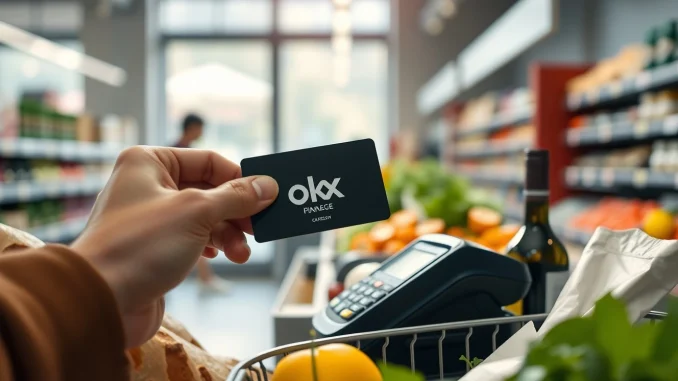
New data from OKX reveals that crypto card users in Europe are spending primarily on everyday essentials like groceries and dining, challenging the stereotype that digital assets are mainly used for luxury purchases. The findings, based on transaction data from the first month of the OKX Card’s rollout across the European Economic Area (EEA), suggest a growing shift toward stablecoin-funded payments for routine expenses.
Groceries and Restaurants Lead Crypto Card Spending
According to data shared by OKX on May 6, 2026, grocery stores and supermarkets accounted for 26% of all OKX Card transactions in the EEA between January 28 and February 26. Restaurants and fast food outlets together made up 18% of spending, placing them ahead of travel and online marketplaces. The analysis covered settled purchase transactions across the top 20 merchant types by transaction count, volume, or unique users.
A spokesperson for OKX told Cointelegraph that the dataset spans all EEA markets where the card is active, capturing the majority of daily spending behaviors and high-value outliers, including utilities, while excluding peer-to-peer transfers.
Country-Level Spending Patterns Reveal Cultural Habits
The data also highlights distinct national spending habits. In France, bakeries represented 5% of OKX Card transactions, compared with 2% across the EEA, reflecting the country’s strong boulangerie and café culture. In Germany, 30% of transactions occurred on online marketplaces, more than double the EEA average of 13%. The Netherlands recorded the highest grocery share in the dataset, with 37% of transactions in supermarkets.
Also read: Spain’s CNMV Chair Rules Out MiCA Deadline Extension for Crypto Firms, Impacting Binance
Poland stood out for small-ticket, in-person usage: 16% of OKX Card payments were at convenience stores and about 9% at fuel stations, both above the EEA averages.
Stablecoins Moving Into Everyday Routines
The OKX spokesperson argued that the data challenges the stereotype of crypto cards being used mainly for luxury items, pointing instead to groceries and coffees bought by everyday people. The company said that while country-level differences largely reflect existing cultural habits, the numbers suggest stablecoin-funded card payments are beginning to displace traditional cards in customers’ day-to-day routines.
Broader market data supports this trend. A 2025 Cex.io report found that roughly 45% of crypto card transactions in Europe were for amounts under 10 euros ($11.75), and about 40% of such card spend happened online, nearly double the euro-area average of 21% for online card payments. Separate Brighty data reported by Cointelegraph in April showed that Spain accounted for about 36% of retail transactions and 25% of total volume in Circle’s euro stablecoin EURC between 2025 and the first quarter of 2026, with an average payment size of around 49 euros ($58).
Conclusion
The OKX Card data provides concrete evidence that crypto is increasingly being used for everyday purchases in Europe, rather than as a speculative or luxury asset. This shift, supported by data from other providers, signals a maturing market where stablecoins are becoming a practical alternative for routine transactions. For consumers, it means that crypto-based payments are becoming more integrated into daily life, with potential implications for how traditional financial services compete in the region.
FAQs
Q1: What is the OKX Card?
The OKX Card is a crypto-funded payment card that allows users to spend cryptocurrencies and stablecoins at merchants that accept standard card payments. It is available in the European Economic Area.
Q2: What does the data say about crypto spending habits in Europe?
The data shows that most OKX Card transactions are for everyday items like groceries (26%) and dining (18%), rather than luxury goods, indicating that crypto is being used for routine purchases.
Q3: How does this compare to other crypto card providers?
Similar patterns have been reported by other providers. A 2025 Cex.io report found that 45% of crypto card transactions in Europe were under 10 euros, and Brighty data showed stablecoin usage in Spain for everyday purchases.





Be the first to comment