
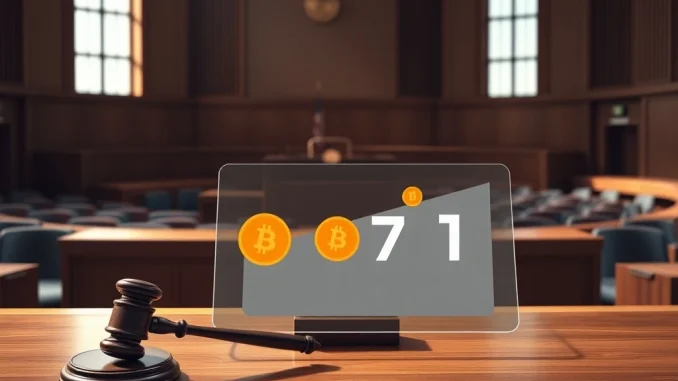
A federal judge in New York has issued an emergency order freezing 71 Bitcoin, worth approximately $5 million, belonging to institutional crypto firm BlockFills. The dramatic ruling on March 3, 2026, came in response to a lawsuit filed by investment firm Dominion Capital, which accuses BlockFills of misappropriating customer funds. This legal action follows BlockFills’ decision to halt all customer withdrawals three weeks prior, sending shockwaves through its base of roughly 2,000 institutional clients. The case represents one of the most significant alleged breaches of customer fund segregation in crypto lending since the 2022 market collapse.
Federal Judge Issues Restraining Order on BlockFills Bitcoin
Judge Mary Kay Vyskocil of the U.S. District Court for the Southern District of New York granted a temporary restraining order (TRO) against BlockFills without prior notice to the defendant. The court filing, reviewed by our newsroom, states Dominion Capital clearly demonstrated the risk of “immediate and irreparable injury” if the assets were moved. Consequently, Judge Vyskocil froze exactly 70.6 Bitcoin currently held by BlockFills and simultaneously ordered the company to provide a full accounting of all segregated customer funds. BlockFills now has until March 17, 2026, to formally respond to the court’s demands. Legal experts note the speed of this ruling indicates the plaintiff presented compelling initial evidence.
Also read: Travala launches AI agent hotel booking with USDC on Base, keeps human approval
The complaint, originally filed on February 27, alleges BlockFills engaged in unlawful retention of millions in customer cryptocurrency. More seriously, Dominion Capital accuses the firm of commingling client assets with corporate funds and using pooled customer money to cover trading losses. “This is a textbook allegation of misuse that regulators have warned about for years,” said Samantha Reed, a former SEC enforcement attorney now with the Fintech Compliance Group. “The court’s immediate freeze suggests these are not mere allegations of poor risk management, but of specific, identifiable asset misuse.” The frozen Bitcoin represents the specific assets Dominion claims it is owed.
Institutional Fallout From the BlockFills Withdrawal Halt
The judge’s order directly stems from BlockFills’ sudden decision on February 11 to suspend all customer deposits and withdrawals. The company cited the need to “protect clients and restore liquidity” following a sharp correction that saw Bitcoin’s price briefly fall to $60,000. However, this move impacted a roster of sophisticated clients, including asset managers, hedge funds, and family offices that had contributed to the platform’s reported $60 billion in trading volume during 2025. The minimum account threshold for certain BlockFills services, like its Options Products, is $10 million, underscoring the institutional scale of this disruption.
Also read: Russia sanctions British teenager for exposing stablecoin used to bypass sanctions
- Client Liquidity Locked: Approximately 2,000 institutional entities cannot access funds on the platform, creating potential cascading liquidity issues in their own portfolios and strategies.
- Reputational Damage to Crypto Lending: The case renews scrutiny on the crypto lending and prime brokerage sector, which has struggled to rebuild trust since the failures of Celsius and Voyager.
- Regulatory Scrutiny Intensifies: Enforcement agencies, including the SEC’s Crypto Assets and Cyber Unit, are likely monitoring this case closely as a potential enforcement action template.
Expert Analysis on Fund Segregation Failures
Dr. Lina Khan, a financial regulation professor at Columbia Law School not involved in the case, provided context on the legal standards at play. “The core allegation here is a failure to segregate customer assets, which is a fundamental requirement in both traditional finance and, increasingly, in digital asset markets,” Khan explained. “When a firm commingles funds, it becomes impossible to determine whose assets are whose in the event of insolvency or misconduct. The judge’s demand for an accounting is the first critical step in untangling that web.” Khan pointed to the Commodity Futures Trading Commission’s (CFTC) existing rules for Futures Commission Merchants as a relevant benchmark, even as specific federal crypto custody rules remain under development.
BlockFills and Dominion Capital: A Profile of the Key Entities
This lawsuit pits two established but distinct financial entities against each other. Chicago-based BlockFills operates as an institutional-focused digital asset trading and lending platform. It services professional traders and funds with high-volume products, positioning itself as a critical piece of market infrastructure. In contrast, New York-based Dominion Capital, founded in 2011, is a traditional investment firm with focuses in private equity, structured finance, and real estate. Its involvement signals how mainstream institutional capital has flowed into crypto strategies, and how those players will use traditional legal avenues to seek redress.
| Entity | Primary Business | Founded | Key Allegation/Role in Case |
|---|---|---|---|
| BlockFills | Crypto Trading & Lending (Institutional) | 2018 | Defendant; Accused of misappropriating and commingling customer funds. |
| Dominion Capital | Investment Firm (Private Equity, Real Estate) | 2011 | Plaintiff; Seeking return of specific 70.6 BTC allegedly misused. |
| U.S. District Court (SDNY) | Federal Judiciary | N/A | Jurisdiction; Judge Vyskocil issued the Temporary Restraining Order. |
What Happens Next in the BlockFills Legal Battle
The immediate timeline is defined by the court’s deadline. BlockFills must file its formal response by March 17, 2026. This document will reveal the company’s legal defense and its version of events regarding customer fund handling. Subsequently, the court will likely schedule a hearing to determine whether to convert the temporary restraining order into a longer-term preliminary injunction, which could keep the Bitcoin frozen for the duration of the litigation. Parallel to this civil case, industry analysts are watching for any signs of a criminal referral or regulatory action from agencies like the CFTC, which has jurisdiction over commodity spot markets including Bitcoin.
Market and Community Reactions to the Freeze
Reaction within the institutional crypto community has been one of heightened caution. “This is a sobering reminder that counterparty risk never disappears, regardless of how professional a platform appears,” commented Michael Tan, a portfolio manager at a crypto-native hedge fund not affiliated with BlockFills. On social media and professional forums, discussions have centered on the due diligence processes for selecting prime brokers and the robustness of proof-of-reserves audits. The case has also sparked renewed calls from industry advocates for clearer federal custody rules to provide a standardized safety framework and prevent similar incidents.
Conclusion
The federal judge’s decision to freeze 71 Bitcoin in the BlockFills case marks a critical escalation in the legal fallout from the firm’s withdrawal halt. It transforms a business decision into a formal judicial process with allegations of serious customer fund misuse at its core. The coming weeks, culminating in BlockFills’ March 17 court response, will determine whether this remains a contractual dispute or evolves into a landmark case on digital asset custody standards. For the broader industry, this lawsuit underscores the persistent vulnerabilities in crypto lending models and the increasing willingness of institutional players to use federal courts to protect their assets. The outcome will be closely watched as a bellwether for legal accountability in the maturing digital asset ecosystem.
Frequently Asked Questions
Q1: Why did the judge freeze Bitcoin in the BlockFills case?
The judge issued a temporary restraining order freezing 70.6 Bitcoin after Dominion Capital alleged BlockFills misappropriated customer funds and commingled assets. The plaintiff argued an immediate freeze was necessary to prevent irreparable harm before BlockFills could be formally heard.
Q2: How much are the frozen Bitcoin worth?
At the time of the court order, the 70.6 Bitcoin were valued at approximately $5 million. The exact value fluctuates with the market price of Bitcoin.
Q3: What is the next key date in this lawsuit?
BlockFills must file its formal response to the court and the lawsuit by March 17, 2026. This document will outline the company’s legal defense and its account of the customer fund allegations.
Q4: Can BlockFills clients access their funds now?
No. Customer withdrawals have been halted since February 11, 2026. The judge’s freeze order applies to specific Bitcoin, but the broader withdrawal suspension remains in effect as BlockFills works on its “liquidity restoration” plan.
Q5: How does this case relate to past crypto lending failures?
It echoes the customer fund misuse allegations seen in the collapses of Celsius and Voyager in 2022. However, this case involves institutional, not retail, clients and is playing out proactively in court rather than in bankruptcy proceedings.
Q6: What does this mean for other crypto lending platforms?
The lawsuit increases regulatory and legal scrutiny on all crypto lending and prime brokerage services. It will likely pressure platforms to enhance transparency, provide more frequent proof-of-reserves, and rigorously segregate customer assets to maintain institutional trust.





Be the first to comment