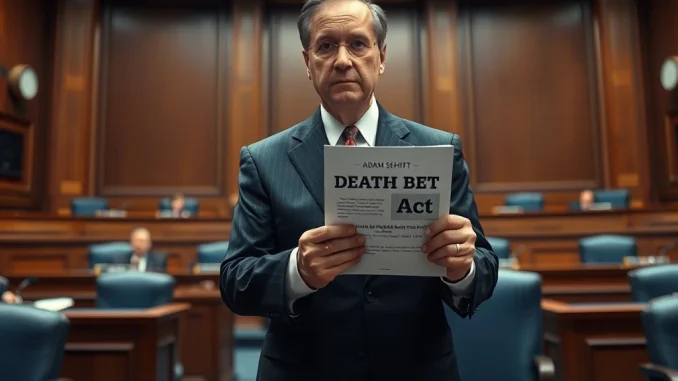
WASHINGTON, D.C. — On Tuesday, April 15, 2026, U.S. Senator Adam Schiff (D-CA) introduced groundbreaking legislation explicitly targeting prediction markets that allow betting on violent events. The proposed DEATH BETS Act seeks to amend the Commodity Exchange Act, prohibiting federally regulated platforms from listing contracts tied to war, terrorism, assassination, or an individual’s death. This legislative move responds directly to escalating national security concerns and multiple high-profile allegations of insider trading linked to military operations. Senator Schiff argues these markets create perverse incentives and threaten the integrity of classified information, marking a significant regulatory pivot for the Commodity Futures Trading Commission (CFTC) and the burgeoning event contract industry.
The DEATH BETS Act: A Direct Response to National Security Threats
Senator Schiff, a member of the Senate Committee on Agriculture, Nutrition, and Forestry where the bill was referred, framed the legislation as a necessary safeguard. “Markets that let traders profit from violent events create incentives for the misuse of classified information,” Schiff stated in his official announcement. He characterized the current landscape of event-contract platforms as a “Wild West” and called for Congress and the CFTC to establish clear prohibitions. The bill’s language is intentionally broad, banning contracts that involve references to “terrorism, assassination, war, or any similar activity,” or that are related to an “individual’s death.” This scope aims to close loopholes that might allow semantically similar contracts to proliferate. Consequently, the legislation places the onus on the CFTC to enforce these new boundaries, potentially requiring significant oversight expansion for the agency.
The timing of the bill is not coincidental. It follows a period of intense scrutiny that began in early 2024. During the recent U.S. and Israeli military confrontation with Iran, war-related prediction markets on platforms like Polymarket saw surging trading volumes. Blockchain analytics firm Lookonchain identified six specific wallets that collectively netted approximately $1 million by accurately predicting the timing of a U.S. strike. Alarmingly, several of these bets were placed mere hours before the first reported explosions in Tehran. This pattern, repeated in other geopolitical events, has convinced lawmakers that the theoretical risk of insider trading has materialized into a demonstrable threat.
Insider Trading Incidents Fuel Legislative Momentum
A series of specific incidents provided the concrete evidence driving the DEATH BETS Act forward. These cases demonstrate a clear pattern of suspicious activity aligning too closely with non-public operational details. For instance, in February 2026, Israeli authorities arrested and indicted two individuals suspected of using secret information about planned Israeli strikes on Iran for insider trading on Polymarket. Similarly, in January 2026, a separate Polymarket account profited $400,000 after placing a bet on a contract predicting the capture of Venezuelan President Nicolás Maduro, wagering funds just hours before U.S. forces executed the operation. These are not isolated allegations but part of a concerning trend.
- Iran Strike Profits: Six wallets created in February 2026 placed coordinated bets on the timing of a U.S. attack, netting $1 million.
- Israeli Insider Case: Two arrests in Israel directly linked secret military information to prediction market bets.
- Maduro Capture Bet: A $400,000 profit from a bet placed hours before a covert U.S. operation.
- Ongoing Suspicious Activity: As recently as Tuesday, a new wallet spent $32,900 betting on U.S. forces entering Iran by Saturday, despite declining odds.
Expert Analysis on Market Integrity and Security
Dr. Evelyn Reed, a former CFTC enforcement attorney and current director of the Georgetown Center for Financial Market Policy, provided context on the regulatory challenge. “The core issue isn’t prediction markets themselves,” Reed explained in an interview. “It’s the specific subset of contracts tied to events where non-public, life-or-death information exists. These create a unique and intolerable national security vulnerability.” Reed noted that while the CFTC has historically taken a principles-based approach to new derivatives, the DEATH BETS Act represents a shift toward explicit, activity-based prohibitions. Meanwhile, a statement from the Defense Department’s Office of General Counsel, reviewed for this article, expressed “serious concerns” about the potential for prediction markets to be used by adversaries to gather intelligence or even fund operations, lending official weight to Schiff’s national security argument.
Broader Context: The Struggle to Regulate Event Contracts
The DEATH BETS Act enters a complex and evolving regulatory arena. Prediction markets, or event contracts, have existed in various forms for decades, but blockchain-based platforms like Polymarket and Kalshi have dramatically increased their accessibility and scale. The CFTC, which oversees these markets as derivatives, has grappled with how to apply existing commodity trading rules to contracts on geopolitical events, election outcomes, and now, acts of violence. This legislative push mirrors actions at the state level; in 2025, Nevada courts upheld orders halting trading by Kalshi and Polymarket within the state, citing conflicts with gaming laws. The table below outlines key regulatory actions and market responses leading up to the DEATH BETS Act.
| Date | Event | Regulatory/Judicial Body |
|---|---|---|
| Jan 2025 | Nevada court upholds trading halt for Kalshi/Polymarket | Nevada District Court |
| Feb 2026 | Israeli authorities arrest suspects for insider trading on Polymarket | Israeli Security Agency |
| Apr 2026 | DEATH BETS Act introduced in U.S. Senate | Sen. Adam Schiff (D-CA) |
| Ongoing | CFTC review of event contract rulemaking | Commodity Futures Trading Commission |
What Happens Next: Legislative Process and Industry Impact
The bill’s immediate future lies with the Senate Committee on Agriculture, Nutrition, and Forestry. As a member, Schiff can advocate for prompt hearings, but the committee’s schedule and the political climate will determine its pace. If it passes committee, it would move to the full Senate for a vote, then require a companion bill in the House of Representatives. Industry response has been cautious. A spokesperson for Polymarket stated the platform “takes compliance seriously and is reviewing the proposed legislation,” while emphasizing their existing policies against insider trading. Kalshi declined to comment directly on the bill but reiterated its commitment to operating within CFTC guidelines. The ultimate impact, if passed, would be a seismic shift for regulated platforms, forcing them to delist a specific, high-volume category of contracts and potentially redesign their business models.
Stakeholder Reactions and Public Debate
Reactions reveal a sharp divide. National security advocates and some intelligence community veterans have praised the bill as a long-overdue fix. “It’s about removing a tool that can be used to monetize treason,” said a retired Army intelligence officer who requested anonymity due to ongoing consulting work. Conversely, advocates for prediction markets argue the legislation is overly broad. “These markets provide valuable information aggregation and public sentiment data,” argued Professor David Kane of the University of Chicago’s Prediction Market Lab. “A blanket ban on entire categories throws the baby out with the bathwater. The focus should be on prosecuting actual insider trading, which is already illegal.” This debate will likely feature prominently in upcoming committee hearings.
Conclusion
The introduction of the DEATH BETS Act marks a critical inflection point in the relationship between financial innovation and national security. Senator Adam Schiff’s legislation directly confronts the alarming pattern of insider trading linked to prediction markets on war and violence. While the bill’s path through Congress is uncertain, its very existence signals that lawmakers are no longer willing to treat these markets as a purely financial novelty. The coming months will test whether a compromise can be found that protects sensitive information without stifling a new asset class. For regulators, platform operators, and traders, the era of the “Wild West” for death bets appears to be closing. The fundamental question now is what new rules will govern the frontier.
Frequently Asked Questions
Q1: What exactly would the DEATH BETS Act ban?
The DEATH BETS Act would amend the Commodity Exchange Act to prohibit CFTC-regulated prediction market platforms from offering contracts tied to terrorism, assassination, war, similar activities, or an individual’s death.
Q2: Why is Senator Schiff targeting these specific prediction markets?
Schiff and national security experts argue these markets create financial incentives for the misuse of classified military or intelligence information, posing a demonstrable insider trading and national security threat, as seen in recent incidents linked to Iran and Venezuela.
Q3: What is the next step for the DEATH BETS Act?
The bill has been referred to the Senate Committee on Agriculture, Nutrition, and Forestry, where it must pass through hearings and a committee vote before potentially advancing to the full Senate for consideration.
Q4: How do prediction markets currently work under CFTC regulation?
Platforms like Polymarket and Kalshi operate under CFTC oversight as markets for event contracts, a type of derivative. Traders buy and sell shares predicting the outcome of future events, with settlements based on verifiable real-world outcomes.
Q5: Have there been successful prosecutions for insider trading on these platforms?
While there have been arrests, such as the two individuals in Israel, public records show no major U.S. federal prosecutions specifically for prediction market insider trading to date, partly due to jurisdictional and evidentiary complexities.
Q6: How would this bill affect a regular person interested in prediction markets?
For retail users, it would mean the removal of a specific category of contracts from regulated U.S. platforms. They could still trade contracts on other topics like elections, sports, or economic indicators, but not on events involving death, war, or terrorism.