
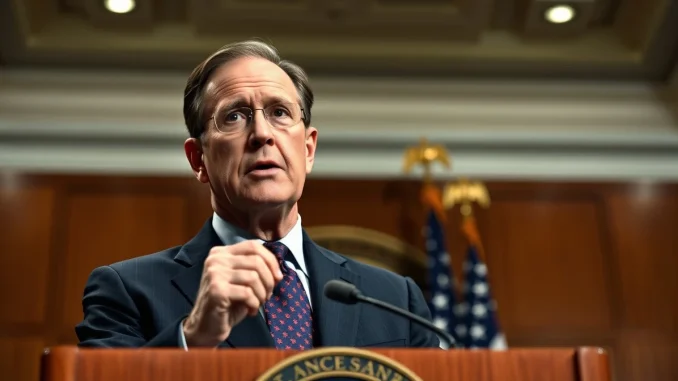
Former Treasury Secretary Henry Paulson has issued a stark warning about the stability of the US Treasury market. In an interview with Bloomberg on April 16, 2026, Paulson called for an immediate contingency plan to address a potential future collapse in demand for US government debt. “We need an emergency break-the-glass plan, which is targeted and short-term, on the shelf, so it’s ready to go when we hit the wall,” Paulson stated. His comments highlight growing concern over the foundation of the global financial system.
The Core of Paulson’s Warning
Paulson, who led the Treasury during the 2008 financial crisis, stressed the unpredictable but severe nature of the risk. “People say, when are you going to hit the wall? I obviously don’t know, it’s impossible to know,” he told Bloomberg. “When we hit it, it will be vicious, so we have to prepare for that eventuality.” His warning centers on a potential liquidity crisis where investor demand for US Treasurys dries up. The US Treasury market, valued at over $31 trillion, is the world’s deepest debt market. It acts as the primary benchmark for pricing nearly all other financial assets globally, from corporate bonds to mortgages.
Also read: Bitcoin at Risk of Sub-$65K Drop as Geopolitical Tensions and Liquidations Pressure Market
Instability here would send shockwaves through the entire economy. For years, analysts have pointed to the risk of a “doom loop.” In this scenario, investors demand higher yields to compensate for the risks posed by the US government’s massive debt, which exceeds $39 trillion. Higher yields mean the government’s interest payments swell. This widens the budget deficit, potentially requiring more borrowing and further spooking investors. It’s a dangerous feedback loop.
The Mechanics of a Potential Crisis
Data from the Treasury Department shows interest payments on the national debt have become a major budget item. The yield on the 10-year Treasury note, a key benchmark, has been volatile. If a crisis of confidence erupts, yields could spike dramatically. According to the Bloomberg report Paulson spoke with, many assume the Federal Reserve would become the principal buyer of last resort if the Treasury market faltered. This process, known as debt monetization, involves the central bank creating money to buy government bonds.
Also read: SEC makes digital assets a strategic priority through 2030, promising clearer rules
While this could provide short-term liquidity, it carries significant long-term risks. Monetizing debt can fuel inflation and undermine confidence in the US dollar’s value. The Treasury has taken steps to manage market functioning. On April 16, 2026, it conducted its largest single debt buyback operation in recent history, accepting $15 billion of older securities. These buybacks aim to improve liquidity in less-traded corners of the market. But analysts note this is a technical tool, not a solution to fundamental debt sustainability concerns.
Historical Context and Expert Perspective
Paulson’s authority on financial crises is well-established. He was a central figure in managing the 2008 meltdown. His warning carries weight because it comes from someone with direct experience in firefighting systemic collapses. Other market watchers echo his concern, though timelines vary. The sheer scale of US debt creates a vulnerability that did not exist to the same degree in previous decades. What this means for investors is heightened sensitivity to fiscal policy and auction demand data.
Implications for Cryptocurrency and Digital Assets
A US Treasury market crisis would have complex and contradictory effects on crypto markets. Industry watchers note that such an event could trigger a flight to assets perceived as outside the traditional system.
- Potential Safe-Haven Demand: Bitcoin, often called “digital gold,” could see increased demand if faith in sovereign debt erodes. A Fed debt monetization response might stoke inflation fears, potentially boosting the appeal of hard-capped assets like Bitcoin.
- Short-Term Liquidity Crunch: Conversely, a severe crisis would likely cause a broad sell-off in risky assets. Andri Fauzan Adziima, Research Lead at Bitrue, told Cointelegraph this remains a “watch-list macro tail risk.” He warned of short-term pain via “spiking yields, tighter global liquidity, and risk-off selling that hits BTC and altcoins hard.”
- Stablecoin Vulnerability: The crypto sector’s deep ties to Treasurys create a direct risk. Tether, the largest stablecoin issuer, holds over $120 billion in US Treasury bills. According to its transparency report, 63% of its total reserves are in T-bills. A Treasury market crisis could pressure these reserves. “Tether alone holds over $120 billion in Treasurys, making it vulnerable to redemption runs or depegs if confidence erodes and it faces fire-sale pressure,” Adziima noted.
This suggests crypto is not a monolithic hedge. Stablecoins could face severe stress, while assets like Bitcoin might benefit in a longer-term, post-crisis field where trust in traditional finance is damaged.
Contingency Planning and Market Reality
Paulson’s call for a plan raises a critical question: what would an “emergency break-the-glass” plan look like? He suggested it must be targeted and short-term. In practice, this likely involves pre-authorized, rapid intervention by the Treasury and Fed to backstop liquidity. Options could include dramatic expansion of existing buyer programs or new facilities to absorb sudden sell-offs. The goal would be to prevent a disorderly collapse that freezes global capital flows.
The Treasury market has shown strains before, notably in September 2019 and March 2020, when the Fed had to intervene heavily. Those episodes proved the market is not invincible. The current environment, with high debt levels and the Fed reducing its own balance sheet, presents new challenges. The implication is that while a crisis is not certain, the system’s buffers may be thinner than many assume.
Conclusion
Henry Paulson’s warning about a potential US Treasury market crash is a sobering reminder of underlying financial vulnerabilities. His experience lends credence to the call for proactive contingency planning. The situation presents a double-edged sword for cryptocurrencies, offering potential as an alternative store of value while exposing embedded risks in stablecoin reserves. Ultimately, the stability of the Treasury market remains a cornerstone of global finance. Preparing for its potential failure is now a topic of urgent discussion among the very officials who would have to manage it.
FAQs
Q1: What exactly is Henry Paulson warning about?
Paulson is warning about a potential future crisis in the US Treasury bond market where investor demand collapses, causing a vicious cycle of spiking yields, higher government borrowing costs, and severe global financial instability.
Q2: Why is the US Treasury market so important?
The $31+ trillion Treasury market is the world’s largest debt market. It serves as the “risk-free” benchmark for pricing all other assets, from corporate loans to mortgages. Its stability is fundamental to the entire global financial system.
Q3: How could a Treasury market crash affect the average person?
It would likely lead to much higher interest rates for mortgages, car loans, and credit cards. It could trigger a deep recession, stock market declines, and potentially a crisis in the banking system, similar to but potentially broader than 2008.
Q4: What did Paulson mean by an “emergency break-the-glass” plan?
He advocates for a pre-prepared, short-term emergency action plan that authorities can execute immediately if the market crashes. The plan would aim to restore liquidity and confidence through targeted government intervention.
Q5: Is Bitcoin a safe haven if this happens?
The effect is uncertain. In the immediate crisis, all risky assets might sell off. However, if the crisis leads to a long-term loss of faith in the US dollar or government debt, Bitcoin could see increased demand as a non-sovereign asset, though its volatility would remain a factor.





Be the first to comment