
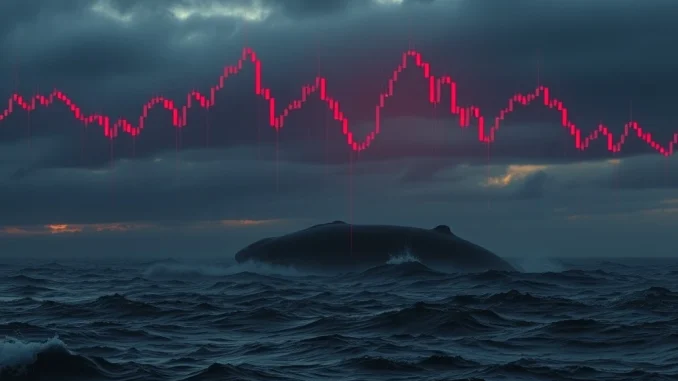
In a dramatic reversal of fortune, a prominent Hyperliquid whale address, previously shrouded in controversy, has witnessed an unrealized loss of approximately $50 million in just four days, according to on-chain analytics firm Onchain Lens. The staggering loss, reported on January 17, 2025, starkly illustrates the extreme volatility and high-risk nature of leveraged cryptocurrency trading, especially for large-scale investors.
Hyperliquid Whale’s $50 Million Loss Explained
The whale address, identified by the starting characters 0xb317, saw its position flip from a $40 million profit to a multi-million dollar deficit. This rapid decline directly resulted from a significant market downturn that began in mid-January. The whale’s portfolio contained several highly leveraged long positions, a strategy that amplifies both gains and losses. Specifically, the address held:
- 1,000 BTC with 5x tap into at an average entry price of $91,506.
- 223,340 ETH with 5x apply at an average price of $3,161.
- A 10x leveraged long position on SOL at an average price of $130.
Consequently, even a modest percentage drop in the underlying asset prices triggers magnified losses due to the tap into multiplier. This scenario provides a textbook case of the risks associated with margin trading in crypto markets.
Background on Insider Trading Allegations
This specific whale address is not new to scrutiny. Onchain analysts and community watchdogs previously flagged it for suspicious activity ahead of a major market event in October of the previous year. The address allegedly established substantial positions just before the largest-ever liquidation event on Hyperliquid, allowing it to potentially profit from the ensuing market chaos. While definitive proof of illegal insider trading requires regulatory investigation, the timing and scale of the earlier trades raised serious questions about market fairness and the potential for information asymmetry on decentralized platforms.
Also read: Spain’s CNMV Chair Rules Out MiCA Deadline Extension for Crypto Firms, Impacting Binance
The Role of On-Chain Transparency
This story is uniquely possible because of blockchain’s transparent nature. Firms like Onchain Lens specialize in tracking the flow of funds across public addresses, connecting pseudonymous activity to real-world events. This transparency acts as a double-edged sword. It allows the community to monitor potentially manipulative behavior, but it also publicly exposes the financial fortunes of large traders in real-time. The narrative around this whale shifted rapidly from a figure of suspicion to a cautionary tale, all based on verifiable, on-chain data.
Understanding Use and Liquidation Risks
The whale’s massive loss stems directly from the mechanics of leveraged trading. Using utilize is akin to borrowing capital to increase the size of a position. For example, with 5x employ, a 10% price move becomes a 50% gain or loss on the trader’s initial capital. If the market moves against the position, the exchange will issue a margin call and eventually liquidate (force-sell) the assets to cover the loan if additional funds are not added. The table below outlines the approximate price drops that would threaten the whale’s positions:
| Asset | Tap into | Rough Liquidation Threshold* |
|---|---|---|
| Bitcoin (BTC) | 5x | -18% from entry (~$75,000) |
| Ethereum (ETH) | 5x | -18% from entry (~$2,592) |
| Solana (SOL) | 10x | -9% from entry (~$118) |
*Thresholds are simplified estimates; actual liquidation prices depend on exchange fees and precise protocol parameters. The high tap into on SOL made it particularly vulnerable to a swift downturn.
Market Impact and Broader Implications
While a single entity’s loss is notable, the broader impact lies in market sentiment and regulatory attention. Firstly, large, forced liquidations can create cascading sell-pressure, exacerbating market downturns as automated systems close positions. Secondly, this event highlights the persistent concerns around risk management in decentralized finance (DeFi). Regulators globally are increasingly focused on leveraged crypto products, and high-profile losses provide fuel for arguments favoring stricter oversight to protect market integrity. Finally, for retail investors, this serves as a powerful reminder that even well-capitalized, sophisticated actors can suffer devastating losses, underscoring the paramount importance of risk management over speculative greed.
Conclusion
The Hyperliquid whale’s $50 million loss is a multifaceted event combining market dynamics, on-chain surveillance, and enduring questions about trading ethics. It demonstrates the severe perils of high-apply strategies in an inherently volatile asset class. Furthermore, it reinforces the critical role of transparent blockchain analysis in understanding market movements and holding large players accountable. This episode will likely resonate as a case study in both the risks of crypto use and the evolving narrative of market surveillance in the digital age.
FAQs
Q1: What is a “whale” in cryptocurrency?
A whale is a term for an individual or entity that holds a large enough amount of a cryptocurrency that their trading activity can potentially influence the market price.
Q2: What does “unrealized loss” mean?
An unrealized loss is a decrease in the value of an open investment position that has not yet been sold. The loss becomes “realized” only when the position is closed at the lower price.
Q3: How does tap into lead to such large losses?
Apply uses borrowed funds to amplify position size. While it can magnify profits, it also magnifies losses relative to the trader’s initial capital, leading to rapid depletion of funds if the market moves opposite to the bet.
Q4: What was the “insider trading” allegation about?
The whale address was suspected of placing trades based on non-public information ahead of a major liquidation event in October, potentially allowing it to profit from the predictable market volatility that followed.
Q5: Can regulators take action against a pseudonymous wallet?
It is challenging but not impossible. Regulators often work with exchanges to uncover the real-world identity behind deposit and withdrawal addresses. High-profile cases involving market manipulation are a growing focus for agencies like the SEC and CFTC.




Be the first to comment