
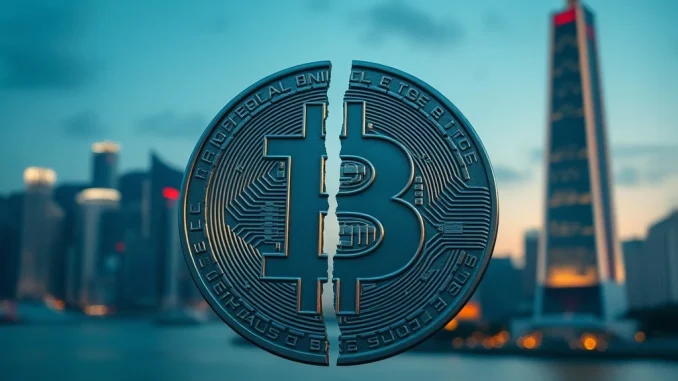
HONG KONG/SOUTH KOREA — February 9, 2026: A sudden, severe Bitcoin sell-off that rattled global markets this week has been linked by industry analysts to a potential multi-billion dollar options trade blowup at a Hong Kong-based fund. Concurrently, South Korea’s major exchange Bithumb faces a regulatory firestorm after mistakenly distributing 620,000 Bitcoin—worth approximately $42.5 billion—in a catastrophic administrative error, raising profound questions about custodial safeguards. These twin crises, unfolding across Asia’s major crypto hubs, highlight the fragility of leveraged institutional strategies and the operational risks still plaguing major trading platforms.
Hong Kong Fund’s Suspected Bitcoin ETF Unwind Triggers Market Plunge
The theory, first articulated by Parker White, Chief of Operations at DeFi Development Corp, went viral across Crypto Twitter. White’s analysis suggests a Hong Kong fund utilized cheap Japanese yen funding to execute leveraged options trades on BlackRock’s spot Bitcoin ETF (IBIT), betting heavily on a price rebound. When Bitcoin failed to recover and funding conditions tightened, the fund faced a cascading, cross-margin liquidation. “We know that Asian traders, particularly in China, have been deeply involved in the Silver and Gold trade,” White noted, connecting the Bitcoin move to a broader unwind of yen-funded apply across assets. BlackRock’s IBIT itself saw a record $10 billion in trading volume last Thursday as Bitcoin slid toward $60,000.
Also read: Defense Tech, AI, and Fundraising Take Center Stage at StrictlyVC Los Angeles on June 18
Franklin Bi, General Partner at Pantera Capital, shared a similar assessment, suggesting the activity flew under the radar because it was concentrated in single-asset ETF structures designed to isolate margin risk. This structure, while protecting a fund’s other investments, can amplify losses within the targeted vehicle. The hypothesis remains unconfirmed until Form 13F filings are released in May, which will reveal significant changes in institutional IBIT holdings. However, the concentrated selling pressure and its correlation with moves in silver—another asset popular with yen-carry traders—lends credence to the narrative.
Bithumb’s ‘Phantom’ Bitcoin: A $42.5 Billion Operational Nightmare
While markets reeled from the sell-off, a separate, staggering crisis emerged in Seoul. During a promotional campaign, South Korean crypto exchange Bithumb mistakenly distributed roughly 620,000 BTC to users—an amount worth nearly $42.5 billion at the time. The error, which saw some users receive over 2,000 BTC each, was a catastrophic “fat-finger” incident. Although Bithumb claims to have recovered 99.7% of the assets, 1,788 BTC were swiftly sold by users before the exchange could claw them back.
Also read: Lovable signs multi-year Google Cloud deal to expand AI usage fivefold
A deeper, more alarming issue then surfaced. Bithumb’s mid-year filing to South Korea’s Financial Supervisory Service (FSS) in August 2025 reported holdings of only 42,031 BTC. This figure is roughly 15 times smaller than the amount it distributed. The discrepancy suggests Bithumb may have distributed more Bitcoin on its platform than it actually held in reserve, creating what the local industry now calls “phantom” Bitcoin. Under South Korea’s strict crypto user protection law, exchanges are mandated to hold 1:1 reserves for customer deposits. FSS Governor Lee Chan-jin confirmed the regulator has launched on-site inspections and that regulatory action is possible.
- Scale of Error: 620,000 BTC distributed erroneously, versus 42,031 BTC reported held.
- Immediate Impact: 1,788 BTC sold by users before recovery.
- Regulatory Risk: Potential violation of the 1:1 reserve requirement under Korean law.
- Market Confidence: The incident shakes trust in major exchanges’ internal controls and proof-of-reserves.
Expert Analysis: Systemic Risks and Apply Dangers
Market analysts point to these events as symptomatic of a maturing yet still volatile ecosystem. “The Hong Kong situation shows how traditional finance utilize strategies, like the yen carry trade, are now directly transmitting risk into crypto markets via ETFs,” said a veteran macro trader who requested anonymity due to firm policy. “It’s contagion 2.0.” Regarding Bithumb, compliance experts highlight the operational risk. “A mistake of this magnitude isn’t just a bug; it points to potentially flawed internal processes for managing and verifying hot wallet balances,” said Mina Lee, a Seoul-based fintech lawyer. “The FSS will be looking for systemic failures, not just a one-time error.”
The Rise and Fall of an Ether Whale: Trend Research Unwinds
Adding to the week’s narrative of leveraged positions unraveling, the entity known as Trend Research—linked to Hong Kong-based Liquid Capital founder Yi Lihua (Jack Yi)—has completely exited its massive Ether position. As of last week, the whale held 578,000 ETH. By Sunday, February 8, its balance hit zero, according to Arkham Intelligence data. Yi built this position aggressively through apply: buying ETH, depositing it as collateral on Aave to borrow stablecoins, and recycling those funds to buy more ETH. The recent market downturn triggered margin calls, forcing a total unwind.
In a machine-translated post, Yi struck a philosophical note, stating, “On the flip side, when crypto enters a bear market, it is often the best time to build positions… Pessimists are often right, but optimists win in the end.” His actions, however, underscore the extreme vulnerability of highly leveraged strategies in a declining market, mirroring the pressures suspected in the Hong Kong Bitcoin ETF trade.
| Entity/Event | Key Action | Estimated Scale/Impact |
|---|---|---|
| Hong Kong Fund (Alleged) | Unwound leveraged IBIT options trade | Contributed to Bitcoin sell-off to ~$60,000; IBIT volume hit $10B |
| Bithumb Exchange | Erroneous distribution of customer BTC | 620,000 BTC ($42.5B) distributed; 1,788 BTC irrecoverably sold |
| Trend Research (Ether Whale) | Complete liquidation of leveraged ETH position | Sold 578,000 ETH; position now zero |
Japan’s Election Outcome Provides Regulatory Stability
Amid the regional turmoil, Japan offered a note of stability. Prime Minister Sanae Takaichi’s Liberal Democratic Party secured a super-majority in Sunday’s snap election, ensuring continuity in ongoing crypto policy discussions. Key debates include revising the punitive tax treatment of crypto gains—currently taxed as miscellaneous income up to 55%—and potentially reclassifying digital assets under the Financial Instruments and Exchange Act (FIEA).
A move to the FIEA would place crypto alongside securities, enabling a clearer path for products like spot Bitcoin ETFs in Japan. Finance Minister Satsuki Katayama has already signaled support for blockchain-based fintech initiatives. This political certainty contrasts with the operational and market shocks elsewhere, positioning Japan as a potential haven for more structured institutional crypto activity.
Market and Community Reactions: Anxiety and Scrutiny
The crypto community reacted with a mix of anxiety and dark humor. “First FTX’s phantom reserves, now Bithumb’s phantom BTC. When will exchanges learn?” tweeted a prominent Korean crypto influencer. On trading forums, discussions centered on whether the Hong Kong theory explained the unusual market structure during the sell-off, where liquidations on centralized exchanges were muted compared to the price drop. This anomaly supported the idea of stress emanating from the ETF market, not direct spot selling by retail or typical leveraged traders.
Conclusion
The events of February 2026 reveal critical pressure points in cryptocurrency’s integration with global finance. The suspected Hong Kong fund blowup demonstrates how Bitcoin ETFs, while bringing legitimacy, also import complex use and cross-asset risks from traditional markets. Bithumb’s catastrophic error exposes the persistent operational vulnerabilities at even the largest exchanges, prompting urgent regulatory scrutiny in South Korea. Meanwhile, the rapid unwinding of Trend Research’s massive Ether position serves as a textbook example of deleveraging in a downturn. For investors and regulators, the lessons are clear: the maturation of crypto markets is not eliminating risk but transforming it, demanding more sophisticated oversight and reliable operational controls. The coming months, particularly with May’s 13F filings and the FSS’s findings, will provide definitive answers and likely shape policy across Asia’s financial hubs.
Frequently Asked Questions
Q1: What is the main theory behind Bitcoin’s sell-off in February 2026?
The leading theory, proposed by analyst Parker White, suggests a Hong Kong-based fund used cheap Japanese yen funding to take leveraged options positions on BlackRock’s Bitcoin ETF (IBIT). As Bitcoin’s price fell and funding tightened, the fund was forced to liquidate, causing cascading selling pressure.
Q2: How much Bitcoin did Bithumb mistakenly distribute, and what’s the ‘phantom’ BTC issue?
Bithumb erroneously distributed roughly 620,000 BTC (worth ~$42.5B) during a promotion. The “phantom” issue arises because Bithumb’s latest financial report showed it held only 42,031 BTC, suggesting it may have distributed more Bitcoin than it actually had in reserve.
Q3: What are the potential consequences for Bithumb from South Korean regulators?
The Financial Supervisory Service (FSS) has launched on-site inspections. Bithumb could face penalties for potentially violating the law requiring exchanges to hold 1:1 reserves for customer deposits. The incident severely damages trust in the platform.
Q4: Who is Trend Research, and why did they sell all their Ether?
Trend Research is a crypto whale linked to Liquid Capital founder Jack Yi. It held a highly leveraged Ether position built using borrowed funds. As prices fell, it faced margin calls and was forced to sell its entire holding of 578,000 ETH to repay loans.
Q5: How did Japan’s election affect cryptocurrency regulation?
Prime Minister Sanae Takaichi’s super-majority victory reduces political uncertainty, allowing ongoing debates about lowering crypto taxes and potentially reclassifying crypto under securities law to proceed smoothly, which could enable Bitcoin ETFs in Japan.
Q6: When will we know for sure if a Hong Kong fund caused the Bitcoin ETF sell-off?
Confirmation likely awaits the release of Form 13F filings with the U.S. SEC in March 2026. These quarterly reports will show any major changes in institutional holdings of IBIT, potentially revealing the fund responsible.






Be the first to comment