WASHINGTON, D.C., May 16, 2026 — U.S. Democratic lawmakers are drafting urgent legislation to impose federal oversight on cryptocurrency-based prediction markets, responding to what they call “probable” insider trading involving bets on military strikes against Iran. The move follows the viral circulation of specific wagers on platforms like Polymarket that netted traders approximately $1 million just hours before explosions were reported in Tehran. Senator Chris Murphy (D-CT) publicly alleged that individuals with close ties to former President Donald Trump placed these bets using non-public information about impending U.S. military action. This regulatory push targets a market that saw over $529 million in trading volume on Iran-related contracts alone, raising profound questions about national security and financial integrity in decentralized spaces.
Core Allegations: “Very Specific Bets” Preceding Military Action
Senator Chris Murphy detailed the central concern in a video statement on social media platform X. He pointed to a cluster of bets placed on Friday, April 25, 2026, which accurately predicted U.S. military engagement with Iran the following Saturday. “Obviously, there are people close to Donald Trump who, on Friday, knew what was happening on Saturday,” Murphy stated. He asserted it was “very likely — probable even” that those placing the bets possessed inside information. The bets in question appeared on the decentralized prediction market Polymarket, which operates on the Polygon blockchain. According to market data analyzed by Cointelegraph, six newly created accounts collectively earned around $1 million from these well-timed wagers. In several instances, bets were placed mere hours before initial reports of explosions in Tehran surfaced from international news agencies.
This incident is not isolated. Just last month, a separate Polymarket trader gained roughly $400,000 from a precisely timed wager on the capture of Venezuelan President Nicolás Maduro. These high-profile successes have drawn intense scrutiny to a market segment that has operated in a regulatory gray area. The volume for contracts related to U.S. or Israeli strikes on Iran has now surpassed half a billion dollars, demonstrating significant public and speculative interest in geopolitical event trading. Consequently, the line between informed speculation and illicit insider trading has become dangerously blurred in the view of legislators.
Legislative Response: The Forthcoming Prediction Markets Regulation Act
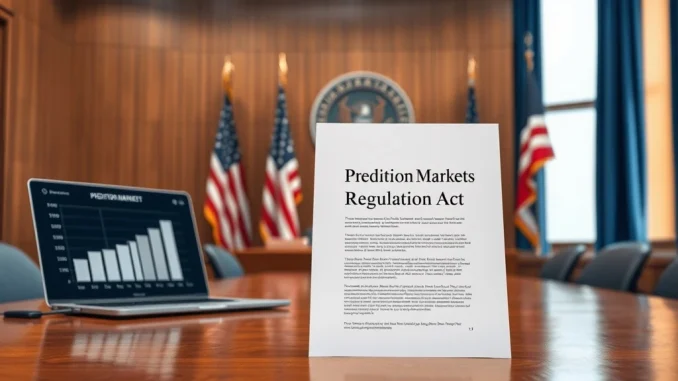
Senator Murphy and Representative Mike Levin (D-CA) are collaborating on draft legislation, confirmed by sources to Reuters. The bill aims to explicitly ban and penalize the use of non-public information for gain on event contracts, especially those tied to military action, terrorism, or acts “contrary to the public interest.” Representative Levin emphasized the urgency, telling reporters, “It’s unbelievably clear to me that if anyone is using prior knowledge of military action for financial gain, that should be absolutely illegal.” He noted that existing commodity laws, overseen by the Commodity Futures Trading Commission (CFTC), already prohibit certain event contracts but grant prediction markets excessive interpretive freedom. The new legislation seeks to close these loopholes by providing clear statutory definitions and enforcement mechanisms.
The proposed law would likely empower the CFTC or another designated agency to monitor platforms like Polymarket and its competitor Kalshi. It could mandate know-your-customer (KYC) checks, reporting of large or suspicious trades, and potentially ban contracts based on specific categories of events altogether. This represents a significant escalation from the current regulatory posture, which has largely involved cease-and-desist orders for operating unregistered facilities. The bill’s drafters argue that the national security implications are too severe to ignore. “Allowing bets on war to continue could see those close to the president pushing us into war because they can cash in,” Murphy warned, framing the issue as a direct threat to geopolitical decision-making integrity.
Expert Analysis and Institutional Reactions
Financial regulation experts are divided on the approach. Dr. Sarah Jenkins, a professor of financial law at Georgetown University and former CFTC advisor, contextualizes the challenge. “Prediction markets exist at the intersection of commodity trading, gambling law, and free speech,” Jenkins explained. “The 2024 Supreme Court decision in Trendex v. CFTC complicated enforcement by affirming that event contracts can be considered ‘commodities’ under certain conditions, but also protected political speech under others. Crafting a narrow, compliant law is a complex task.” She references the CFTC’s existing guidance, which permits event contracts unless they involve “gaming” or are “contrary to the public interest,” terms now under intense reinterpretation.
Conversely, a statement from the Prediction Market Industry Association (PMIA), a nascent advocacy group, defended the markets’ utility. “Prediction markets aggregate dispersed information efficiently, often providing more accurate forecasts than polls or experts,” the statement read. “They offer a vital economic signal. The solution is not blanket prohibition but smart regulation that prevents abuse while preserving their informative value.” The association pointed to established markets in the European Union and Singapore that operate with clear licensing frameworks. Meanwhile, Polymarket has not issued an official statement on the proposed legislation but has previously stated its commitment to complying with applicable laws and cooperating with regulators.
Broader Context: The Rise and Scrutiny of Decentralized Prediction Markets
The current controversy did not emerge in a vacuum. Decentralized prediction markets have grown exponentially since the early 2020s, fueled by blockchain technology that enables global, pseudonymous participation. These platforms allow users to buy and sell shares in the outcome of future events, from election results to product launch dates. Proponents hail them as powerful tools for collective intelligence, while critics decry them as unregulated gambling platforms ripe for manipulation. The regulatory landscape has been a patchwork, with the CFTC asserting jurisdiction over some markets as commodity pools or unregistered exchanges, while others argue they are merely software protocols.
| Platform | Primary Focus | Notable Contract Volume (2026 YTD) | Regulatory Status |
|---|---|---|---|
| Polymarket | Geopolitics, Crypto Events | $2.1 Billion | Received CFTC order (2024), operates offshore |
| Kalshi | U.S. Politics, Economics | $850 Million | Registered with CFTC as a designated contract market |
| PredictIt | Academic/Research Focus | $120 Million | Operated under CFTC no-action letter (rescinded 2025) |
The table above highlights the varied approaches within the industry. Kalshi, for instance, pursued full CFTC registration, accepting U.S. jurisdiction and implementing strict KYC. Polymarket, after a 2024 CFTC action, moved its operations offshore but remains accessible to U.S. users via VPNs. This jurisdictional arbitrage is a core frustration for lawmakers like Murphy and Levin, whose bill may include provisions to restrict U.S. access to non-compliant foreign platforms. The precedent exists in financial and gambling law, where U.S. authorities have successfully pressured payment processors and internet service providers to block access to offshore entities.
What Happens Next: The Legislative and Enforcement Pathway
The draft bill is expected to be formally introduced in the Senate Banking Committee and the House Financial Services Committee within the next two weeks. Its passage faces political hurdles in a narrowly divided Congress. However, the national security angle and bipartisan skepticism of unregulated crypto markets could generate unusual alliances. Observers note that Republican lawmakers have previously expressed concerns about prediction markets being used by foreign actors to influence U.S. politics, potentially creating common ground. The White House has not yet taken an official position, but administration officials have privately indicated concern over the market integrity issues raised.
Simultaneously, enforcement agencies are not waiting. The CFTC’s Division of Enforcement is reportedly investigating the specific Iran-stake bets flagged by Senator Murphy. While identifying individuals behind pseudonymous blockchain wallets is challenging, the agency can subpoena platform operators for IP data and transaction records. Furthermore, the Securities and Exchange Commission (SEC) may explore whether some prediction market shares constitute unregistered securities, another potential avenue for action. The outcome of these investigations could significantly influence the legislative debate, providing concrete evidence of abuse or demonstrating the limitations of current law.
Market and Community Reactions
Within the cryptocurrency and prediction market community, reaction is mixed. Some traders express frustration at potential overreach, arguing that the market merely reflected widespread geopolitical analysis and news speculation available on social media. “The bets mirrored what every security analyst on X was saying Friday night,” commented one pseudonymous trader with a large following. Others acknowledge the need for clearer rules. “I’d rather have a regulated market I can use openly than a gray market that could vanish overnight,” said another user on a prediction market forum. Legal scholars warn that an overly broad bill could face First Amendment challenges, as courts have recognized markets as venues for exchanging opinions about future events.
Conclusion
The Democratic initiative to regulate prediction markets marks a pivotal moment for a burgeoning but controversial financial technology. Driven by alarming allegations of insider trading on matters of war and peace, the proposed legislation seeks to impose traditional market integrity rules on a decentralized, global ecosystem. The core tension lies between preventing demonstrable harms—market manipulation and national security risks—and preserving the innovative, informative potential of these platforms. As the bill moves through Congress and enforcement agencies deepen their probes, the future of betting on real-world events hangs in the balance. The coming weeks will reveal whether Washington can craft a targeted, effective solution or if the inherently borderless nature of blockchain-based markets will defy centralized control. One outcome seems certain: the era of unscrutinized growth for prediction markets is over.
Frequently Asked Questions
Q1: What exactly are lawmakers alleging happened with the Iran strike bets?
Lawmakers, led by Senator Chris Murphy, allege that individuals with insider knowledge of planned U.S. military strikes against Iran used that non-public information to place profitable bets on the prediction market Polymarket. They point to six newly created accounts that earned approximately $1 million from bets placed just hours before strikes were publicly reported.
Q2: What would the proposed prediction markets bill actually do?
The bill, still in draft form, aims to explicitly outlaw using material non-public information (like military plans) for financial gain on event contracts. It would likely grant the CFTC clearer authority to regulate these platforms, potentially requiring KYC checks, trade reporting, and banning contracts tied to specific sensitive events like acts of war or terrorism.
Q3: Is using prediction markets currently illegal in the United States?
The legality is complex and platform-dependent. Some platforms, like Kalshi, are registered with the CFTC and legal. Others, like Polymarket, operate in a gray area after moving offshore following regulatory pressure. Using them is not explicitly illegal for individuals, but operating an unregistered exchange is.
Q4: Why do supporters argue prediction markets are valuable?
Proponents argue they are powerful information aggregation tools. By allowing people to “bet” on outcomes, they create a market price that reflects the collective wisdom and probability of an event, often outperforming expert polls or punditry in forecasting accuracy for elections, economic indicators, and more.
Q5: How does this relate to broader cryptocurrency regulation?
Prediction markets are a significant use case for blockchain and cryptocurrency. They rely on crypto for borderless, pseudonymous trading. This regulatory push is part of a larger trend of bringing decentralized finance (DeFi) applications under traditional financial oversight frameworks, focusing on anti-money laundering, consumer protection, and market integrity.
Q6: What should a user of platforms like Polymarket do now?
Users should monitor legal developments closely. If a U.S.-based bill passes restricting access to non-compliant platforms, users may face barriers or legal risk. It is also prudent to understand the tax implications of trading on these platforms, as profits are generally considered taxable income.