
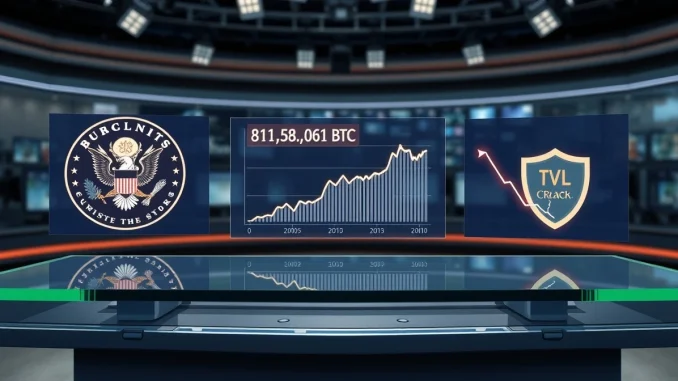
Three major stories are defining the cryptocurrency sector on April 21, 2026, signaling a day of regulatory change, aggressive corporate accumulation, and significant DeFi vulnerability. The SEC’s approach under new leadership, a landmark corporate Bitcoin purchase, and the fallout from a major hack are collectively reshaping the market space.
SEC’s Regulatory Pivot Under Paul Atkins
According to agency filings and public statements, the U.S. Securities and Exchange Commission has undertaken a notable change in direction since Paul Atkins was confirmed as chair one year ago, on April 21, 2025. This shift marks a departure from the enforcement-heavy posture under former Chair Gary Gensler. Industry watchers note that the change aligns with political promises made during the 2024 election cycle.
Also read: Russia sanctions British teenager for exposing stablecoin used to bypass sanctions
Data from SEC dockets shows a measurable decrease in new enforcement actions against digital asset firms in the first quarter of 2026 compared to the same period in 2025. Instead, the commission has issued several proposed rule clarifications concerning digital asset custody and trading. This suggests a move toward establishing clearer operational guidelines. The implication is a potential reduction in regulatory uncertainty for U.S. crypto businesses.
A Fulfilled Campaign Pledge
The transition stems directly from the 2024 presidential election. Then-candidate Donald Trump explicitly promised the crypto industry to replace Gensler. Following his November 2024 victory, Gensler resigned in January 2025. Commissioner Mark Uyeda served as acting chair until the Senate confirmed Atkins, Trump’s nominee. Analysts see the past year as a deliberate recalibration. “The SEC’s recent guidance on token issuance is fundamentally different in tone and substance,” noted a policy analyst from the Cato Institute, referencing public documents. This could signal a more collaborative, though still rigorous, regulatory phase.
Also read: Bitcoin at Risk of Sub-$65K Drop as Geopolitical Tensions and Liquidations Pressure Market
MicroStrategy’s Monumental Bitcoin Acquisition
In a separate but equally impactful development, MicroStrategy Incorporated has dramatically increased its Bitcoin treasury. An 8-K filing with the SEC on Monday, April 21, 2026, reveals the company purchased 34,164 Bitcoin between April 13 and 19. The total cost was $2.54 billion.
This purchase is the company’s third-largest by coin count. It follows buys of 55,500 and 51,780 BTC in November 2024. The latest acquisition pushes MicroStrategy’s total holdings to 815,061 BTC. The company’s total investment now stands at $61.56 billion. The average price paid last week was $74,395 per Bitcoin. That figure sits slightly below the firm’s cumulative average cost of $75,527 per coin.
Key details of the purchase:
- Bitcoin Acquired: 34,164 BTC
- Total Cost: $2.54 billion
- Average Price: $74,395
- New Total Holdings: 815,061 BTC
- Total Capital Deployed: $61.56 billion
CEO Michael Saylor had hinted at the move publicly the day before the filing. The company also disclosed a plan to pay dividends twice monthly using its STRC preferred security. What this means for investors is continued intense corporate demand acting as a foundational support for Bitcoin’s market valuation.
Aave Contends with $8 Billion TVL Drop After Kelp Hack
The decentralized finance sector faced a severe stress test over the weekend. The total value locked on the Aave lending protocol plummeted by nearly $8 billion. This collapse followed a sophisticated exploit of the Kelp DAO bridge.
On Saturday, hackers stole approximately 116,500 Kelp DAO Restaked ETH tokens. The value was about $293 million. The attackers then used these stolen tokens as collateral on Aave to borrow wrapped Ether. According to analytics from Lookonchain, this maneuver created roughly $195 million in “bad debt” on Aave’s platform. The sudden insolvency risk triggered massive user withdrawals. Aave’s TVL fell from around $26.4 billion to $18.6 billion by Sunday. This drop cost Aave its position as the largest DeFi protocol by TVL.
The incident demonstrates the persistent risks in interconnected DeFi systems. A breach on one protocol rapidly cascaded into another. At the time of writing, available liquidity in major Aave pools was severely depleted. For example, only about $2,540 was available for withdrawal from a $2.87 billion USDT pool on Aave v3. This suggests a liquidity crunch, though the protocol’s insolvency mechanisms are designed to handle such events.
Market Implications and Analyst Outlook
These three events collectively paint a picture of a maturing yet volatile industry. The SEC’s evolving stance may encourage more traditional finance participation. MicroStrategy’s purchase underscores unwavering institutional conviction in Bitcoin as a treasury asset. Conversely, the Aave incident is a stark reminder of DeFi’s technical and economic vulnerabilities.
Some analysts see a bifurcation. “We’re observing a growing divide between the institutional Bitcoin narrative and the operational risks in decentralized application layers,” stated a market strategist from Fidelity, referencing an internal memo. The Kelp-Aave exploit could prompt calls for enhanced risk modeling and insurance products within DeFi. Meanwhile, regulatory clarity could accelerate the development of compliant crypto products.
Conclusion
The crypto news today highlights a sector in flux. Regulatory winds are shifting in the United States, corporate Bitcoin strategies are growing more aggressive, and DeFi’s promise continues to be tested by systemic risk. The SEC’s new direction under Paul Atkins, MicroStrategy’s colossal accumulation, and the fallout from the Kelp hack will likely influence market structure, investor confidence, and regulatory debates for months to come. These developments show an asset class grappling with its scale and its place in the global financial system.
FAQs
Q1: What is the significance of Paul Atkins leading the SEC?
Paul Atkins’ first year as SEC chair has seen a shift toward more defined rulemaking and a relative slowdown in aggressive enforcement actions against crypto firms, compared to his predecessor. This is viewed by the industry as a move toward clearer regulatory guidelines.
Q2: How much Bitcoin does MicroStrategy own now?
Following its latest purchase, MicroStrategy holds 815,061 Bitcoin. The company spent a total of $61.56 billion to acquire this position, making it the largest corporate holder of Bitcoin globally.
Q3: What caused Aave’s TVL to drop by $8 billion?
The drop was primarily caused by a cascade of user withdrawals after hackers exploited the Kelp DAO bridge. The attackers used stolen tokens as collateral on Aave, creating $195 million in bad debt and sparking a liquidity crisis.
Q4: What is “bad debt” in a DeFi protocol like Aave?
Bad debt occurs when borrowed funds are not fully backed by sufficient collateral, often due to a sharp drop in collateral value or an exploit. The protocol may be left with loans that cannot be repaid, potentially requiring treasury funds or insurance mechanisms to cover the shortfall.
Q5: Has MicroStrategy’s Bitcoin strategy been profitable?
Based on its disclosed average purchase price of $75,527 per Bitcoin, MicroStrategy’s profit or loss depends entirely on Bitcoin’s current market price. The strategy is a long-term treasury reserve bet, not a short-term trading position.





Be the first to comment