
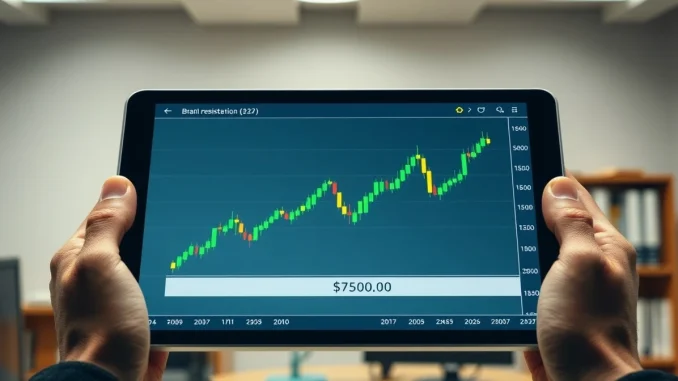
Bitcoin faces a decisive moment. After a volatile period, the cryptocurrency’s ability to maintain a value above $76,000 hinges on meeting three specific market conditions, according to technical analysts. The digital asset’s recent 8% climb brought it back to key technical levels, but the battle for sustained higher ground is just beginning. This analysis breaks down the precise requirements experts say are non-negotiable for a lasting bull run.
The $76,000 Line in the Sand
For analysts, $76,000 isn’t just another number. It’s the level that decides the next major price direction. “We need a proper HTF candle close above this zone to trust the move,” analyst Crypto Patel stated in a social media post. A high-time frame close—meaning a weekly or monthly candle ending above this price—is the first mandatory step. Without it, any move higher is considered vulnerable. Data from Glassnode supports the significance of this region, showing that investors acquired over 2 million BTC in the $84,000-$96,000 zone over a recent six-month period. This creates a massive concentration of potential selling pressure that Bitcoin must eventually confront.
Also read: Russia sanctions British teenager for exposing stablecoin used to bypass sanctions
But the path isn’t clear. Trading resource Material Indicators noted that “multiple levels of technical resistance” are stacked above the current spot price. These include the yearly open near $87,500 and the 50-week moving average around $97,000. Reclaiming these levels would confirm the bull market’s return. The implication is clear: breaking $76,000 is just the opening act. What this means for investors is that patience and confirmation are required before declaring a new uptrend.
Sustained Demand: The ETF and Spot Volume Imperative
The second condition involves consistent capital flows. Demand for U.S. spot Bitcoin exchange-traded funds (ETFs) has been intermittent. While a single day of $451 million in net inflows is positive, it’s not enough. Persistent positive flows are required to propel the price higher and provide a stable foundation. According to flow data from SoSoValue, these products have recorded alternating inflows and outflows every few days. This inconsistency reflects ongoing uncertainty among institutional and retail investors.
Also read: Bitcoin at Risk of Sub-$65K Drop as Geopolitical Tensions and Liquidations Pressure Market
Simultaneously, sustained buy volume in the spot market is critical. This refers to actual purchases of Bitcoin on exchanges, not derivative bets. Spot volume indicates real capital deployment and conviction. When spot buying leads a rally, it is generally viewed as healthier and more sustainable than a rally driven primarily by leveraged futures trading. Industry watchers note that the current market needs to see both ETF inflows and sturdy spot market activity working in tandem. One without the other likely won’t provide the fuel for a sustained move.
The Bull Score and Market Health
Beyond pure price, analysts monitor broader market health. CryptoQuant’s Bull Score Index, which combines fundamental and technical metrics, recently increased to 40. This was its highest reading since late October 2025. While an improvement, analyst Arab Chain pointed out this remains in neutral territory. The indicator must rise above 60 to signal “strong optimism” and typical bullish conditions. “If the indicator continues to improve gradually, it may signal a potential return of upward momentum,” Chain noted. This metric suggests the market is recovering from weak momentum but isn’t yet in a decisively strong position.
Technical Confirmations Beyond the Price
The third set of conditions involves specific technical confirmations. Analyst Rekt Capital emphasized that BTC needs a weekly close above $72,800 to “confirm a breakout.” This is a separate, more immediate level that must be held. Furthermore, the Relative Strength Index (RSI) on weekly charts must close and hold above the 41 level. Material Indicators highlighted this, noting that similar RSI recoveries in 2023, 2020, and 2019 preceded massive rallies of 660%, 1,600%, and 316%, respectively. “Those are the macro things that need to happen to say a validated bull market is on,” they stated.
This suggests that the current market structure, while improving, lacks these broader technical validations. The trading resource was blunt: “Obviously, we are not there yet.” The takeaway for traders is to watch for these specific technical milestones alongside the price action.
On-Chain Activity Offers a Bullish Counterpoint
Amid the cautious technical outlook, on-chain data provides a more optimistic signal. Bitcoin’s daily transaction count has reached 17-month highs. This surge in network activity is often interpreted as “bull market behavior.” More transactions can indicate growing adoption, utility, or speculative interest. This fundamental metric reinforces the asset’s long-term upside potential, even if short-term technical hurdles remain. It creates a complex picture where underlying network health is strong, but market price mechanics face significant resistance.
What this means for investors is that the foundation for growth exists. The network is active and being used. However, translating that fundamental strength into a sustained price breakout requires conquering the specific technical and capital flow challenges outlined by analysts. The two narratives—strong on-chain fundamentals versus tough technical resistance—will compete in the coming weeks.
Conclusion
Bitcoin’s journey above $76,000 is a three-part challenge. First, it must achieve and hold a decisive weekly close above that key price level. Second, it requires unwavering support from both spot market buying and consistent ETF inflows. Third, broader technical indicators like the weekly RSI must confirm the strength of the move. While on-chain activity shows promising bull market behavior, the price must still manage a wall of technical resistance. For the rally to extend toward the $84,000-$96,000 zone, all three conditions must be met. Until then, the market remains in a state of contested equilibrium, with the outcome hinging on these clear, measurable factors.
FAQs
Q1: Why is $76,000 so important for Bitcoin?
Analysts identify $76,000 as a major technical resistance level based on historical trading patterns and investor cost basis data. A sustained break above it is viewed as a critical signal that could open the path to significantly higher prices, while failure to hold it suggests continued range-bound trading.
Q2: How do Bitcoin ETF flows affect the price?
Consistent net inflows into spot Bitcoin ETFs represent new, institutional-grade demand for the asset. This buying pressure can directly support and elevate the price. Intermittent or negative flows, however, remove that support and can lead to increased selling pressure or stagnation.
Q3: What is the Bull Score Index?
The Bull Score Index, from analytics firm CryptoQuant, is a metric that combines several fundamental and technical indicators to gauge the overall health and momentum of the Bitcoin market. A score above 60 typically indicates strong bullish conditions.
Q4: What does “spot market buy volume” mean?
This refers to the volume of actual Bitcoin purchases happening on exchanges for immediate delivery, as opposed to trades in futures or derivatives contracts. High spot buy volume suggests strong, direct demand from investors wanting to own the asset, which is considered a healthier driver for price increases than leveraged speculation.
Q5: What on-chain signal is currently bullish for Bitcoin?
Bitcoin’s daily transaction count has recently hit a 17-month high. This increase in network usage and activity is a fundamental metric often associated with growing adoption and bullish network phases, providing a positive counter-narrative to short-term technical resistance.





Be the first to comment