March 16, 2026 — A significant pivot by cryptocurrency miners toward artificial intelligence infrastructure is fueling a debate about the long-term security of the Bitcoin network. Industry observers are divided on whether the migration threatens Bitcoin’s foundational security or will be mitigated by its built-in economic mechanisms.
The Miner Migration to AI
Crypto trader Ran Neuner recently argued that AI has become Bitcoin mining’s “biggest competitor” due to competition for electricity. He cited data showing AI data center revenue per megawatt can reach $200 to $500, significantly higher than Bitcoin mining’s estimated $57 to $129 for the same power. This economic disparity is driving a shift.
Several major mining firms have announced moves into AI. Core Scientific secured substantial credit for AI hosting earlier this month. Hut 8 entered a multi-billion dollar AI infrastructure agreement with Google in December. Cipher Mining has also reduced its Bitcoin hashrate to focus on AI compute operations.
“So if I were a miner, it wouldn’t be a tough decision. And that’s why every day more and more miners are leaving the network,” Neuner stated. He warned this exodus could make the network more vulnerable to a majority attack if the hashrate falls too low.
Bitcoin’s Built-In Rebalancing
Other experts counter that the Bitcoin protocol is designed for this exact scenario. Cryptographer Adam Back argued that the network’s difficulty adjustment would force only the least efficient miners out, improving profitability for those who remain.
“What happens to Bitcoin is simple: tick tock, next block! Difficulty adjusts downwards, the least efficient and AI switchers move out, and Bitcoin mining profitability converges to AI profitability,” Back explained. Investor Fred Krueger echoed this, noting miners would simply power down until the next difficulty adjustment made operations profitable again.
This automatic adjustment occurs roughly every two weeks, recalibrating the computational effort required to mine a block based on the total network hashrate. The system aims to maintain a consistent block time regardless of miner participation.
Assessing the Security Risk
The core of the debate centers on network security. Bitcoin’s hashrate has declined approximately 14.5% since its peak in October, according to public blockchain data. Neuner contends this reduction in securing power increases potential risk, especially if the trend accelerates.
However, Bitcoin ESG specialist Daniel Batten challenged the narrative. He argued that Bitcoin mining’s ability to use stranded energy and act as a flexible load for power grids gives it a distinct advantage. Batten suggested AI expansion might depend on Bitcoin’s unique energy consumption profile rather than compete with it directly.
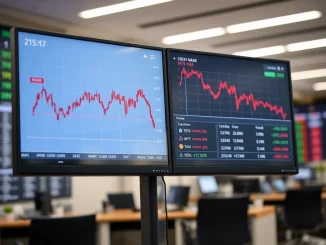
Market data shows Bitcoin mining profitability, or hashprice, remains near historic lows. This pressure incentivizes miners to seek higher-margin opportunities like AI compute hosting.
Market Dynamics and the Path Forward
The ultimate factor may be Bitcoin’s market price. Neuner suggested a significant price increase could rebalance the economics, making mining competitive with AI again. “What I hope is that Bitcoin has one green candle,” he said, referring to a sustained price rally.
Bitcoin recorded five consecutive monthly price declines until recently, a pattern not seen since the 2018 bear market. The current month is showing gains, with the asset up roughly 8% so far in March, according to data from CoinGlass.
The situation highlights a tension between short-term economic incentives for miners and the long-term security requirements of a decentralized network. The Bitcoin network’s difficulty adjustment will be tested if the migration to AI computing continues at its current pace.
For official announcements, see SEC filings from public mining companies. Network hashrate and difficulty data is publicly available from sources like Blockchain.com’s explorer.
This article was produced with AI assistance and reviewed by our editorial team for accuracy and quality.