
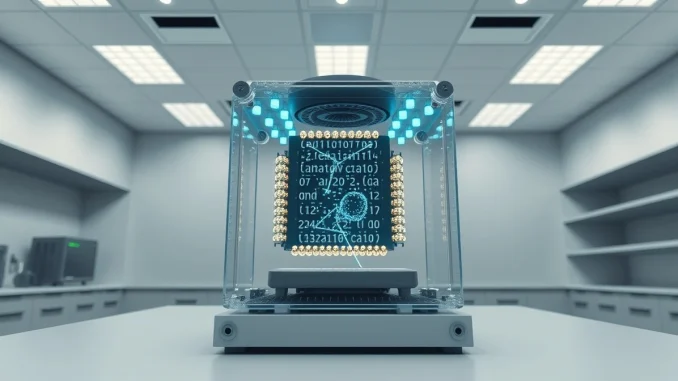
PARIS, April 16, 2026 – The Bitcoin community should start building defenses against quantum computers immediately, even though the technology remains largely theoretical. That’s the urgent message from Blockstream CEO and early crypto pioneer Adam Back, who argues preparation is the only safe path forward.
Adam Back’s Quantum Warning for Bitcoin
Speaking at Paris Blockchain Week, Back delivered a nuanced but firm warning. He has followed quantum computing for over 25 years. His assessment is blunt. “Quantum computing still has a lot to prove,” Back stated. “Current systems are essentially lab experiments. Progress has been incremental.”
Also read: Bitcoin at Risk of Sub-$65K Drop as Geopolitical Tensions and Liquidations Pressure Market
But he insists the time for action is now. The safest approach, according to Back, is to develop optional upgrades for Bitcoin. These would allow a controlled migration to quantum-resistant cryptography when—or if—the threat materializes. This proactive stance aims to avoid a future crisis.
Industry watchers note this reflects a growing consensus among core developers. The goal is to maintain Bitcoin’s security without disruptive, last-minute changes.
Also read: SEC makes digital assets a strategic priority through 2030, promising clearer rules
Understanding the Quantum Risk to Cryptography
The threat is specific. Most blockchain security, including Bitcoin’s, relies on public-key cryptography. Systems like Elliptic Curve Digital Signature Algorithm (ECDSA) protect wallets and validate transactions. Quantum computers, using algorithms like Shor’s algorithm, could theoretically break this encryption.
This could allow a bad actor to derive private keys from public addresses. The result would be catastrophic. They could drain wallets, including dormant ones holding billions in value. Market confidence would likely collapse.
Data from a November 2025 interview shows Back’s timeline. He estimated the quantum threat is 20 to 40 years away for breaking ECDSA at scale. He told Bloomberg earlier this month that today’s quantum machines are slower than calculators for these tasks. The risk is distant, but the consequences are extreme.
Blockstream’s Quiet Research Efforts
Despite the long timeline, Back’s company isn’t waiting. Blockstream has a dedicated quantum research team. Their job is to identify potential threat vectors to the Bitcoin network. Part of this work is already being tested.
Back revealed they have implemented hash-based signatures on the Liquid Network. This is Blockstream’s Bitcoin sidechain. Hash-based signatures, like SPHINCS+, are considered quantum-resistant. This work serves as a practical testbed for future Bitcoin mainnet upgrades.
“Preparation is key,” Back emphasized in Paris. “Making changes in a controlled way is far safer than reacting in a crisis.”
Could the Quantum Timeline Accelerate?
Some researchers believe the danger could arrive sooner. In March 2026, a team from Google and the California Institute of Technology published a paper. They argued functional quantum computers might need less power to break cryptography than prior estimates suggested.
Google researchers made a startling claim. They said a sufficiently advanced quantum computer could break Bitcoin’s cryptography in as little as nine minutes. This would enable an “on-spend” attack, stealing funds the moment a transaction is broadcast.
Asked about a faster-than-expected threat, Back pointed to Bitcoin’s history of rapid response. “We’ve seen that before—bugs have been identified and fixed within hours,” he said. “When something becomes urgent, it focuses attention and drives consensus.” He believes the developer community would act quickly.
Controversial Proposal to Freeze Vulnerable Bitcoin
The debate took a contentious turn recently. On April 15, 2026, Bitcoin developer Jameson Lopp and five security researchers published a proposal. Known as BIP-361, it suggested freezing Bitcoin deemed vulnerable to quantum attack.
This would include coins that have never moved from their original P2PKH addresses. Analysis suggests this category holds over 1.1 million BTC. A significant portion is linked to Satoshi Nakamoto’s early mining. At current prices, that stash is valued at over $80 billion.
The proposal sparked immediate backlash. Developer and researcher Mark Erhardt called it “authoritarian and confiscatory.” Phil Geiger, head of business development at investment firm Metaplanet, offered a sharp critique. “We have to steal people’s money to prevent their money from being stolen,” he said.
This reaction highlights a core tension. Balancing proactive security with Bitcoin’s foundational principle of censorship resistance is complex. The Lopp proposal appears to have little community support, suggesting a softer upgrade path, as Back advocates, is more likely.
The Role of Bitcoin’s Taproot Upgrade
There is a potential technical path forward already in place. Back noted that Bitcoin’s 2021 Taproot upgrade could be instrumental. Taproot’s flexibility allows for alternative signature schemes to be implemented later.
This means quantum-resistant signatures could be added as a new option. Current users and wallets wouldn’t be forced to change immediately. The network could support both old and new signature types during a transition period. This aligns with Back’s vision of an optional, controlled migration.
What This Means for Bitcoin Investors and Users
The immediate takeaway is there is no cause for panic. The quantum threat is not imminent. However, the discussion signals that long-term stewardship of the protocol is active.
For holders, the advice remains consistent. Use modern wallet software that generates new addresses for each transaction. This practice, already standard for privacy, also reduces quantum vulnerability. Coins stored in reused addresses from the early years present a higher theoretical risk.
The implication for the broader market is one of resilience. The fact that core developers and companies like Blockstream are researching this decades in advance is a positive signal. It suggests the network is being managed with a long-term, security-first mindset.
Conclusion
Adam Back’s call to action on quantum computing is not a forecast of doom. It is a pragmatic engineering directive. While quantum computers capable of breaking Bitcoin remain a distant prospect, the work to defend against them must begin now. The preferred method is clear: build optional, backward-compatible upgrades that prepare the network without forcing immediate change. This approach, tested on layers like Liquid and enabled by upgrades like Taproot, aims to secure Bitcoin’s future while preserving its foundational principles. The community’s vigorous debate over proposals like BIP-361 shows that security solutions must align with Bitcoin’s ethos to succeed.
FAQs
Q1: What is the quantum computing threat to Bitcoin?
Quantum computers could potentially break the public-key cryptography that secures Bitcoin wallets. This might allow someone to derive a private key from a public address and steal funds.
Q2: How soon could quantum computers break Bitcoin?
Experts like Adam Back estimate it could take 20 to 40 years. Current quantum computers lack the scale and stability to perform this attack, but research into the threat is accelerating.
Q3: What is being done to protect Bitcoin?
Companies like Blockstream are researching quantum-resistant cryptography, such as hash-based signatures. The 2021 Taproot upgrade also allows for new signature types to be added to Bitcoin in the future.
Q4: Should I move my Bitcoin because of quantum computing?
No immediate action is needed. The threat is not current. Using modern wallet software that creates a new address for each receipt is a good general practice that also mitigates future quantum risk.
Q5: What was the controversial BIP-361 proposal?
It was a suggestion to freeze old, potentially quantum-vulnerable Bitcoin to prevent theft. It was widely criticized as being against Bitcoin’s principles and is not expected to be adopted.






Be the first to comment