Explosive Report: UAE Royal’s $500M Trump-Family Crypto Investment Preceded Key AI Chip Approval
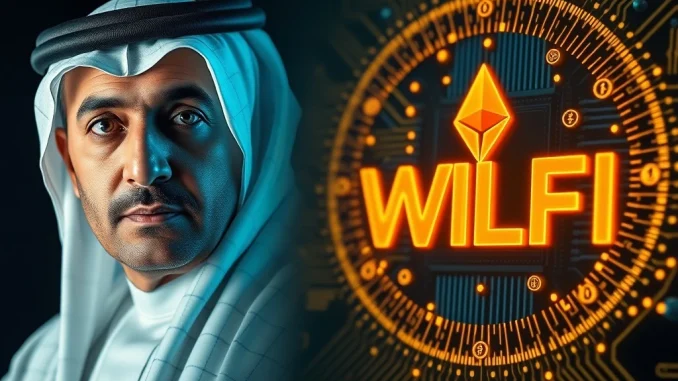
Washington D.C., March 2025: A significant financial transaction linking Middle Eastern royalty, a former U.S. first family, and the volatile cryptocurrency sector has ignited a firestorm of political and regulatory scrutiny. According to a report by CNBC citing The Wall Street Journal, Sheikh Tahnoon Bin Zayed Al Nahyan, a powerful United Arab Emirates royal and national security adviser, channeled approximately $500 million into World Liberty Financial (WLFI), a decentralized finance (DeFi) project connected to the Trump family. The timing of this massive, undisclosed crypto investment, finalized months before a pivotal U.S. government decision to allow advanced AI semiconductor exports to the UAE, has raised profound questions about potential conflicts of interest and the intersection of geopolitics, technology, and finance.
Anatomy of the $500 Million Crypto Deal
The transaction centers on Aryam Investment, a firm backed by Sheikh Tahnoon. Last year, Aryam Investment acquired a 49% stake in World Liberty Financial, a DeFi platform that has drawn attention due to its associations with the Trump business empire. While the exact nature of the Trump family’s link to WLFI remains a subject of public records and previous reporting, the involvement has consistently placed the project under a media microscope. The $500 million valuation for a substantial minority stake indicates significant perceived value or strategic importance in the project, an enormous sum even within the well-capitalized realm of cryptocurrency ventures.
DeFi, or decentralized finance, represents a blockchain-based form of finance that does not rely on central financial intermediaries. Instead, it uses smart contracts on blockchains. Investments of this scale from traditional sovereign-adjacent entities like those tied to UAE royals signal a continued, high-stakes institutional interest in the crypto asset class, despite its regulatory uncertainties and market volatility. This move by Sheikh Tahnoon, a figure renowned for his strategic investments across technology and security sectors, underscores a calculated bet on the future of blockchain-based financial systems.
The AI Chip Approval and Mounting Political Backlash
The controversy stems not from the investment itself, but from its proximity to a major U.S. policy decision. Several months after the WLFI stake was secured, the Trump administration approved the export of advanced artificial intelligence semiconductors to the United Arab Emirates. The U.S. subsequently permitted the sale of hundreds of thousands of these high-performance Nvidia AI chips. A significant portion was reportedly designated for G42, an ambitious Abu Dhabi-based artificial intelligence company that is also chaired by Sheikh Tahnoon.
This sequence of events has triggered intense criticism from members of the U.S. Congress, who allege a troubling correlation. Lawmakers have pointed to the potential for a conflict of interest, suggesting the crypto investment could be perceived as an inducement or linked to favorable policy outcomes. Senator Elizabeth Warren, a long-standing critic of both cryptocurrency regulatory gaps and political corruption, labeled the situation a “clear case of corruption.” She has publicly demanded an immediate reversal of the AI chip sale approval, framing it as a matter of national integrity and security.
- Timeline of Key Events:
- Early 2024: Aryam Investment, backed by Sheikh Tahnoon, finalizes the $500 million purchase of a 49% stake in World Liberty Financial (WLFI).
- Mid-2024: The Trump administration grants approval for the export of advanced U.S.-made AI semiconductors to the UAE.
- Late 2024: Sales of hundreds of thousands of Nvidia AI chips to the UAE proceed, with allocations reported for Sheikh Tahnoon’s G42 AI company.
- Early 2025: CNBC report reveals the previously undisclosed crypto investment, leading to congressional inquiries and allegations.
Understanding the Strategic Players: Sheikh Tahnoon and G42
To grasp the full implications, one must understand the central figure. Sheikh Tahnoon Bin Zayed Al Nahyan is not merely a royal family member; he is a pivotal operator in the UAE’s geopolitical and economic strategy. As the national security adviser and brother to the UAE’s president, he oversees a vast portfolio of strategic investments through entities like the Royal Group. His chairmanship of G42 places him at the forefront of the UAE’s push to become a global leader in artificial intelligence. AI chips are the fundamental hardware required to train and run large AI models, making them a critical, sought-after commodity for any nation with AI ambitions. Access to U.S. technology, often restricted for national security reasons, is a significant advantage.
The White House has formally denied any wrongdoing or conflict of interest regarding the chip approvals. Officials maintain that the decision was made solely on foreign policy and national security merits, following rigorous interagency reviews. They assert that the two events—the private crypto investment and the public policy decision—are entirely unrelated. This defense highlights the challenging nature of proving causality in high-level finance and politics, where influence can be exerted subtly and through complex, layered transactions.
Broader Implications for Crypto and Geopolitical Finance
This incident illuminates several critical trends in modern finance and regulation. First, it demonstrates how cryptocurrency and blockchain projects have become attractive vessels for large-scale, cross-border capital movements, sometimes attracting investors seeking opacity or new asset diversification. The use of a DeFi project, a sector still grappling with Know-Your-Customer (KYC) and Anti-Money Laundering (AML) standards globally, adds a layer of complexity for regulators attempting to track such flows.
Second, it underscores the growing nexus between technological supremacy (in AI and semiconductors) and geopolitical influence. Investments can be strategic tools, and access to cutting-edge technology is a powerful diplomatic lever. The controversy raises questions about how nations vet the overseas financial dealings of their senior officials and whether existing frameworks are adequate to prevent perceived or actual pay-for-play scenarios in the tech sector.
Finally, for the cryptocurrency industry, this level of scrutiny is a double-edged sword. While a half-billion-dollar investment from a prestigious source validates the sector’s financial gravity, the association with political scandal invites more aggressive regulatory oversight. Lawmakers like Senator Warren are likely to use this case as evidence for stricter cryptocurrency regulations, arguing that the current environment enables financial maneuvers that could compromise national interests.
Conclusion
The report of a $500 million crypto investment by UAE royal Sheikh Tahnoon in a Trump-family-linked firm, preceding a sensitive U.S. approval for AI chip exports, has created a perfect storm of political and financial controversy. While the White House denies any linkage, the timing has fueled allegations of conflict of interest and corruption from prominent members of Congress. This situation transcends a simple business deal, touching on vital issues of technological sovereignty, the regulatory future of cryptocurrency, and the opaque intersections of global wealth and political power. The unfolding scrutiny will test the resilience of existing ethical safeguards and likely influence both crypto regulation and export control policies for critical technologies like artificial intelligence semiconductors.
FAQs
Q1: Who is Sheikh Tahnoon Bin Zayed Al Nahyan?
Sheikh Tahnoon is a senior member of the UAE royal family, serving as the country’s national security adviser. He is also a major business figure, chairing the AI company G42 and overseeing a network of investment vehicles, making him one of the most influential individuals in the UAE’s strategic economic and technological pursuits.
Q2: What is World Liberty Financial (WLFI)?
World Liberty Financial is a decentralized finance (DeFi) project built on blockchain technology. It has been reported in media to have connections to the Trump business family. DeFi platforms aim to recreate traditional financial systems like lending and trading in a decentralized manner, without banks or brokers.
Q3: Why is the timing of the investment and the AI chip approval significant?
The significance lies in the sequence: a massive, private investment by a UAE royal into a U.S.-linked entity occurred shortly before the U.S. government made a favorable decision allowing that royal’s country (and his own AI company) access to strategically restricted technology. Critics argue this creates an appearance of a quid pro quo, even if none was officially intended.
Q4: What has been the U.S. government’s response to the allegations?
The White House has denied any conflict of interest, stating the AI chip export approval was made independently based on national security and foreign policy considerations. They maintain there is no connection between the two events.
Q5: What are the potential consequences of this report?
Potential consequences include congressional investigations, increased scrutiny and possible delays of future technology exports, calls for stricter cryptocurrency transaction reporting laws, and a renewed debate about the ethics of political family business dealings on the global stage.
Related News
- COTI and Poolz Unveil MomentumX Accelerator to Drive Privacy-Focused Web3 Innovation
- X's Crucial Crypto Stance: Nikita Bier Confirms Platform Won't Act as Broker
- The Core Pillars of the XERA Pro Universe
Related: OpenClaw Discord Crypto Ban: The Shocking Policy That Silenced Bitcoin Talk
Related: Essential Analysis: 4 Cryptocurrencies Showing Strong Growth Signals for 2026
Related: Smart Money Chooses DeepSnitch AI Over Trump Crypto Coin Rumors as SEC Urges Calm