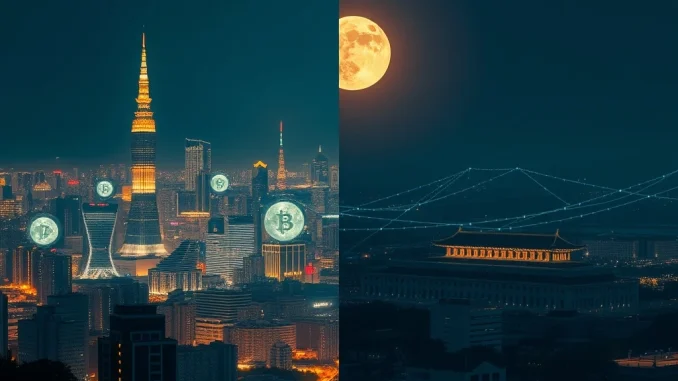
SEOUL/PYONGYANG, February 4, 2026 — A stark cryptocurrency divide now defines the Korean Peninsula, where South Korea’s booming digital asset markets directly contrast with North Korea’s weaponized blockchain operations. While Seoul’s retail traders dominate global exchange volumes, Pyongyang’s state-sponsored hackers extract billions to fund weapons programs, creating unprecedented geopolitical tensions in global crypto governance. This exclusive analysis reveals how the two Koreas’ opposing approaches to cryptocurrency are reshaping both regional security and international financial systems.
The Korean Crypto Paradox: Retail Boom Versus State Theft
South Korea’s cryptocurrency markets have evolved into a retail-driven economic force, with won-denominated trading volumes frequently surpassing US dollar pairs on major exchanges. According to Kaiko data, the South Korean won became the most traded fiat currency against cryptocurrency in early 2024, maintaining that position through 2025. Meanwhile, North Korea’s crypto activities remain deliberately invisible, designed to bypass international sanctions. Chainalysis reports that Pyongyang’s state actors have stolen approximately $6.75 billion in cryptocurrency since 2017, with 2025 setting new records despite global enforcement efforts.
The economic impact is staggering. United Nations estimates place North Korea’s 2023 GDP between $15 billion and $17 billion, meaning cryptocurrency theft represented roughly 13.5% of the country’s total economic activity last year. This illicit funding directly supports Pyongyang’s weapons of mass destruction program, according to multiple UN Security Council reports. The contrast creates what blockchain researcher Heechang Kang calls “infrastructure versus innovation” — where crypto serves as survival mechanism for one regime and economic opportunity for the other.
South Korea’s Retail Revolution and Political Transformation
Crypto’s integration into South Korean society began with technological foundations laid in the late 1990s, when the nation adopted nationwide high-speed internet ahead of most developed countries. “People learned to absorb information very quickly, and the internet became a source of data, community and culture,” explains John Park, Arbitrum Foundation’s head of Korea. “Crypto fits neatly into that system.” Park identifies wealth fascination as another accelerant, combined with economic realities of long work hours and limited traditional career upside.
- Political Power: Crypto emerged as an electoral priority in 2022, with candidates adopting crypto-friendly platforms to court Gen Z and Millennial voters
- Regulatory Evolution: South Korea’s crypto user protection law took effect in 2024, with broader frameworks under development despite coordination challenges
- Market Resilience: Despite Terraform Labs’ catastrophic collapse in 2022, retail enthusiasm and institutional interest have continued growing
Expert Analysis: The Post-Terra Landscape
John Park of Arbitrum Foundation provides crucial context about South Korea’s market evolution. “Before it failed, Luna was the pride of our community,” Park tells Magazine. “It was the first time people looked at South Korea as a serious country that could build a world-class crypto product.” The Terra collapse accelerated policy discussions and regulatory development, leading to what Park describes as a “structural importance” that persists despite the scandal. Major venture firms like a16z have recognized this significance, recently opening their Asia-Pacific go-to-market office in Seoul after describing South Korea as the “second-largest crypto market.”
North Korea’s Cyber Operations and Global Security Threats
North Korea treats cryptography and secure communications as national priorities, according to Heechang Kang, chief strategy officer at blockchain research company Four Pillars. “In terms of cryptographic communication, the top is America [US], and the second is North Korea,” Kang explains. “For them, preventing interception is essential.” This expertise naturally extends to cryptocurrency theft, which Kang describes as infrastructure that “lets a sanctioned state move money without banks or intermediaries.”
| Year | Estimated Crypto Theft | Primary Method | Notable Incident |
|---|---|---|---|
| 2023 | $2.02 billion | Exchange Hacks | Multiple mid-sized exchanges |
| 2024 | $3.18 billion | DeFi Exploits | Cross-chain bridge attacks |
| 2025 | $1.55 billion (through Q3) | Social Engineering | Bybit $1.4 billion exploit |
Regulatory Responses and Global Implications
The Financial Action Task Force (FATF) explicitly identified North Korea as a major driver of urgency around crypto oversight in its June 2025 update. The intergovernmental body pointed to growing use of cryptocurrency and stablecoins by state actors, urging jurisdictions to accelerate implementation of Recommendation 15, which treats crypto as regulated financial infrastructure. Several countries tightened licensing frameworks and expelled non-compliant exchanges following the FATF report, creating what analysts describe as a “regulatory perimeter” around exchanges North Korean actors have exploited.
Industry and Institutional Reactions
Inside South Korea, North Korean cyber operations provoke more resignation than alarm. “When South Koreans hear about North Korea doing shady things in crypto, most people do not really care,” Kang observes. “It is more like, ‘Here it goes again.'” Meanwhile, institutional participation is growing despite historical hesitation. “If you rewind a couple of years, crypto was still viewed as a high-risk industry, something niche and a little weird,” Park notes. “Over the last 12 months, that shifted. You’ve seen major players, including Tether, paying closer attention to Korea as an important market.”
The Kimchi Premium and Market Isolation Dynamics
South Korea’s regulatory framework has inadvertently created market isolation through Anti-Money Laundering/Combating the Financing of Terrorism obligations that tie crypto access to domestic accounts and exchange licensing that hinges on exclusive banking partnerships. These rules have limited foreign and corporate participation while making cross-border arbitrage difficult. The result is a won-based retail market where Bitcoin prices frequently trade above global averages — a phenomenon known as the “kimchi premium.”
This structural isolation is now shifting as regulators lower barriers that kept corporations and institutions sidelined. The change represents what analysts describe as a “second wave” of Korean crypto adoption, moving beyond retail speculation toward institutional integration. Hashed, one of South Korea’s top crypto investment firms, recently launched its own blockchain for a won-backed stablecoin, signaling growing traction among traditional finance conglomerates and banks.
Conclusion
The Korean cryptocurrency divide presents one of digital finance’s most complex geopolitical challenges. South Korea demonstrates how retail enthusiasm, political engagement, and evolving regulation can create structurally important markets, while North Korea shows how blockchain technology can be weaponized by sanctioned states. The irony is profound: North Korea’s illicit activities accelerate global regulatory conversations that ultimately legitimize the industry it exploits. As 2026 progresses, watch for three key developments: South Korea’s institutional integration deepening, North Korean adaptation to tightened regulatory perimeters, and increased international coordination against state-sponsored crypto theft. The peninsula’s division, frozen in 1953, has found startling new expression in blockchain technology.
Frequently Asked Questions
Q1: How much cryptocurrency has North Korea stolen according to recent estimates?
Chainalysis reported in December 2025 that North Korean state actors have stolen approximately $6.75 billion in cryptocurrency since 2017, with 2025 setting new records despite global enforcement efforts. The 2024 total reached $3.18 billion primarily through DeFi exploits.
Q2: What percentage of North Korea’s GDP comes from crypto theft?
United Nations estimates place North Korea’s 2023 GDP between $15 billion and $17 billion. With $2.02 billion in crypto theft attributed to the country that year, illicit digital asset operations represented roughly 13.5% of total economic activity.
Q3: How has South Korea’s political landscape been affected by cryptocurrency?
Crypto emerged as a decisive electoral issue in South Korea’s 2022 presidential election, with candidates adopting crypto-friendly platforms to court younger voters. The trend continued in subsequent elections, ensuring crypto-friendly administrations regardless of which candidate won.
Q4: What is the “kimchi premium” in South Korea’s crypto markets?
The kimchi premium refers to Bitcoin and other cryptocurrency prices trading higher on South Korean exchanges compared to global averages, caused by regulatory isolation that limits foreign participation and cross-border arbitrage.
Q5: How are global regulators responding to North Korea’s crypto activities?
The Financial Action Task Force explicitly identified North Korea as a major driver for crypto oversight urgency in June 2025, urging accelerated implementation of regulations treating crypto as financial infrastructure. Multiple countries have since tightened licensing and expelled non-compliant exchanges.
Q6: What major companies are investing in South Korea’s crypto ecosystem?
Venture firm Andreessen Horowitz (a16z) recently opened its Asia-Pacific go-to-market office in Seoul after describing South Korea as the “second-largest crypto market.” Solana, LayerZero, Aptos, and Arbitrum have all established Korea-focused ecosystem presences with local teams and community programs.