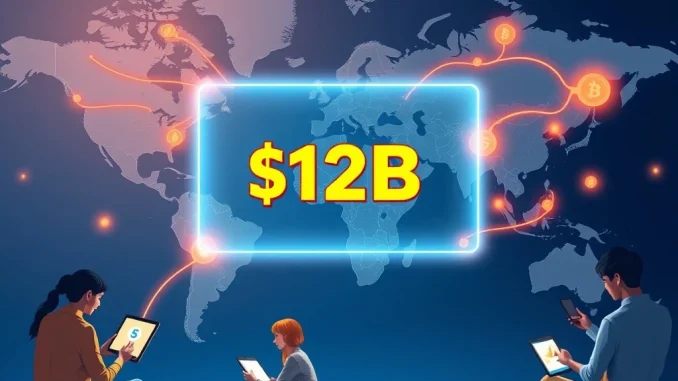
Global, May 2025: The decentralized finance landscape has witnessed a seismic shift, with prediction markets achieving a previously unimaginable milestone. Weekly trading volume across these platforms has surged to a new all-time high of $12 billion, a figure that underscores their rapid transition from niche crypto experiments to mainstream financial instruments. This record-breaking activity signals a fundamental change in how individuals and institutions approach forecasting and hedging against real-world events.
Prediction Markets Reach Unprecedented Scale
The $12 billion weekly trading volume represents more than a simple statistic. Analysts point to this figure as concrete evidence of robust, organic growth and deepening liquidity. Unlike traditional financial markets, which often see volume concentrated in a handful of assets, this activity is distributed across thousands of individual markets. These markets cover a vast array of topics, from election outcomes and economic indicators to sports results and technological milestones. The sheer diversity of these contracts attracts a broad user base, each contributing to the overall liquidity pool. This distributed model enhances market resilience and reduces the risk of manipulation in any single prediction arena.
The Engine Behind Decentralized Prediction Growth
Several key technological and social drivers have converged to propel prediction markets into the spotlight. First, the underlying blockchain infrastructure has matured significantly. Transactions are faster and cheaper than they were just a few years ago, thanks to layer-2 scaling solutions and more efficient consensus mechanisms. Second, user experience has improved dramatically. Modern prediction platforms feature intuitive interfaces that abstract away blockchain complexity, making them accessible to non-technical users. Third, there is a growing cultural acceptance of using these tools for serious decision-making. Institutions are now exploring them for risk assessment, while individuals use them to gain insights into future probabilities.
- Advanced Oracle Networks: Reliable, tamper-proof data feeds are now the backbone of these markets, ensuring accurate and timely resolution of events.
- Cross-Chain Liquidity: Assets and liquidity are no longer siloed on single blockchains, allowing for deeper pools and better prices for traders.
- Regulatory Clarity: In several jurisdictions, clearer guidelines have provided a more stable operating environment for platform developers.
From Theoretical Concept to Practical Tool
The journey of prediction markets is a story of practical application overcoming theoretical skepticism. Initially championed by academics for their ability to aggregate dispersed information, their real-world utility was limited. The advent of blockchain technology solved the critical issues of trust and global accessibility. Today, a farmer in Kenya can hedge against drought by trading in a weather prediction market, while a logistics firm in Germany might use a market predicting port congestion to inform shipping contracts. This global, permissionless access is the core innovation, transforming prediction markets from a curious idea into a functional, global utility.
Analyzing the $12 Billion Volume Milestone
Breaking down the record volume reveals important trends about participant behavior and market maturity. A significant portion of the volume is now considered “sticky”—liquidity that remains in the system across market cycles rather than chasing short-term speculative frenzies. This indicates that users are engaging with these platforms for sustained, strategic purposes. Furthermore, the distribution of volume shows increased participation in longer-dated markets, which are typically used for fundamental hedging and research, as opposed to short-term event trading. The table below illustrates a hypothetical breakdown of volume by market type, based on analyst observations from leading platforms.
| Market Category | Estimated Share of Volume | Typical Time Horizon |
|---|---|---|
| Politics & Governance | 30% | 3-12 months |
| Financial & Economic Indicators | 25% | 1-6 months |
| Technology & Science | 20% | 6-24 months |
| Sports & Entertainment | 15% | Days to weeks |
| Miscellaneous Events | 10% | Variable |
Implications for Traditional Finance and Information Markets
The rise of decentralized prediction markets presents both a challenge and a complement to traditional systems. In finance, they offer a transparent, real-time gauge of market sentiment on specific outcomes, potentially leading to more efficient pricing in related derivatives. For media and research, they provide a quantified, stake-weighted consensus view that can be a valuable data point alongside expert analysis and polls. However, this growth also raises important questions about market integrity, the potential for misinformation to influence trading, and the need for user education to distinguish between price signals and guaranteed outcomes. The industry’s focus is now shifting towards building robust governance models and educational resources to ensure sustainable growth.
Conclusion
The achievement of a $12 billion weekly trading volume is a definitive marker for decentralized prediction markets. It moves the conversation beyond potential and into the realm of proven, scalable utility. This milestone reflects a powerful convergence of technological readiness, improved user experience, and broadening mainstream acceptance. As these platforms continue to mature, their role in aggregating global knowledge and providing unique financial instruments will likely become more deeply embedded in both crypto and traditional ecosystems. The record volume is not an endpoint, but a strong indicator of a significant and lasting shift in how society manages uncertainty and values collective foresight.
FAQs
Q1: What exactly is a decentralized prediction market?
A decentralized prediction market is a platform, built on blockchain technology, that allows users to trade shares in the outcome of future events. Prices reflect the market’s collective probability estimate of that outcome occurring, creating a powerful information aggregation tool.
Q2: What does “$12 billion weekly volume” actually mean?
This figure represents the total value of all trades executed across major decentralized prediction market platforms in a single week. It includes users buying and selling positions, and its growth indicates increasing user activity, liquidity, and the overall economic significance of these markets.
Q3: Are prediction markets just for gambling on events?
No. While speculative trading exists, their primary utility is for hedging risk and gaining insight. A company might use them to hedge against a regulatory change, or a researcher might analyze prices to gauge the consensus likelihood of a scientific breakthrough.
Q4: How do these markets get accurate information to resolve bets?
They rely on decentralized oracle networks. These are systems that fetch verified real-world data from multiple independent sources and deliver it to the blockchain in a secure, tamper-resistant manner to settle markets fairly.
Q5: Is my money safe on these prediction market platforms?
Safety depends on the platform’s underlying smart contract security and the decentralization of its oracle system. While blockchain provides transparency, users must conduct due diligence, as technical vulnerabilities or oracle failures can pose risks, as with any decentralized application.
Updated insights and analysis added for better clarity.
This article was produced with AI assistance and reviewed by our editorial team for accuracy and quality.