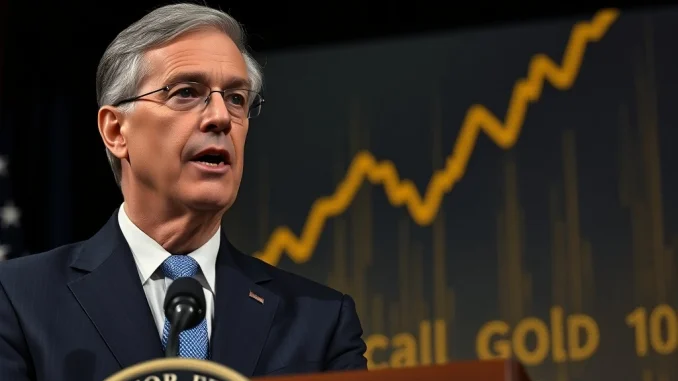
Washington, D.C., April 2025: In a move that underscores the Federal Reserve’s disciplined approach to monetary policy, Chair Jerome Powell recently addressed the financial world’s fascination with soaring gold prices. During a press conference following the Federal Open Market Committee (FOMC) meeting, Powell provided a crucial perspective, stating the central bank does not assign significant meaning to the price movements of specific assets like gold. This stance, while seemingly dismissive, reveals the intricate and measured framework the Fed employs to navigate complex global markets and maintain economic stability.
Jerome Powell Gold Price Commentary and Fed Philosophy
Chair Powell’s remarks came in direct response to a journalist’s question about the notable rally in gold prices, which have recently touched record highs. “We monitor a wide range of financial conditions and asset prices,” Powell stated, “but we do not place significant meaning on the price movements of any single asset.” This comment is not an admission of ignorance but a reflection of a core central banking principle. The Federal Reserve’s dual mandate focuses on maximum employment and price stability. Its policy tools—primarily the federal funds rate and balance sheet operations—are blunt instruments designed to influence broad economic conditions, not to target or interpret the volatility of individual commodities or stocks.
Historically, gold has served as a barometer for market sentiment, often rising during periods of perceived economic uncertainty, geopolitical tension, or anticipated inflation. However, the Fed’s models prioritize aggregated data: core inflation metrics like the Personal Consumption Expenditures (PCE) index, labor market reports, consumer spending, and business investment. A surge in a single asset class, even one as symbolically weighty as gold, represents a single data point within a vast and noisy dataset. Powell’s downplaying is a deliberate effort to steer market focus toward the comprehensive indicators that genuinely inform policy decisions.
The Federal Reserve’s Broader Market Monitoring Framework
While Powell minimized the specific significance of gold, he was careful to add, “the Fed does, however, monitor such changes.” This is a critical distinction. The Fed maintains sophisticated divisions, like the Division of Monetary Affairs, that constantly analyze financial markets. Their monitoring serves several key purposes beyond setting interest rates.
- Financial Stability Assessment: Rapid, correlated moves across asset classes can signal building systemic risks. A gold surge coupled with a falling dollar and rising bond yields might indicate a broader loss of confidence, which the Fed must understand.
- Transmission Mechanism Check: The Fed assesses how its policies are flowing through the economy. If rising rates are intended to tighten financial conditions but speculative asset prices continue to climb unabated, it may suggest the policy is not transmitting effectively.
- Sentiment Gauge: Asset prices reflect collective market psychology. Sustained moves in traditional safe-havens like gold or Treasury bonds provide qualitative insight into investor fears about inflation, growth, or stability.
The following table contrasts how the market often interprets gold prices versus the Fed’s analytical perspective:
| Market Interpretation of Gold Surge | Federal Reserve Analytical Perspective |
|---|---|
| Direct signal of imminent high inflation. | One potential indicator among many; looks at core PCE, wage growth, and inflation expectations. |
| Loss of faith in the U.S. dollar or Treasury system. | Monitors dollar index and Treasury market liquidity as part of broader financial stability checks. |
| Predictor of economic recession or crisis. | Relies on hard data: GDP forecasts, unemployment claims, consumer sentiment, and yield curve analysis. |
| A commodity to be targeted or explained by policy. | A data point within the wider constellation of financial conditions influenced by global, non-policy factors. |
Historical Context: Gold and Central Bank Communication
Powell’s approach mirrors that of his predecessors. Former Chair Alan Greenspan was famously known for his opaque, metaphorical references to “irrational exuberance” rather than commenting on specific assets. Ben Bernanke and Janet Yellen also consistently framed discussions around labor markets and inflation targets. This consistency is strategic. If a Fed Chair were to explicitly validate gold’s price move as meaningful, it could inadvertently amplify its significance, potentially fueling a feedback loop where traders buy gold anticipating a Fed reaction, thus distorting the very signal the Fed seeks to understand. By maintaining a disciplined, almost clinical detachment, Powell preserves the Fed’s focus and avoids adding fuel to speculative fires.
The recent gold rally itself has multifaceted drivers that extend beyond U.S. monetary policy, illustrating why the Fed avoids over-interpreting it. Key global factors include substantial purchases by central banks in China, India, and other emerging markets diversifying reserves, ongoing geopolitical conflicts driving safe-haven demand, and structural buying from exchange-traded funds (ETFs). Isolating the “Fed policy expectation” component from this mix is exceptionally difficult, justifying Powell’s broad-view stance.
Powell’s Advice on Politics and Central Bank Independence
Perhaps the most revealing part of the exchange was Powell’s response to a separate question about advice for his eventual successor. His succinct counsel: “stay out of politics.” This statement is profoundly interconnected with his comments on gold. Central bank independence is the bedrock of its credibility. When a central bank is perceived as making decisions based on political cycles rather than economic data, its ability to control inflation and ensure long-term stability evaporates. Market participants would then seek alternative stores of value, like gold, not because of economic fundamentals, but due to a loss of trust in the institution.
Powell’s tenure has been marked by intense political pressure from both sides of the aisle, especially during the high-inflation period of 2022-2023. His steadfast, if sometimes delayed, commitment to raising interest rates to combat inflation, despite potential political fallout, was a practical demonstration of this principle. By advising his successor to avoid politics, he is advocating for the continued use of a data-dependent framework—the same framework that leads the Fed to monitor but not overreact to a gold price surge. The independence to ignore short-term political noise is what allows the Fed to also ignore short-term market noise.
Conclusion: Monitoring Without Meaning
Jerome Powell’s downplaying of the recent gold price surge is a masterclass in central bank communication and discipline. It reaffirms that the Federal Reserve’s primary compass is built on hard economic data related to employment and inflation, not the fluctuating prices of individual assets. However, his acknowledgment of continued monitoring highlights the Fed’s vigilant role in safeguarding overall financial stability. Ultimately, Powell’s twin messages—to disregard the singular significance of gold and to stay out of politics—are two sides of the same coin. Both are essential for maintaining the credibility, focus, and independence required to execute the difficult and often unpopular task of managing the world’s largest economy. For investors, the key takeaway is to understand that while the Fed watches the markets, its reactions will be calibrated to its broad mandates, not to any single asset’s performance, no matter how glittering.
FAQs
Q1: Why did Jerome Powell downplay the significance of rising gold prices?
Chair Powell downplayed the surge to emphasize the Federal Reserve’s data-dependent framework. The Fed’s policy decisions are based on aggregated economic indicators like inflation and employment data, not the volatility of any single commodity, as its tools are designed to influence the broad economy.
Q2: Does the Federal Reserve pay any attention to gold prices?
Yes. Powell explicitly stated the Fed “monitors such changes.” Gold is watched as part of a broader analysis of financial conditions and market sentiment, helping the Fed assess potential risks to financial stability and the effectiveness of its policy transmission.
Q3: What are the main drivers of the recent gold price surge that the Fed recognizes?
Major drivers include significant purchases by foreign central banks diversifying reserves, geopolitical tensions increasing safe-haven demand, and investment flows into gold-backed ETFs. These global factors are largely separate from direct U.S. monetary policy.
Q4: What did Powell mean by advising his successor to “stay out of politics”?
He was stressing the critical importance of central bank independence. For the Fed to maintain credibility and effectively manage inflation and employment, its decisions must be based solely on economic analysis, free from short-term political pressure or influence.
Q5: How should investors interpret Powell’s comments regarding gold and other assets?
Investors should understand that while the Fed is aware of market movements, it will not adjust monetary policy specifically in response to them. Market participants should focus on the underlying economic fundamentals the Fed prioritizes, rather than anticipating a policy reaction to asset price swings.