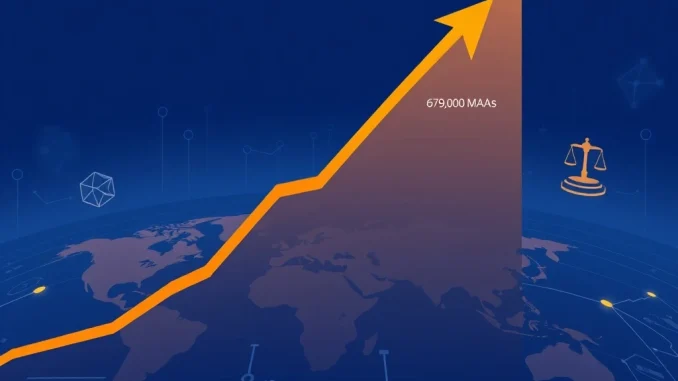
Global, May 2025: The decentralized prediction market platform Polymarket has recorded a staggering all-time high (ATH) of 679,000 monthly active addresses, according to the latest on-chain data. This unprecedented user growth directly correlates with a significant surge in the platform’s monthly trading volume, marking a pivotal moment for the prediction market sector. The milestone arrives as global financial regulators intensify their examination of crypto-based prediction and event-trading platforms, creating a complex backdrop of rapid adoption amid escalating compliance pressures.
Polymarket’s Record-Breaking User Growth and Trading Volume Surge
On-chain analytics firms first reported the new ATH for monthly active addresses (MAAs) on Polymarket in late April 2025. The figure of 679,000 represents a substantial increase from previous months and solidifies the platform’s position as a dominant force in decentralized prediction markets. Analysts directly link this spike in unique active wallets to a parallel rise in total value locked (TVL) and monthly trading volume, which has consistently broken its own records throughout the first quarter of 2025. The data indicates not just speculative interest, but sustained engagement from a growing global user base participating in markets ranging from political elections and macroeconomic events to entertainment and technology outcomes.
This growth trajectory follows a period of technical and UX-focused development on the platform. The integration of layer-2 scaling solutions has reduced transaction costs and latency, making frequent, smaller trades more feasible for a broader audience. Furthermore, the expansion of market categories beyond high-profile geopolitical events into pop culture, sports, and financial indicators has attracted a more diverse demographic of users. The 679,000 MAAs metric is a key performance indicator that reflects successful user acquisition and, critically, user retention within the competitive Web3 landscape.
Understanding the Regulatory Landscape for Prediction Markets
The remarkable growth of platforms like Polymarket occurs within an increasingly stringent regulatory environment. Prediction markets, which allow users to trade on the outcome of future events, occupy a complex legal gray area in many jurisdictions. In the United States, the Commodity Futures Trading Commission (CFTC) and the Securities and Exchange Commission (SEC) have historically scrutinized such platforms, often categorizing them under gambling regulations or securities laws. The core regulatory challenge hinges on whether prediction market contracts constitute illegal off-exchange binary options or unregistered securities offerings.
Internationally, the stance varies significantly. Some European nations apply existing gambling legislation, while others are exploring bespoke regulatory frameworks for decentralized finance (DeFi) applications. This patchwork of global regulations creates a significant compliance hurdle for borderless, blockchain-based platforms. The recent user growth on Polymarket has inevitably drawn more attention from these regulatory bodies, who are concerned with consumer protection, market manipulation, and financial integrity. Regulatory experts note that the scale implied by 679,000 active addresses often triggers threshold-based reviews in traditional finance, a precedent now being tested in crypto.
The Technical and Economic Drivers Behind the ATH
Several concurrent factors explain the surge to 679,000 monthly active addresses. Firstly, the conclusion of several major global events in Q1 2025, with clear, resolvable outcomes, built trust in the platform’s oracle and resolution mechanisms. Users who successfully traded on these markets were likely to return and explore others. Secondly, the broader cryptocurrency market entered a phase of increased stability and institutional inflow, raising the overall tide for all credible DeFi applications. Thirdly, Polymarket’s user interface and onboarding processes have seen iterative improvements, lowering the technical barrier to entry.
Economically, the platform’s design promotes liquidity. The use of automated market makers (AMMs) and liquidity pools ensures that even niche markets have sufficient depth for trading, enhancing the user experience. The data shows a positive feedback loop: more users create more liquid and diverse markets, which in turn attracts more users seeking specific trading opportunities not found elsewhere. This network effect is clearly demonstrated in the ATH metric, which is a lagging indicator of months of compounding growth in platform utility and liquidity.
Comparative Analysis: Prediction Markets vs. Traditional Finance
The rise of decentralized prediction markets invites comparison with traditional financial instruments. The table below outlines key distinctions:
| Feature | Decentralized Prediction Markets (e.g., Polymarket) | Traditional Event Derivatives / Betting Markets |
|---|---|---|
| Access & Censorship | Permissionless, global access | Geographically restricted, requires KYC |
| Market Creation | Often decentralized or community-driven | Centralized, institution-controlled |
| Settlement | Automated via blockchain oracles | Manual or institutionally verified |
| Regulatory Status | Evolving, often unclear | Heavily regulated and licensed |
| Asset Type | Typically crypto-collateralized | Fiat-collateralized |
This contrast highlights why prediction markets face unique regulatory scrutiny. Their decentralized nature challenges conventional jurisdictional and enforcement models, while their global user base—evidenced by the 679,000 MAAs—complicates consumer protection frameworks designed for national markets. Regulators are grappling with how to apply principles of market fairness and anti-manipulation to systems where the oracle (the data source that determines market outcomes) is a critical, yet potentially vulnerable, component.
Expert Perspectives on Sustainability and Compliance
Financial technology analysts emphasize that sustainable growth for prediction markets depends on navigating the regulatory frontier. “A record of 679,000 monthly active addresses is a powerful signal of market fit,” notes Dr. Anya Sharma, a fintech researcher at the Digital Governance Institute. “However, it also represents 679,000 potential touchpoints for regulatory concern. The platforms that thrive will be those that proactively engage with regulators to demonstrate robust anti-fraud mechanisms, clear dispute resolution, and responsible market design, rather than those that operate purely on the principle of seeking forgiveness later.”
This perspective is echoed by compliance specialists within the crypto industry. They point to a trend of “regulated DeFi,” where platforms implement know-your-customer (KYC) checks at certain access points or for specific high-value markets, creating a hybrid model. The immense user growth puts pressure on Polymarket and its peers to invest heavily in compliance technology and legal expertise to ensure this growth is not jeopardized by enforcement actions. The path forward likely involves distinguishing between financialized prediction markets and those for casual events, with tailored regulatory approaches for each.
Conclusion: Growth at a Regulatory Crossroads
Polymarket’s achievement of 679,000 monthly active addresses is a definitive milestone for the prediction market sector, underscoring significant global demand for decentralized event-driven trading. The data confirms a powerful product-market fit and a maturing infrastructure capable of supporting large-scale user engagement. However, this very success amplifies the sector’s central challenge: operating at the intersection of innovative finance and evolving global regulation. The future trajectory of platforms like Polymarket will depend not only on their ability to attract users but on their capacity to build transparent, compliant, and resilient systems that satisfy both user demand for open markets and regulatory demands for safety and fairness. The record ATH is therefore both a celebration of adoption and a stark reminder of the complex responsibilities that come with it.
FAQs
Q1: What are monthly active addresses (MAAs)?
Monthly active addresses are a key blockchain metric that counts the number of unique wallet addresses that initiated a transaction on a specific platform or protocol within a 30-day period. It is a standard measure of user engagement and network growth in decentralized applications.
Q2: Why is regulatory scrutiny increasing on prediction markets?
Regulatory scrutiny is increasing due to their rapid growth, borderless nature, and concerns over consumer protection, market manipulation, and whether the trading contracts constitute unregulated securities or gambling instruments. High user numbers, like Polymarket’s 679,000 MAAs, bring more mainstream attention from financial authorities.
Q3: How does Polymarket’s trading volume relate to active addresses?
Generally, a higher number of monthly active addresses correlates strongly with higher trading volume. More users create more trading activity, provide more liquidity, and generate more fees for the platform. The ATH in addresses directly contributed to a concurrent ATH in monthly trading volume.
Q4: What is an oracle in the context of prediction markets?
An oracle is a service that feeds real-world data (like election results or sports scores) onto the blockchain. Prediction markets rely on oracles to automatically and trustlessly settle contracts based on the outcome of real events. The reliability and security of the oracle are critical for the platform’s integrity.
Q5: Can prediction markets like Polymarket operate globally without restrictions?
While blockchain technology allows for permissionless access, platforms often implement geoblocking or restrict users from jurisdictions with explicit bans to manage legal risk. The decentralized nature makes enforcement difficult, but most major platforms take steps to restrict access in certain countries due to regulatory pressure.