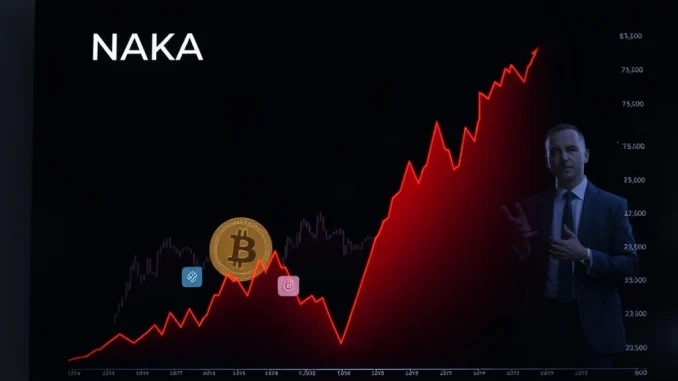
NAKA Crash: $23.6B Erased in Stunning 99% Plunge After Bitcoin Treasury Gamble
Global Cryptocurrency Markets, April 2025: The cryptocurrency NAKA has experienced a catastrophic decline, shedding 99.32% of its value over 280 days and erasing an estimated $23.64 billion in market capitalization. This stunning collapse is directly tied to a high-stakes treasury strategy by its associated company, Nakamoto Inc., which involved significant Bitcoin purchases near the asset’s all-time highs. The event serves as a stark case study in the volatile interplay between corporate treasury management, token valuation, and broader market sentiment.
NAKA Crash: A Timeline of the 99% Plunge
The descent of NAKA from its peak represents one of the most severe drawdowns in recent crypto history. Analysis of market data reveals the decline was not a single-day event but a prolonged erosion of confidence and value spanning several months. The downturn began shortly after Nakamoto Inc., the entity closely linked to the NAKA ecosystem, publicly disclosed a major shift in its corporate strategy. The company announced it would convert a substantial portion of its reserves into Bitcoin, positioning the cryptocurrency as its primary treasury asset. This move was initially met with optimism by some segments of the market, viewing it as a bold endorsement of Bitcoin’s long-term value. However, the timing proved disastrous. The purchases, totaling 5,398 BTC, were executed at an average price nearing $118,000 per Bitcoin—a level close to the market’s historical peak at that time.
Anatomy of a Failed Bitcoin Bet
Nakamoto Inc.’s foray into a Bitcoin-heavy treasury has resulted in profound financial consequences. With Bitcoin’s price failing to sustain its record highs and entering a subsequent corrective phase, the value of the company’s holdings has sharply declined. The 5,398 BTC, once worth approximately $637 million at the purchase price, now carries an unrealized loss estimated at $270 million, assuming current market prices. This massive paper loss on the company’s balance sheet has had a direct and severe impact on investor perception of the NAKA token. The token’s value was intrinsically linked to the perceived strength and strategic acumen of Nakamoto Inc. As the Bitcoin bet soured, confidence in the company’s management and, by extension, the utility and future of the NAKA ecosystem evaporated.
- Strategic Misstep: Concentrating treasury assets in a single volatile asset (Bitcoin) at peak prices.
- Market Timing: Executing large purchases without apparent dollar-cost averaging, exposing the treasury to immediate downside risk.
- Liquidity Impact: The declining value of the Bitcoin collateral potentially affected the company’s operational liquidity and ability to fund ecosystem development.
The Ripple Effect on Trading and Sentiment
The financial impairment of Nakamoto Inc.’s strategy triggered a vicious cycle for the NAKA token. As news of the unrealized losses circulated, trading volumes, which are a key indicator of market health and liquidity, began to dry up. Falling volumes often precede increased price volatility and make the asset susceptible to larger swings on smaller trades. Weak investor sentiment solidified, creating a feedback loop where fear of further decline discouraged new buying and encouraged existing holders to exit. The token’s market depth—the ability to execute large orders without drastically affecting the price—likely deteriorated significantly, exacerbating the downward pressure. This environment stands in contrast to projects with diversified treasuries or more conservative asset management, which have generally exhibited greater stability during market downturns.
Bitcoin’s Central Role in Hopes for Recovery
The future trajectory of NAKA is now inextricably tied to the price movements of Bitcoin. For Nakamoto Inc. to stem the bleeding and potentially restore some value to its treasury—and by proxy, investor confidence in NAKA—a sustained recovery in Bitcoin’s market price is essential. The company’s ability to execute its roadmap, fund development, and maintain operations may be constrained until the value of its Bitcoin holdings recovers. This creates a precarious dependency. While a strong Bitcoin bull market could theoretically bail out the strategy and revive the NAKA token, it also means NAKA’s fate is largely out of its developers’ hands and subject to the whims of the broader crypto market. This dynamic highlights a critical risk of over-concentration in corporate crypto strategies.
Historical Context and Industry Implications
The NAKA situation is not without precedent in the digital asset space. History is littered with examples of tokens collapsing after failed associated ventures or poor treasury management. However, the scale of this loss, at over $23 billion in erased market value, places it among the most significant. The event is likely to prompt serious reflection industry-wide. Other projects with similar Bitcoin-centric treasury models may face increased scrutiny from their communities. Investors and analysts are now placing greater emphasis on transparent, risk-managed, and diversified treasury strategies. The episode underscores that while Bitcoin is often viewed as “digital gold,” treating it as a risk-free asset for corporate finance is a dangerous miscalculation. Prudent risk management, including asset diversification and phased accumulation strategies, remains as crucial in cryptocurrency as in traditional finance.
Conclusion
The NAKA crash, resulting in a 99% loss of value and the evaporation of $23.6 billion, stands as a powerful cautionary tale. It was precipitated not by a technical failure of its blockchain, but by a high-risk Bitcoin treasury strategy executed by Nakamoto Inc. at an inopportune time. The resulting $270 million in unrealized losses on their Bitcoin bet shattered market confidence, leading to collapsing trading volumes and a total erosion of token value. This event vividly illustrates the profound risks of corporate treasury mismanagement in the crypto era and demonstrates how the fortunes of an altcoin can become dangerously leveraged to the price of Bitcoin itself. The path to any potential recovery for NAKA now appears wholly dependent on a sustained Bitcoin rally, leaving its future uncertain and serving as a stark lesson for the entire cryptocurrency industry.
FAQs
Q1: What caused the NAKA token to crash 99%?
The primary cause was a loss of investor confidence following Nakamoto Inc.’s strategic decision to buy 5,398 Bitcoin near its all-time high. As Bitcoin’s price fell, the company faced massive unrealized losses, undermining faith in the NAKA ecosystem and triggering a sell-off.
Q2: How much did Nakamoto Inc. lose on its Bitcoin bet?
The company purchased Bitcoin at an average price near $118,000. Based on the difference between that purchase price and Bitcoin’s subsequent lower market value, Nakamoto Inc. is carrying approximately $270 million in unrealized losses on its 5,398 BTC holdings.
Q3: Can NAKA recover from this crash?
Any significant recovery for NAKA is largely contingent on a strong and sustained increase in Bitcoin’s price, which would improve Nakamoto Inc.’s treasury balance. However, regaining lost trust and market liquidity presents a major additional challenge.
Q4: What is a Bitcoin treasury strategy?
A Bitcoin treasury strategy is when a company, often in the crypto space, holds a significant portion of its corporate reserves in Bitcoin instead of traditional cash or bonds. It is intended as a hedge against inflation and a bet on Bitcoin’s long-term appreciation, but it carries high volatility risk.
Q5: What lessons can other crypto projects learn from the NAKA crash?
Key lessons include the dangers of concentrating treasury assets in a single volatile cryptocurrency, the importance of prudent dollar-cost averaging over large lump-sum purchases, and the need for transparent risk management to maintain investor confidence.
Related News
- UK Banks Block Crypto Transfers: Shocking 40% of Exchange Deposits Hindered, Report Reveals
- Quantum Threat to Ethereum: Vitalik Buterin's Urgent Warning Reveals 2028 Security Deadline
- Kansas Bitcoin Reserve: Pioneering Legislation Aims to Transform State Treasury with Abandoned Digital Assets
Related: Solana Whale Awakens: 50,000 SOL Shift from Exchanges to Staking Signals Major Confidence
Related: OpenClaw Discord Crypto Ban: The Shocking Policy That Silenced Bitcoin Talk
Related: Essential Analysis: 4 Cryptocurrencies Showing Strong Growth Signals for 2026