Federal Reserve Chair Jerome Powell’s recent statements offer vital clarity on a critical economic debate. His perspective on tariffs and their impact on inflation holds significant weight for global markets. Investors, particularly those navigating the dynamic cryptocurrency landscape, closely monitor such economic signals. Understanding the Federal Reserve policy on price stability helps to gauge the broader US economic outlook. This insight can influence investment strategies and risk assessment.
Jerome Powell Tariffs: Unpacking the Fed’s Stance
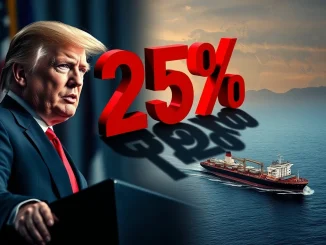
Speaking on the economic outlook in Warwick, Rhode Island, Federal Reserve Chair Jerome Powell delivered a notable assessment. He specifically addressed the widely discussed topic of trade tariffs. Powell stated that these import taxes are not a significant factor in current inflation trends. This assertion challenges a common perception regarding their economic impact. He noted that the ‘pass-through effect’ of tariffs has been considerably smaller than anticipated.
Furthermore, Powell explained that businesses appear to be absorbing these additional costs. They are not yet significantly passing them on to consumers. This absorption mechanism prevents a direct rise in consumer prices. Therefore, the immediate impact on household budgets remains limited. This observation provides a nuanced view of trade policy’s real-world economic consequences. It also highlights the adaptive capacity of the business sector.
Understanding Inflation Drivers Beyond Tariffs
While tariffs often capture headlines, the Federal Reserve monitors a much broader range of inflation drivers. These include robust consumer demand, wage growth, and disruptions in global supply chains. Energy prices, for instance, also play a substantial role. Monetary policy decisions, such as adjustments to interest rates, are equally crucial. Powell’s comments help to redirect focus towards these more fundamental economic forces. He emphasized that the overall US economic outlook is shaped by a multitude of interconnected factors. The Fed, consequently, adopts a holistic approach when evaluating price stability across the economy.
Economic theory often categorizes inflation into two main types. Demand-pull inflation occurs when aggregate demand outstrips supply. Conversely, cost-push inflation arises from increased production costs. Powell’s statement suggests that tariffs, in this instance, are not contributing significantly to cost-push inflation. This nuanced understanding is essential for effective policymaking. It also helps the public grasp the complexities of economic dynamics.
Federal Reserve Policy and Its Economic Impact
The Federal Reserve policy operates with a dual mandate. Its primary goals are to achieve maximum employment and maintain stable prices. This commitment to price stability is paramount. When the Fed communicates its assessment, such as on the impact of tariffs, it provides crucial guidance. This clarity helps to anchor market expectations. It also informs investment decisions across various sectors.
Moreover, a stable inflation outlook generally supports long-term economic planning. Businesses can invest with greater confidence. Consumers can manage their finances more predictably. Conversely, high or unpredictable inflation can introduce significant uncertainty. This uncertainty often leads to market volatility. Assets like cryptocurrencies, which are sometimes seen as hedges against traditional financial instability, can be particularly sensitive to such shifts. Therefore, the Fed’s consistent communication is vital for market equilibrium.
The Current US Economic Outlook
The broader US economic outlook remains a central focus for policymakers and global investors alike. Various indicators paint a comprehensive picture of the nation’s economic health. Gross Domestic Product (GDP) growth, unemployment rates, and consumer confidence surveys are all closely watched. Manufacturing output and housing market data also contribute significantly to this assessment. Powell’s recent remarks on tariffs offer a specific piece of this intricate puzzle. They suggest that external trade pressures, while relevant, are not the sole or primary determinant of domestic consumer prices. This perspective helps refine economic forecasts.
Global trade tensions have been a recurring theme in recent years. Many analysts initially feared a substantial inflationary impact from these measures. However, Powell’s statement indicates a different reality. Businesses have demonstrated adaptability. This adaptability has mitigated some of the anticipated adverse effects. Consequently, the domestic economy shows resilience in certain areas. This ongoing evaluation informs future policy decisions by the Fed.
Monitoring Consumer Prices and Market Stability
The Federal Reserve diligently monitors consumer prices using several key metrics. The Personal Consumption Expenditures (PCE) price index is particularly favored by the Fed. It provides a broad measure of inflation across goods and services. Stable and predictable inflation is absolutely vital for sustained economic health. It enables both businesses and households to plan effectively for the future. When the Fed clearly articulates its understanding of inflation drivers, it helps maintain overall market stability.
This transparency is crucial for fostering confidence among investors and the general public. Ultimately, the Fed’s objective is to promote sustained economic growth alongside maximum employment. Its rigorous analysis ensures that monetary policy decisions are data-driven. Therefore, Powell’s clarification on tariffs reassures markets that the Fed has a clear grasp of inflationary pressures. This commitment to clarity underpins broader economic confidence.
Conclusion: Tariffs and the Inflation Debate
Federal Reserve Chair Jerome Powell’s recent statement offers a measured and insightful perspective on tariffs. He confirmed their limited direct impact on domestic inflation. By asserting that businesses are largely absorbing these costs, he indicated that trade measures are not a primary force driving higher consumer prices. This insight is critical for understanding current Federal Reserve policy. It also helps clarify the broader US economic outlook.
Ultimately, this reinforces the idea that inflation is a multifaceted phenomenon. It is influenced by numerous factors well beyond just trade barriers. Investors, including those active in the dynamic crypto space, continuously analyze such economic signals. These statements provide crucial guidance for navigating complex market conditions. Powell’s clarity helps demystify one aspect of the ongoing inflation debate, promoting greater economic understanding.
Frequently Asked Questions (FAQs)
1. What did Jerome Powell say about tariffs and inflation?
Jerome Powell stated that tariffs are not a major driver of inflation. He noted that the pass-through effect of tariffs has been smaller than anticipated, with businesses largely absorbing the costs rather than passing them on to consumers.
2. How do tariffs typically affect consumer prices?
Typically, tariffs are taxes on imported goods. They can increase the cost of those goods, which businesses might then pass on to consumers through higher retail prices. However, Powell’s statement suggests that this pass-through has been limited in the current economic climate.
3. What are the Federal Reserve’s primary inflation drivers?
The Federal Reserve considers various factors as primary inflation drivers, including strong consumer demand, wage growth, supply chain disruptions, and energy prices. Monetary policy adjustments, such as changes to interest rates, also play a significant role.
4. How does the Federal Reserve measure inflation?
The Federal Reserve primarily measures inflation using the Personal Consumption Expenditures (PCE) price index. This index tracks the prices of goods and services purchased by consumers and is preferred over the Consumer Price Index (CPI) due to its broader coverage and ability to account for substitution effects.
5. Why is the Fed’s stance on tariffs important for the US economic outlook?
The Fed’s stance provides clarity on specific economic pressures. By stating tariffs are not a major inflation driver, it helps refine the overall US economic outlook. This information can influence market expectations, investment decisions, and broader economic planning by indicating where inflationary pressures are (or are not) originating.
6. Does this statement indirectly impact cryptocurrency markets?
While not directly about cryptocurrency, Powell’s statements on inflation and the US economic outlook indirectly affect crypto markets. Economic stability and the Fed’s monetary policy influence investor sentiment, risk appetite, and liquidity in the broader financial system, which can, in turn, impact cryptocurrency valuations and trading activity.
This article was produced with AI assistance and reviewed by our editorial team for accuracy and quality.