
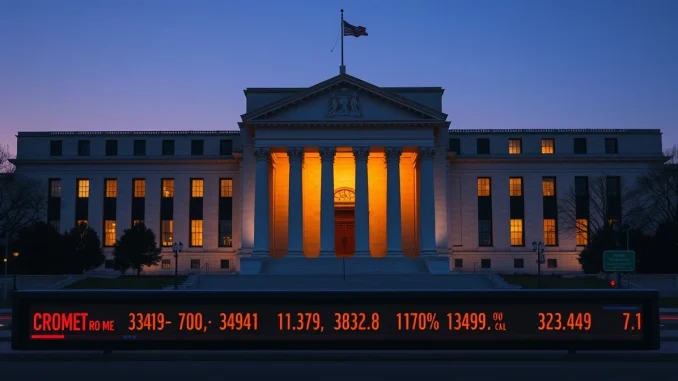
WASHINGTON, D.C. — Federal Reserve officials are openly debating the potential for interest rate reductions later this year, but a dangerous new variable has entered their calculations: the expanding conflict involving Iran. Minutes from the March Federal Open Market Committee meeting, released on April 8, 2026, show a central bank divided on how to respond to simultaneous pressures from stubborn inflation and rising geopolitical instability.
Fed Minutes Reveal Deep Policy Split
The March 17-18 meeting concluded with an 11-1 vote to hold the benchmark federal funds rate steady at its current range of 3.5% to 3.75%. That outcome was widely expected. The real story lies in the detailed discussion behind that vote. According to the official record, “many participants judged that, in time, it would likely become appropriate to lower the target range for the federal funds rate if inflation were to decline in line with their expectations.” This language keeps the door open for a policy shift.
Also read: Bitcoin Hashrate in Iran Plummets 77% as Conflict and Price Slump Reshape Global Mining Map
But the consensus was fragile. Other officials warned that the opposite move might be necessary. The minutes note that “some participants judged that there was a strong case for a two-sided description of the Committee’s future interest rate decisions.” This phrasing directly acknowledges the possibility of rate hikes if price pressures fail to cool. The implication is clear. The Fed’s path is not predetermined.
Iran Conflict Adds Major Uncertainty
The war in the Middle East, specifically involving Iran, has become a primary concern for policymakers. Officials stated it was “too early to know how developments in the Middle East would affect the U.S. economy.” This admission of uncertainty is significant. Geopolitical events typically influence monetary policy through two channels: energy prices and broader financial market sentiment.
Also read: Changpeng Zhao's Revealing Memoir: Inside Binance's Tumultuous Rise and Fall
A prolonged conflict risks spiking global oil prices, which could reignite inflationary forces the Fed has spent years combating. Conversely, a major geopolitical shock could dampen business investment and consumer confidence, slowing economic growth and arguing for more accommodative policy. The Fed is trying to gauge which force will dominate. Industry watchers note that the central bank’s models have historically been poor at pricing in sudden geopolitical ruptures.
The Inflation Versus Growth Dilemma
This tension defines the current policy dilemma. Consumer price data for February showed inflation running at a 3.1% annual rate, still above the Fed’s 2% target. At the same time, recent employment reports have indicated a softening labor market. The minutes highlight this concern, noting that “in the current situation of low rates of net job creation, labor market conditions appeared vulnerable to adverse shocks.”
What this means for investors is a Fed that is data-dependent to an extreme degree. Every new inflation print and jobs report will be scrutinized. Every development in the Middle East will be assessed for its economic impact. The central bank has explicitly rejected providing a fixed calendar for rate moves.
Market Expectations and the Path Ahead
Financial markets have absorbed the Fed’s cautious message. Data from the CME Group’s FedWatch tool shows traders currently assign a 75.6% probability that rates will remain unchanged at the December 2026 policy meeting. The chance of a cut is priced at 20.4%, while the probability of a hike sits at just 2.4%. This suggests investors see a steady stance as the most likely outcome, but are hedging against the risk of a dovish pivot if the economy weakens.
The Fed’s last rate move was a 25-basis-point cut on December 10, 2025. Since then, the economic picture has grown more complex. Analysts point out that the current rate range, while down from the peaks of 2024, remains restrictive by historical standards. Further cuts would provide relief to sectors like housing and automotive, which are sensitive to borrowing costs.
Broader Economic Implications
The policy debate extends beyond traditional markets. Rate cuts are generally viewed as a positive for speculative assets, including cryptocurrencies, as they increase system liquidity and can push investors toward higher-risk opportunities. However, the minutes contained no direct commentary on digital assets. The Fed’s focus remains squarely on its dual mandate of price stability and maximum employment.
The global context also matters. Other major central banks, including the European Central Bank and the Bank of England, are facing similar trade-offs. A coordinated shift toward easier policy could emerge later in 2026, but for now, each institution is wrestling with domestic data and unique geopolitical exposures.
Conclusion
The March FOMC minutes paint a picture of a Federal Reserve at a crossroads. The possibility of Fed rate cuts in 2026 remains alive, but it is contingent on a decline in inflation that has not yet materialized. The wild card is the Iran war, an external shock that could derail economic forecasts in either direction. The next meeting on April 28-29 will provide further clues, but the central message is one of heightened vigilance. Policymakers are preparing for multiple scenarios, refusing to be locked into a single path while global risks escalate.
FAQs
Q1: What did the Fed decide at its March 2026 meeting?
The Federal Open Market Committee voted 11-1 to keep the federal funds rate in a range of 3.5% to 3.75%. The decision was expected, but the meeting minutes revealed deep discussions about future policy.
Q2: How does the Iran war affect the Fed’s decisions?
The conflict creates major uncertainty. It could push inflation higher via energy prices or slow growth by damaging confidence. The Fed stated it is too early to gauge the full economic impact, making future rate decisions more difficult.
Q3: What are the chances of a rate cut in 2026?
Based on market pricing from the CME FedWatch tool, traders see about a 20% chance of a cut by December 2026. The majority expectation is for rates to hold steady, but this could change quickly with new data or geopolitical events.
Q4: Why are some Fed officials talking about rate hikes?
Inflation remains above the Fed’s 2% target. Some officials worry that if price pressures stall or reverse, the Committee may need to consider raising rates again to ensure inflation returns to target, though this is currently seen as a lower-probability outcome.
Q5: When is the next FOMC meeting?
The next scheduled Federal Open Market Committee meeting is set for April 28-29, 2026. The policy decision and updated economic projections will be released on April 29, followed by a press conference with Chair Jerome Powell.

This article was produced with AI assistance and reviewed by our editorial team for accuracy and quality.




Be the first to comment