For cryptocurrency investors, understanding the broader economic landscape is paramount. The Federal Reserve’s decisions on interest rates significantly influence market sentiment and asset valuations. Therefore, a recent statement from Cleveland Federal Reserve Bank President Beth Hammack warrants close attention.
Cleveland Fed President Discusses Fed Rate Cut Outlook
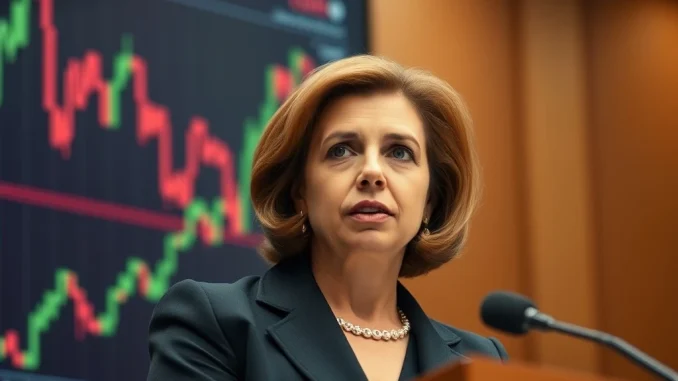
Cleveland Federal Reserve Bank President Beth Hammack recently offered a clear perspective on the immediate future of U.S. monetary policy. She indicated that current economic data does not support a Fed rate cut in September. This statement came via a report from the Walter Bloomberg economic news account on X.
Hammack’s remarks provide insight into the thinking within the Federal Reserve. Policymakers continuously assess various economic indicators. Their goal is to determine the most appropriate path for interest rates. Her assessment suggests a cautious approach. The Fed prioritizes data-driven decisions. This stance aims to ensure long-term economic stability.
The Federal Reserve operates with a dual mandate. They strive for maximum employment and price stability. These objectives guide all their policy decisions. Current inflation levels and labor market conditions play a significant role. These factors directly influence whether the Fed will adjust rates. Therefore, Hammack’s comments reflect ongoing internal deliberations.
Understanding Interest Rates and Their Economic Impact
Interest rates are a fundamental tool of monetary policy. They affect nearly every aspect of the economy. When the Federal Reserve raises rates, borrowing becomes more expensive. This discourages spending and investment. Conversely, lower rates make borrowing cheaper. This stimulates economic activity.
Here’s how interest rates influence the economy:
-
Consumer Spending: Higher rates mean more expensive loans for cars, homes, and credit cards. Consumers tend to spend less.
-
Business Investment: Companies face higher costs for borrowing capital. This can slow expansion plans and job creation.
-
Savings: Higher rates can encourage saving. Savers earn more on their deposits.
-
Asset Prices: Higher rates often reduce the attractiveness of riskier assets. This includes stocks and cryptocurrencies. Fixed-income investments become more appealing.
The Fed adjusts these rates to manage inflation and employment. Too much inflation erodes purchasing power. High unemployment harms economic growth. Therefore, the Fed constantly balances these competing forces.
Beth Hammack’s Stance and the Current Economic Outlook
Beth Hammack’s assessment highlights the Federal Reserve’s current focus. She emphasizes a data-dependent approach. This means the Fed will not rush into policy changes. Instead, they will carefully evaluate incoming economic reports.
The decision to hold rates steady, or to cut them, depends on several key metrics. These include:
-
Inflation Data: The Consumer Price Index (CPI) and Personal Consumption Expenditures (PCE) are crucial. The Fed aims for 2% inflation. If inflation remains elevated, rate cuts are less likely.
-
Employment Figures: Job growth, unemployment rates, and wage increases provide insights. A strong labor market might allow the Fed to maintain higher rates.
-
GDP Growth: Gross Domestic Product indicates overall economic health. Robust growth might suggest less need for rate cuts.
Hammack’s statement implies that current data points do not yet show sufficient cooling. This cooling would be necessary to justify a September rate reduction. This cautious approach reflects the Fed’s commitment. They want to avoid prematurely easing policy. Such a move could reignite inflationary pressures.
Navigating Monetary Policy and Market Reactions
The Federal Reserve’s monetary policy directly influences financial markets. When officials signal a delay in rate cuts, markets often react. Stock markets might experience volatility. Bond yields could adjust upwards. This reflects investors’ revised expectations.
For the cryptocurrency market, the impact is often pronounced. Crypto assets are generally considered riskier investments. Higher interest rates make safer assets, like bonds, more attractive. This can draw capital away from speculative assets. Therefore, a prolonged period of higher rates can create headwinds for crypto prices. Investors closely monitor Fed communications for any hints. These hints guide their investment strategies.
The market had previously priced in potential rate cuts later in the year. Hammack’s comments challenge this expectation. This adjustment in market sentiment can lead to short-term price movements. Traders and analysts will now recalibrate their forecasts. They will focus on upcoming economic reports. These reports will either confirm or contradict the current outlook.
The Broader Economic Outlook and Future Considerations
The economic outlook remains dynamic. Various global and domestic factors shape it. Geopolitical events can impact supply chains and commodity prices. Consumer confidence and spending patterns are also vital. These elements collectively influence the Fed’s decisions.
While September seems unlikely for a rate cut, the situation can change. Future data releases will be critical. A significant slowdown in inflation could alter the Fed’s stance. Likewise, unexpected weakness in the labor market might prompt action. The Fed maintains flexibility in its policy. They respond to evolving economic conditions.
Investors should continue to monitor official statements. Speeches from other Fed officials provide additional clues. The summary of economic projections (SEP) offers a collective view. This document outlines policymakers’ forecasts for inflation, unemployment, and GDP. It also includes their individual rate expectations. This comprehensive data helps market participants anticipate future policy moves.
In conclusion, Beth Hammack’s recent remarks underscore the Fed’s cautious approach. A September rate cut appears off the table based on current information. This outlook has implications across financial markets, including cryptocurrencies. Staying informed about monetary policy remains essential for navigating these complex economic waters.
Frequently Asked Questions (FAQs)
Q1: What is the Federal Reserve’s primary goal with interest rates?
The Federal Reserve aims to achieve maximum employment and price stability. They use interest rates as a tool to manage inflation and support a healthy job market.
Q2: How do higher interest rates affect the cryptocurrency market?
Higher interest rates typically make safer investments, like bonds, more attractive. This can reduce investor appetite for riskier assets such as cryptocurrencies, potentially leading to price declines.
Q3: What data does the Fed consider for a Fed rate cut decision?
The Fed closely monitors inflation data (like CPI and PCE), employment figures (job growth, unemployment rate), and overall GDP growth. These indicators help them assess the economic outlook.
Q4: Why is Beth Hammack’s statement about no September rate cut significant?
Beth Hammack is a Federal Reserve Bank President. Her statements offer direct insight into the Fed’s current thinking and data assessment. This helps set market expectations for future monetary policy actions.
Q5: Could the Fed still cut rates later in the year?
Yes, the Federal Reserve’s policy is data-dependent. If future economic data, particularly on inflation or employment, changes significantly, the Fed could still decide to cut interest rates later in the year.
This article was produced with AI assistance and reviewed by our editorial team for accuracy and quality.