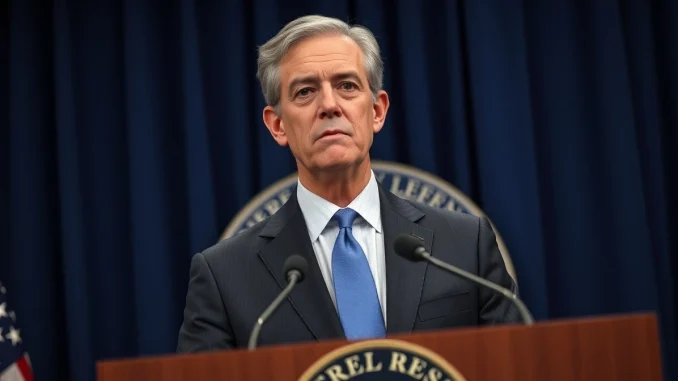
WASHINGTON, D.C. — March 19, 2026 — The Federal Reserve announced a pivotal decision to maintain its benchmark interest rate, citing significant economic crosscurrents and the daunting shadow of geopolitical conflict. Consequently, the Federal Open Market Committee (FOMC) voted to hold the target range for the federal funds rate at 3.5% to 3.75%, a move widely anticipated by financial markets. This decision underscores the central bank’s delicate balancing act between persistent inflation and emerging economic soft spots, all while navigating the unpredictable fallout from ongoing war in the Middle East.
Federal Reserve Holds Rates Amid Economic Crosscurrents
Federal Reserve Chairman Jerome Powell outlined a mixed economic picture following the March 2025 FOMC meeting. He stated that economic activity has expanded at a solid pace, supported by resilient consumer spending and continued business investment growth. However, Powell immediately tempered this optimism by highlighting persistent weaknesses. Specifically, the housing sector remains subdued, and the labor market shows clear signs of softening after a prolonged period of strength.
Most critically, inflation remains somewhat elevated above the Fed’s longstanding 2% target. This creates a direct tension within the Fed’s dual mandate, which charges it with both maximizing employment and stabilizing prices. Powell acknowledged this challenge, noting that policymakers must carefully weigh the risks of acting too aggressively against those of acting too slowly.
Geopolitical Shock Clouds the Economic Outlook
The ongoing conflict in the Middle East, particularly involving Iran, introduces a major layer of uncertainty. Chairman Powell explicitly stated that the implications for the U.S. economy remain highly uncertain in the near term. The primary transmission mechanism is through energy markets. Higher oil prices resulting from regional instability directly push up overall inflation, complicating the Fed’s disinflationary efforts.
Nevertheless, the ultimate size and duration of this macroeconomic shock are still unknown. Analysts note that the Fed must now consider a supply-side shock—something monetary policy cannot directly fix—on top of existing domestic demand pressures. This geopolitical overhang makes forecasting exceptionally difficult and increases the probability of policy error.
Market Reactions and Analyst Perspectives
Financial markets had overwhelmingly priced in a steady policy decision. Data from the Chicago Mercantile Exchange (CME) showed that 97% of market participants forecast no change at this meeting. A minority 3% anticipated a 25-basis-point hike. The focus has now shifted to the future path of policy, with traders keenly parsing the Fed’s language for clues on the timing of any potential rate cuts or further hikes.
The connection between interest rate policy and risk assets like cryptocurrencies and equities remains fundamental. Lower rates typically stimulate asset prices by reducing the yield on safe-haven government bonds, making riskier investments more attractive. Conversely, higher rates restrict asset prices by pulling investment capital toward bonds. Following the announcement, Bitcoin demonstrated volatility, reflecting this sensitivity to liquidity expectations.
Several prominent market voices have weighed in. Arthur Hayes, co-founder of BitMEX, has publicly stated he awaits Fed rate cuts before resuming significant Bitcoin purchases. He has also speculated that conflict financing needs could pressure the Fed toward easier monetary policy. Meanwhile, macroeconomist Lyn Alden has described the current environment as a “gradual print” phase, where steady money creation slowly elevates asset prices across the board.
The Fed’s Policy Toolkit and Forward Guidance
With rates held steady, the Fed’s primary tools are its forward guidance and balance sheet policy. The statement’s language regarding future actions is therefore scrutinized more than the immediate decision. Powell emphasized a data-dependent approach, meaning future meetings will be “live” and decisions will hinge on incoming information on inflation, employment, and the geopolitical situation.
The Fed also continues to reduce its balance sheet through quantitative tightening (QT), allowing maturing securities to roll off without reinvestment. This process passively removes liquidity from the financial system, acting as a complementary tightening measure to the active setting of interest rates. No changes to the pace of QT were announced.
Historical Context and the Inflation Fight
The current rate range of 3.5-3.75% represents a plateau following one of the most aggressive hiking cycles in modern Fed history. Beginning in early 2022, the Fed raised rates from near-zero to combat surging post-pandemic inflation. While inflation has retreated from its peak, the “last mile” back to the 2% target has proven stubborn, complicated by tight labor markets and now external energy shocks.
This period draws comparisons to the 1970s, when oil price shocks led to stagflation—a combination of high inflation and stagnant growth. However, today’s economy exhibits stronger underlying fundamentals, and the Fed’s credibility on inflation is significantly higher than it was five decades ago. The central bank’s current challenge is to avoid a premature declaration of victory that could let inflation become entrenched.
Global Implications and Central Bank Coordination
The Fed’s decision has immediate global repercussions. Many central banks, especially in emerging markets, align their policy trajectories with the Fed’s to manage currency stability and capital flows. A steady Fed rate provides temporary relief for these banks, but prolonged uncertainty can still trigger volatility. Furthermore, global economic growth forecasts for 2026 are being revised downward due to the same geopolitical tensions affecting the U.S. outlook.
International bodies like the International Monetary Fund (IMF) have warned that fragmentation and conflict pose severe risks to global economic stability. The Fed’s caution reflects these broader, systemic concerns, indicating that domestic policy cannot be made in an international vacuum.
Conclusion
The Federal Reserve’s decision to hold interest rates steady is a defensive move in a highly uncertain environment. It reflects a pragmatic assessment of competing domestic risks—elevated inflation versus a softening labor market—now magnified by an external geopolitical shock. Chairman Powell’s message was clear: the path forward is clouded, and the Fed will proceed with caution. For markets, businesses, and consumers, this means preparing for extended volatility and a central bank poised to react, not pre-empt, as the fog of war and economic data slowly lifts.
FAQs
Q1: What is the current Federal Funds rate?
The Federal Open Market Committee (FOMC) is maintaining the target range for the federal funds rate at 3.5% to 3.75%.
Q2: Why did the Fed decide to keep rates unchanged?
The Fed cited a mixed economic picture with solid growth but softening labor conditions, elevated inflation, and significant uncertainty from the geopolitical situation in the Middle East, which affects energy prices and the broader economic outlook.
Q3: How does the war in the Middle East affect the Fed’s decision?
The conflict creates uncertainty and risks pushing inflation higher through increased energy costs. The Fed stated it is too soon to know the full scope and duration of the economic impact, making aggressive policy moves risky.
Q4: What is the Fed’s dual mandate?
The Federal Reserve has a statutory mandate to promote maximum employment and stable prices (typically interpreted as 2% inflation).
Q5: What are market expectations for the next Fed meeting?
Based on CME data, markets had overwhelmingly expected no change at this meeting. Expectations for future meetings remain data-dependent, with traders closely watching inflation reports and geopolitical developments for clues on the timing of any policy shift.
Updated insights and analysis added for better clarity.
This article was produced with AI assistance and reviewed by our editorial team for accuracy and quality.